

TL;DR:
- Asset protection involves legally structuring assets to safeguard them from creditors and litigation before threats arise. Entrepreneurs should proactively build layered protections like LLCs, trusts, and insurance, and review these plans annually to adapt to legal and personal changes.
Asset protection is the legal process of placing your wealth beyond the reach of creditors, claimants, and litigation before any threat arises. For entrepreneurs, this is not optional planning. Over 85% of successful business owners fear unjust lawsuits, yet only around 27.5% have formal protection plans in place. That gap represents enormous personal financial exposure. Why asset protection matters for entrepreneurs comes down to one fact: business ownership creates liability, and liability without a legal structure can strip you of everything you have built, including assets that have nothing to do with the business itself.
Why asset protection matters for entrepreneurs: the legal foundation
The core principle behind all asset protection is the separation of ownership from control. You continue to use and benefit from your assets, but you no longer own them in a way that makes them accessible to creditors. This is not a loophole. It is a recognised legal framework used by solicitors, financial advisers, and tax professionals across the UK and internationally.

Structures such as Limited Liability Companies (LLCs), irrevocable trusts, and Discretionary Asset Protection Trusts achieve this separation formally. When assets sit inside a properly constituted trust or entity, a personal creditor cannot simply reach in and take them. The legal barrier forces any claimant to prove their case against the structure itself, which is far more costly and difficult than pursuing an individual directly.
Timing is the critical variable that most entrepreneurs overlook. Transfers made after a legal threat emerges can be reversed by courts under the Uniform Voidable Transactions Act. This legislation exists specifically to prevent people from moving assets once a claim is already in motion. Asset protection is preventive care, not emergency medicine. A structure built years before any dispute carries full legal weight. One built the week before a lawsuit does not.
Pro Tip: Set up your legal structures during a period of financial stability, not in response to a threat. Courts look at the timing of transfers, and proactive planning is the only kind that holds.
What tools do entrepreneurs use to protect their assets?
No single tool covers every risk. Layered approaches combining LLCs, trusts, and insurance provide the most defensible protection. Each layer addresses a different category of risk, and together they create a structure that is genuinely difficult and expensive for creditors to penetrate.
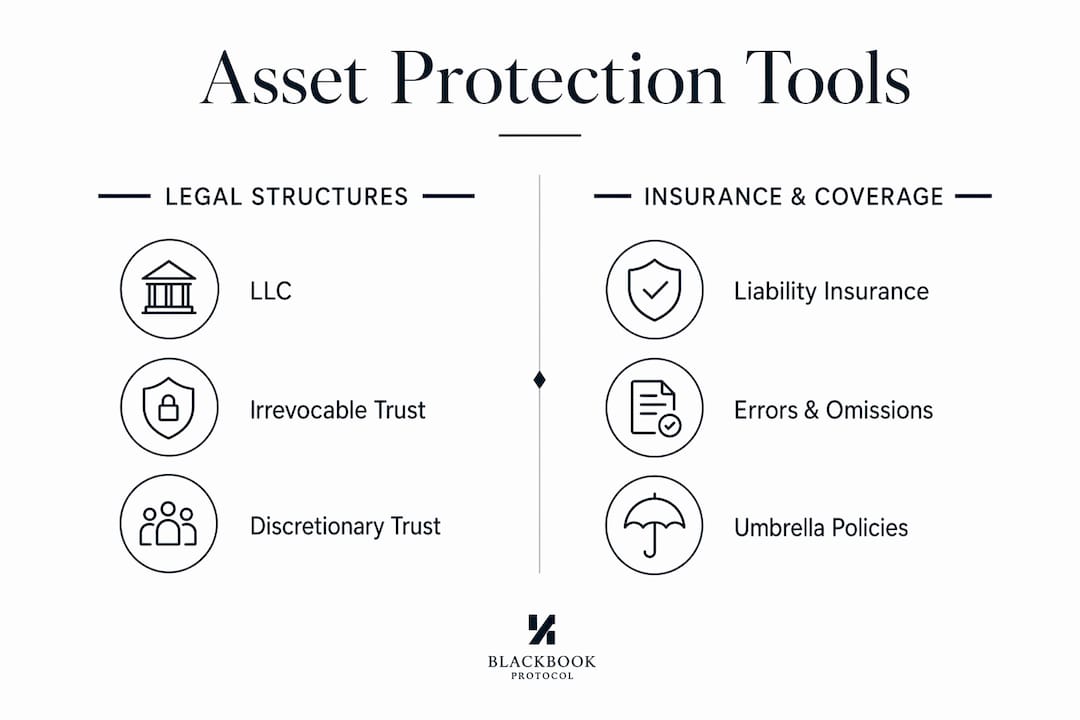
The table below outlines the primary tools and their core functions.
| Tool | Core function | Key benefit |
|---|---|---|
| Limited Liability Company (LLC) | Separates business liabilities from personal assets | Creditors cannot pursue personal wealth for business debts |
| Irrevocable trust | Removes assets from personal ownership permanently | Assets are legally outside the estate and beyond creditor reach |
| Discretionary Asset Protection Trust | Holds personal wealth with trustee discretion over distributions | Combines control with legal separation |
| Umbrella insurance | Provides excess liability coverage above standard policies | Financial advisers recommend £1M to £5M in coverage as a baseline |
| Estate planning documents | Coordinates wills, lasting powers of attorney, and succession | Preserves wealth across generations and prevents forced asset sales |
Hiding assets is not a strategy. Courts treat concealment as fraudulent conveyance, which carries serious legal consequences and destroys any protection you thought you had. Layering multiple lawful structures is both ethical and far more defensible. Transparency within a properly constructed framework is what makes the protection durable.
The deterrent effect of layered protection is real and measurable. Creditors frequently abandon claims when the legal cost of pursuing a well-structured defendant exceeds the likely recovery. A single LLC with no additional layers rarely achieves this effect. A combination of an LLC for operational risk, an irrevocable trust for personal wealth, and umbrella insurance as a financial buffer creates a structure that signals to any claimant that litigation will be expensive and uncertain.
Pro Tip: Ask your solicitor to map the “attack surface” of your current structure. Identify which assets a creditor could reach today, and build your layering plan around closing those gaps.
Why do entrepreneurs face higher asset risk than employees?
Business success increases litigation exposure. The more visible and profitable your business becomes, the more attractive you are as a target for claims. Employees face limited personal liability. Entrepreneurs face liability from customers, suppliers, employees, regulators, and business partners simultaneously.
Standard business insurance rarely covers every scenario. Gaps in coverage are common, and when a claim exceeds policy limits, personal assets become the next line of recovery. Your home, savings, investments, and pension can all be at risk if your business structure does not legally separate them from operational liabilities.
“Asset protection is foundational operational planning, not a luxury reserved for the ultra-wealthy. Every business owner with personal assets at stake needs a plan.”
The specific risks entrepreneurs face include:
- Lawsuits from clients or customers who allege negligence, breach of contract, or product liability
- Creditor claims during periods of business difficulty or insolvency
- Divorce proceedings where business assets may be treated as marital property without proper structuring
- Personal guarantees on business loans that expose personal property if the business defaults
- Regulatory penalties that can pierce standard corporate protections in certain industries
Asset protection is a business standard, comparable to taking out liability insurance. Treating it as optional is the same as running a business without public liability cover. The risk is always present. The question is whether you have a structure in place when it materialises.
Understanding how to legally shield startup equity is one of the most practical starting points for founders who want to separate personal wealth from business risk from day one.
How do you maintain an asset protection plan over time?
An asset protection plan is not a document you sign once and file away. Plans must be reviewed regularly because laws change, asset values shift, and personal circumstances evolve. A structure that was adequate three years ago may have gaps today.
Effective maintenance requires collaboration between financial advisers, tax professionals, and legal counsel. Each discipline sees a different dimension of your exposure. A solicitor identifies legal vulnerabilities. A tax adviser ensures the structure does not create unintended tax liabilities. A financial adviser monitors whether insurance coverage keeps pace with asset growth.
A practical review process follows these steps:
- Annual legal review. Confirm that all entities and trusts remain properly constituted and compliant with current legislation.
- Asset valuation update. Reassess whether insurance limits still reflect the current value of your assets.
- Life event check. Review the plan after marriage, divorce, the birth of a child, or a significant change in business ownership.
- Legislative scan. Identify any changes to trust law, insolvency rules, or tax legislation that affect your structure.
- Adviser coordination meeting. Bring your legal, tax, and financial advisers together annually to confirm the plan works as a whole, not just in individual parts.
Understanding what an asset protection blueprint covers in practice gives entrepreneurs a clear framework for what each review should assess and update.
Pro Tip: Treat your annual asset protection review the same way you treat your annual accounts. Both are non-negotiable if you are serious about protecting what you have built.
Key takeaways
Entrepreneur asset safeguarding works only when legal structures are built proactively, layered across multiple tools, and reviewed regularly to reflect changes in law and personal circumstance.
| Point | Details |
|---|---|
| Act before any threat arises | Transfers made after a claim emerges can be reversed under the Uniform Voidable Transactions Act. |
| Separate ownership from control | LLCs and irrevocable trusts place assets beyond the reach of personal creditors. |
| Layer multiple protections | Combining LLCs, trusts, and umbrella insurance creates a deterrent that single tools cannot match. |
| Review the plan annually | Laws, asset values, and family circumstances change; your structure must keep pace. |
| Protection is for all business owners | Asset protection is foundational planning, not a privilege reserved for the ultra-wealthy. |
Asset protection as standard practice: a view from Blackbook
Most entrepreneurs I speak with assume asset protection is something they will sort out once the business is large enough. That assumption is the single most expensive mistake I see. The time to build a wall is before the storm, not during it.
The misconception that this is only for high-net-worth individuals persists because the planning has historically been expensive and inaccessible. That is no longer true. The legal structures available to a founder with £200,000 in personal assets are the same structures used by those with £20 million. The principles do not change with the balance sheet.
What I find most underappreciated is the deterrent effect. A creditor’s solicitor will assess the cost of pursuing a claim against the likely recovery. When your assets sit inside a properly layered structure, that calculation rarely favours the claimant. Many claims never reach court because the economics do not support them. That is not luck. That is the direct result of building the right structure at the right time.
Entrepreneurs who treat asset protection as a business standard, rather than a reactive measure, operate with a clarity that others do not have. They know their personal wealth is separate from their operational risk. That separation is worth more than any single insurance policy.
— Blackbook
Blackbookprotocol: resources for building your protection plan
Blackbookprotocol provides structured resources for entrepreneurs who are ready to move from understanding asset protection to implementing it.

The Blackbook Protocol hardback covers UK Trust Law, 95/5 equity splits, and tax-efficient structuring in a format designed for founders who want a complete governance framework, not a generic overview. For entrepreneurs who prefer a portable format, the Kindle eBook edition delivers the same frameworks in a format you can reference anywhere. Both resources are built around the practical steps that separate entrepreneurs who are protected from those who are exposed.
FAQ
What is asset protection for entrepreneurs?
Asset protection is the legal process of structuring your wealth so that personal creditors, claimants, and litigation cannot reach it. It uses entities such as LLCs and trusts to separate ownership from control.
When should an entrepreneur set up asset protection?
The plan should be in place before any legal threat arises. Transfers made after a claim emerges can be reversed under the Uniform Voidable Transactions Act, which removes any protection they would otherwise provide.
Does asset protection only apply to large businesses?
Asset protection is foundational planning for any business owner with personal assets at risk, regardless of business size. The legal structures available to small business owners are the same as those used by larger enterprises.
What is the most effective asset protection structure?
No single structure covers all risks. The most effective approach combines an LLC for operational liabilities, an irrevocable or Discretionary Asset Protection Trust for personal wealth, and umbrella insurance as a financial buffer against claims that exceed standard policy limits.
How often should an asset protection plan be reviewed?
Plans require at least an annual review to account for changes in legislation, asset values, and personal circumstances such as marriage, divorce, or changes in business ownership.
0 commenti