

TL;DR:
- Protecting startup equity involves implementing founder vesting schedules, trust arrangements, securities compliance, and shareholder agreements from the outset. Founder vesting ensures shares are earned over time, while trusts shield equity from taxes and creditors, with early transfers being most advantageous. Proper legal compliance and careful negotiation of shareholder provisions are essential to safeguard control and maximize long-term value.
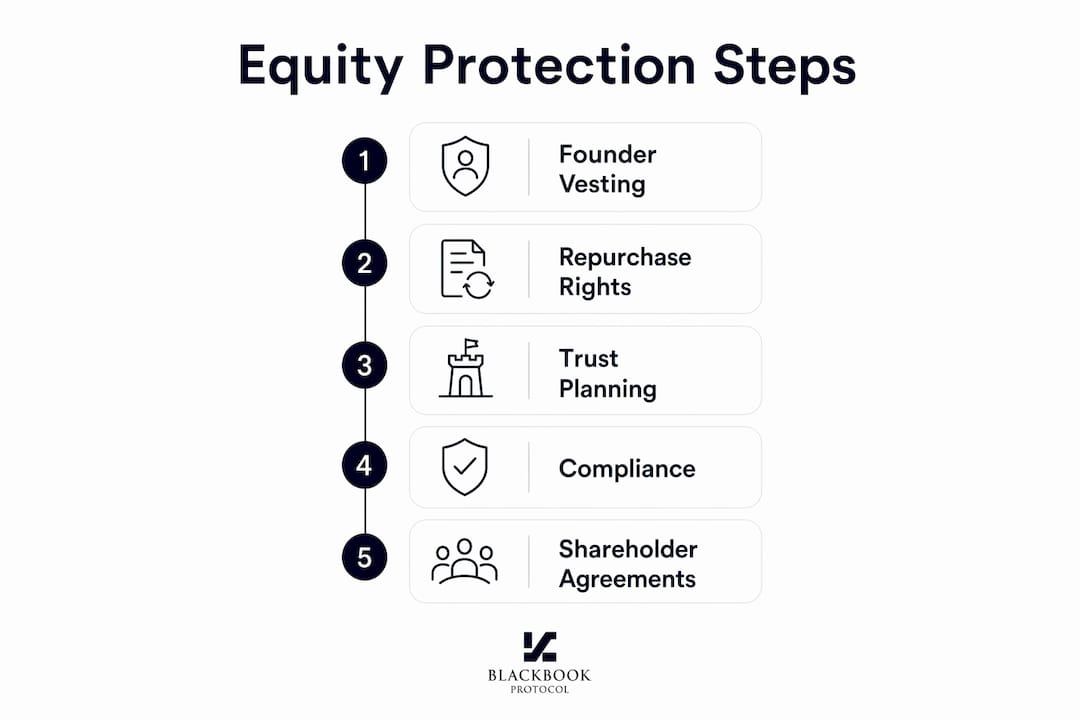
Startup equity protection is the legal process of structuring founder ownership so it survives co-founder departures, investor pressure, and inheritance tax exposure. Knowing how to legally shield startup equity from day one separates founders who retain control at exit from those who discover too late that their shares were diluted, disputed, or taxed away. The core mechanisms are founder vesting schedules, trust arrangements, securities compliance, and shareholder protective provisions. Each one addresses a distinct vulnerability in your cap table.
How to legally shield startup equity with founder vesting
Founder vesting is the single most effective first line of defence for startup equity protection. A standard vesting schedule in venture-backed startups runs four years with a one-year cliff. That means a co-founder who leaves in month ten walks away with nothing. A founder who stays the full four years earns their shares incrementally, month by month after the cliff.

The rationale is straightforward. Without vesting, a departed founder holds a full equity stake that blocks fundraising, complicates acquisitions, and forces costly recapitalisations. Investors will not back a company where a non-contributing founder owns 25% of the cap table. Vesting eliminates that risk before it becomes a crisis.
How repurchase rights work in practice
Repurchase rights give the company the option to buy back unvested shares at the original issue price if a founder leaves. This is the mechanical engine behind vesting. The company does not automatically reclaim shares. It exercises a contractual right, typically within 90 days of departure, to repurchase whatever portion remains unvested.
The distinction between voluntary and involuntary termination matters here. Most vesting agreements include acceleration clauses. Single-trigger acceleration vests shares upon a change of control. Double-trigger acceleration requires both a change of control and the founder’s termination. Double-trigger is the standard preferred by founders because it prevents acquirers from firing founders immediately after closing to avoid paying out accelerated equity.
- Draft vesting agreements at incorporation, before any external capital enters.
- Specify cliff duration, vesting frequency (monthly is standard), and acceleration triggers.
- File an 83(b) election within 30 days of receiving restricted shares to lock in a low tax basis.
- Review vesting terms with company counsel before each funding round.
Pro Tip: Negotiate double-trigger acceleration from the start. Investors rarely object at seed stage, but they will push back hard at Series A once they understand the implications for acquisition economics.
Vesting encourages commitment and protects the company’s long-term health. It is not a signal of mistrust between co-founders. Frame it that way in your founding documents and your early conversations with investors.
How can trusts be used to protect and shield startup equity?
Trusts are the most underused tool in a founder’s equity protection toolkit. A non-grantor trust is a separate legal taxpayer, distinct from the founder who creates it. That separation is what makes it powerful.
Non-grantor trusts allow founders to stack Qualified Small Business Stock (QSBS) exclusions, reduce estate tax exposure, and shield equity from creditor claims. The lifetime gift tax exemption sits at $15 million per individual, which means substantial equity can be transferred into a trust without triggering gift tax. That is a significant planning window for early-stage founders whose shares are still valued at near zero.
The contrast with grantor trusts is critical. A grantor trust is treated as the founder’s own property for tax purposes. Any retained powers over the trust, such as the ability to revoke it or swap assets, can trigger grantor status and invalidate the tax benefits entirely. Trusts used for equity protection must be carefully drafted to avoid this outcome.
For UK founders, the picture is different but equally urgent:
- Founder equity under SEIS and EIS schemes can face up to 40% inheritance tax without proper planning.
- Shares held for more than two years under Business Property Relief (BPR) qualify for 100% inheritance tax relief. That two-year clock starts from the date of acquisition.
- Discretionary trusts can hold founder shares and distribute them to beneficiaries at the trustees’ discretion, providing both asset protection and flexibility.
- Share trust agreements in the UK must be structured to comply with HMRC rules on relevant property trusts and periodic charges.
Pro Tip: Transfer shares into a trust as early as possible, ideally at incorporation when the share value is minimal. A transfer at a £0.001 par value generates no gift tax liability. A transfer after a Series A at a £5 per share valuation creates a taxable event that may exceed your available exemptions.
Transfers into trusts require consent or formal notice under stockholder agreements. Coordinate with company counsel before any transfer to avoid breaching transfer restrictions embedded in your shareholder agreement.
What legal and securities compliance is necessary for protecting startup equity?
Securities compliance is not optional. It is the foundation on which every other equity protection strategy rests. A share issuance that violates securities law can be unwound, triggering rescission rights that hand investors the power to demand their money back at the worst possible moment.
Proper incorporation requires authorised share issuance, board resolutions approving each grant, and adherence to your equity incentive plan. Every grant must be documented. Every board approval must be minuted. Gaps in this paper trail create enforcement risk and complicate due diligence at exit.
| Exemption | Key rule | Best suited for |
|---|---|---|
| Rule 506(b) | No general solicitation; up to 35 non-accredited investors | Friends, family, and known investors |
| Rule 506© | General solicitation permitted; all investors must be verified accredited | Broader fundraising campaigns |
| Rule 701 | Covers equity awards to employees and consultants | Employee stock option plans |
Securities filings and notice requirements vary by state. Texas Blue Sky Law, for example, imposes its own filing obligations on top of federal Regulation D requirements. Failing to map your exemption path jurisdiction by jurisdiction can delay fundraising or trigger enforcement.
Best practice is to make equity a standing agenda item at every board meeting. Review outstanding grants, confirm filings are current, and flag any transfers that may require securities analysis. This discipline costs very little time and prevents very large problems.
Which shareholder agreements and protective provisions safeguard founder equity?
Shareholder agreements are where equity protection becomes contractual. The provisions you negotiate before signing a term sheet determine how much control you retain when things get difficult.
The key provisions every founder should understand:
- Right of first refusal (ROFR): Gives the company or existing shareholders the right to purchase shares before a founder sells to a third party. This prevents unwanted parties from entering the cap table.
- Drag-along rights: Allow a majority of shareholders to compel minority holders to sell in an acquisition. Founders need to ensure drag-along thresholds are set high enough that investors cannot force a sale without founder consent.
- Anti-dilution clauses: Protect investors from down rounds by adjusting their conversion price. Full-ratchet anti-dilution is the most aggressive form and should be negotiated carefully to avoid severe founder dilution.
- Protective provisions: Give preferred shareholders veto rights over specific company actions. These provisions can override board unanimity, meaning investors can block decisions even when the entire board agrees.
| Provision | Founder-friendly version | Investor-preferred version |
|---|---|---|
| Anti-dilution | Broad-based weighted average | Full-ratchet |
| Drag-along threshold | Majority of all shares | Majority of preferred only |
| Acceleration | Double-trigger | Single-trigger or none |
| ROFR | Company first, then pro-rata | Investor first, unrestricted |
Avoiding full-ratchet anti-dilution clauses is critical to maintaining founder equity during down rounds. Negotiate these terms before you need the money. Once you are capital-constrained, your leverage disappears.
Pro Tip: Prioritise control provisions over headline valuation. A £10 million valuation with aggressive protective provisions is worth less to you at exit than an £8 million valuation with founder-friendly terms. The maths on dilution and control always catches up.
How should founders integrate equity protection into estate planning?
Estate planning is an extension of startup strategy, not a separate exercise you defer until you are wealthy. The tools available to founders are most powerful when deployed early, when share values are low and tax exposure is minimal.
For US-based founders, the primary estate planning vehicles are:
- Grantor Retained Annuity Trusts (GRATs): Transfer equity appreciation out of your estate by paying yourself an annuity. If the company grows faster than the IRS hurdle rate, the excess passes to beneficiaries tax-free.
- Intentionally Defective Grantor Trusts (IDGTs): Allow founders to sell shares to a trust in exchange for a promissory note, freezing the estate tax value while retaining income tax liability. The trust then benefits from future appreciation outside the estate.
- QSBS stacking via multiple trusts: Each non-grantor trust can claim its own $10 million QSBS exclusion. A founder with three trusts can potentially exclude $30 million in gains from federal tax.
For UK founders, the priorities differ:
- File for Business Property Relief eligibility by tracking the two-year holding period from share acquisition.
- Use discretionary trusts to hold SEIS and EIS shares and distribute proceeds to beneficiaries at the trustees’ discretion.
- Review the founder legacy planning checklist to confirm your equity structure aligns with your personal estate objectives.
- Coordinate any trust transfer with company counsel to confirm it does not breach transfer restrictions in your shareholder agreement.
The 83(b) election is the most time-sensitive action on this list. You have 30 days from the date of receiving restricted shares to file. Missing that window means you pay income tax on the full value of shares as they vest, rather than on the nominal value at grant. That difference can be substantial by the time your company reaches Series B.
Key takeaways
Legally shielding startup equity requires founder vesting, trust planning, securities compliance, and shareholder agreement provisions to be implemented together from the point of incorporation.
| Point | Details |
|---|---|
| Vesting protects the cap table | A four-year schedule with a one-year cliff prevents departed founders from holding dead equity. |
| Trusts reduce tax exposure | Non-grantor trusts enable QSBS stacking and can shield equity from inheritance tax in both the US and UK. |
| Securities compliance is non-negotiable | Proper board approvals, exemption filings, and equity plan adherence prevent rescission risk at exit. |
| Negotiate provisions before funding | Anti-dilution and drag-along terms are far easier to negotiate before you need capital than after. |
| Act early on estate planning | The 83(b) election, trust transfers, and BPR eligibility all depend on timing relative to share issuance. |
Why founders consistently underestimate equity protection
Most founders treat equity protection as a legal formality rather than a strategic priority. That is the mistake I see most often, and it is the one that costs the most at exit.
Vesting schedules are not about distrust. They are about corporate hygiene. A cap table with a departed founder holding 20% is not just an emotional problem. It is a structural one that every serious investor will flag in due diligence. I have seen term sheets withdrawn because of exactly this issue.
The trust planning piece is where founders lose the most money through inaction. Transferring shares into a non-grantor trust at incorporation costs almost nothing in tax. Doing the same transfer after a Series A can trigger a six-figure gift tax liability. The window is open for a very short time, and most founders do not realise it exists until it has closed.
Investor protective provisions deserve more scrutiny than founders typically give them. A drag-along clause that allows preferred shareholders to force a sale at a price you would never accept is not a theoretical risk. It is a mechanism that has been used to push founders out of exits they built. Read every provision. Understand what it means in a down round scenario, not just in the optimistic case.
The founders who protect their equity most effectively are the ones who treat it as a governance matter from day one. They put vesting agreements in place before the first hire. They consult company counsel before any trust transfer. They negotiate shareholder agreements with the same rigour they apply to product strategy. That discipline is what separates founders who own their exit from those who are surprised by it.
— Blackbook
Protect your equity with the Blackbookprotocol
The legal frameworks in this article are only as effective as the documents and structures you put in place to implement them. Blackbookprotocol has built a set of practical resources specifically for founders who want to move from understanding to action.

The Blackbookprotocol Asset Protection Audio, eBook and Templates covers UK Trust Law, 95/5 equity splits, and tax-efficient ownership structures in a format you can apply directly to your company’s governance framework. Whether you are at incorporation stage or preparing for a funding round, these resources give you the blueprint to secure your equity before the window closes.
FAQ
What is the standard founder vesting schedule?
The standard founder vesting schedule in venture-backed startups is four years with a one-year cliff. Shares vest monthly after the cliff, ensuring equity is earned through ongoing contribution.
How does a non-grantor trust protect startup equity?
A non-grantor trust is a separate taxpayer that shields equity from estate tax and creditor claims, and enables founders to stack QSBS exclusions across multiple trusts. It must be carefully drafted to avoid retained powers that would trigger grantor trust status.
What is the 83(b) election and why does it matter?
An 83(b) election is a tax filing made within 30 days of receiving restricted shares that locks in the tax basis at the grant date value. Missing the deadline means paying income tax on the full fair market value of shares as they vest, which can be significantly higher.
How do anti-dilution clauses affect founder equity?
Anti-dilution clauses adjust an investor’s conversion price in a down round, which dilutes founder ownership. Full-ratchet anti-dilution is the most aggressive form and should be replaced with broad-based weighted average provisions wherever possible.
Do UK founders need to worry about inheritance tax on startup shares?
Yes. Founder equity under SEIS and EIS schemes can face up to 40% inheritance tax without planning. Shares held for more than two years under Business Property Relief qualify for 100% relief, making early trust planning and BPR eligibility tracking critical for UK founders.
0 comments