

TL;DR:
- A founder vesting schedule is a formal agreement that releases equity gradually, protecting the company from early departures. Most startups adopt a four-year plan with a one-year cliff, ensuring founders earn their shares over time and aligning long-term interests. Proper documentation and legal structuring of vesting are essential for securing investor confidence and maintaining a balanced cap table.
A founder vesting schedule is a contractual timeline that determines when founders earn their equity in a company, releasing shares incrementally over a defined period rather than granting full ownership at once. Approximately 92% of venture-backed startups implement founder vesting schedules, and most seed-stage investors require one as a condition of funding. The mechanism protects the company from a co-founder leaving early and retaining a large, unearned stake. Three terms define the structure: the cliff (the minimum period before any equity vests), the vesting period (total duration of the schedule), and reverse vesting (where founders own shares upfront but the company holds repurchase rights over unvested portions).
What is a founder vesting schedule and how does it work?
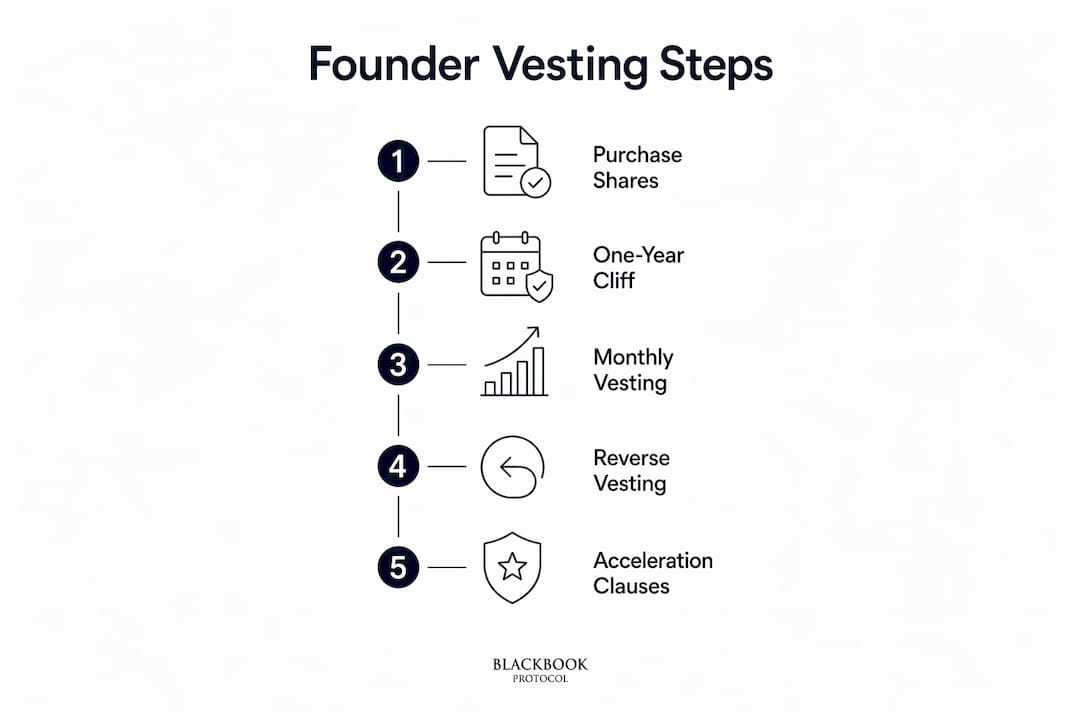
The market standard for founder vesting is a four-year schedule with a one-year cliff and monthly vesting thereafter. At the one-year mark, 25% of a founder’s total equity vests in a single tranche. After that, the remaining 75% vests in equal monthly instalments over the following 36 months, at a rate of 1/48th of the total grant per month.

The cliff serves a specific purpose. It acts as a commitment filter, ensuring that a co-founder who leaves in the first year receives nothing. This protects the remaining founders and the company from a permanent shareholder who contributes no ongoing value. Without a cliff, a founder could depart after three months and retain a proportional equity stake indefinitely.
The table below illustrates how equity accumulates under the standard four-year schedule for a founder holding 25% of a company with 1,000,000 shares.
| Period | Shares vested | Cumulative shares | Cumulative % vested |
|---|---|---|---|
| Month 12 (cliff) | 250,000 | 250,000 | 25% |
| Month 24 | 83,333 | 333,333 | 33% |
| Month 36 | 83,333 | 416,666 | 42% |
| Month 48 | 83,334 | 500,000 | 50% |
Note: this table shows one founder’s 500,000 shares (50% of the company) vesting over four years.
Reverse vesting is the legal mechanism most commonly used for founders. Rather than receiving options that convert to shares later, founders purchase all their shares at nominal value on day one via a Restricted Stock Purchase Agreement. The company then holds repurchase rights over the unvested portion. If a founder departs early, the company exercises those rights and reclaims the unvested shares at the original purchase price. This structure also carries tax advantages, as founders acquire shares at low cost before the company’s value increases.
Pro Tip: File an 83(b) election with HMRC or the relevant tax authority within 30 days of purchasing restricted shares. This locks in the tax valuation at the time of purchase, not at vesting, which can save founders significant sums if the company grows.
Why vesting schedules matter for startups and investors
Without vesting, a departing founder retains full equity and becomes a permanent shareholder contributing no value. Investors call this dead equity. It sits on the cap table, dilutes active founders, and signals poor governance to any incoming investor conducting due diligence.
The risks extend beyond optics. A legacy shareholder with 20% or 30% of the company can block decisions, complicate future funding rounds, and create legal disputes. Vesting removes this risk by tying equity ownership to continued contribution.
From an investor’s perspective, the absence of a vesting schedule is a red flag at every stage of funding:
- No vesting at seed stage signals that founders have not thought through governance or long-term alignment.
- Unequal vesting terms between co-founders suggest unresolved tensions that will surface later.
- Missing documentation at incorporation signals risk and can delay or block funding rounds entirely.
- No repurchase rights means the company cannot legally recover unvested shares if a founder exits.
The framing matters too. Many founders initially view vesting as a sign of mistrust between co-founders. The more accurate view is that vesting is a company survival tool. It protects all founders equally and keeps the cap table clean for future investment.
“Vesting is not about distrust. It is about building a company structure that survives the inevitable changes in people, roles, and commitment over time.”
Failing to document vesting properly at formation signals risk to investors and can block funding rounds. The time to resolve vesting terms is during the first weeks of company formation, not during a Series A due diligence process.
How do vesting schedule variations affect founder equity?
The four-year cliff model is the standard, but founders regularly negotiate variations. Understanding these options allows you to structure a schedule that reflects actual contributions and circumstances.
| Variation | Description | Pros | Cons |
|---|---|---|---|
| Standard 4-year / 1-year cliff | 25% at cliff, monthly thereafter | Investor-familiar, widely accepted | May not reflect unequal founder contributions |
| Shorter cliff (6 months) | Earlier initial vest | Rewards early commitment | Less protection against short-term departures |
| Longer vesting (5 or 6 years) | Extended earning period | Stronger long-term alignment | Can deter founders or complicate later hires |
| Single-trigger acceleration | Full vest on acquisition | Protects founder on exit | Can reduce acquirer’s incentive to retain founder |
| Double-trigger acceleration | Full vest on acquisition plus termination | Balances protection and retention | More complex to negotiate |
Acceleration clauses are commonly negotiated by founders to protect equity value in a sale or change of control. A single-trigger clause vests all remaining equity upon acquisition alone. A double-trigger clause requires both an acquisition and the founder’s termination before acceleration kicks in. Most investors prefer double-trigger because it keeps founders incentivised post-acquisition.
The vesting commencement date is another variable that founders frequently overlook. This date should reflect when founders actually began working full-time on the company, not the date of formal incorporation. Misaligning these dates creates diligence issues and can undermine investor confidence. If a founder spent six months building the product before incorporating, the vesting schedule should reflect that history, documented contemporaneously with board consents.
Tolling provisions are a lesser-known but consequential clause. Tolling pauses vesting during unpaid leave, extending the final vesting date by the duration of the absence. A founder taking three months of unpaid leave will not complete their four-year schedule at month 48. They will complete it at month 51. Many founders discover this clause only when it affects them.
Pro Tip: When negotiating vesting terms with co-founders, use a contribution-based framework rather than defaulting to equal splits. Weight factors such as full-time commitment, capital contributed, and prior-art ownership. This reduces resentment and reflects actual value delivered to the company.
How should founders implement and manage vesting schedules?
Vesting terms must be resolved and documented before any external capital enters the company. Retroactive fixes are possible but create complications during due diligence and can raise questions about the integrity of the cap table.
The implementation process follows a clear sequence:
- Agree vesting terms between co-founders before incorporation. Decide on the schedule length, cliff duration, acceleration provisions, and commencement date.
- Incorporate the company and issue shares via Restricted Stock Purchase Agreements. Each founder signs an individual agreement specifying their vesting schedule and the company’s repurchase rights.
- Pass board consents approving the vesting terms. These consents create the formal record that investors will review during due diligence.
- File any required tax elections within the statutory deadline. In the United States this is the 83(b) election; UK founders should consult a solicitor on equivalent EMI scheme or growth share provisions.
- Track vesting on an equity management platform. Tools such as Carta or Pulley reduce administrative errors and provide real-time visibility into each founder’s vested and unvested position.
Legal fees to formalise vesting schedules typically range from £2,000 to £5,000 when using a specialist startup solicitor. This cost is modest relative to the disputes it prevents. Founders who use generic online templates without legal review frequently discover gaps in repurchase rights or missing board consents during their first funding round.
Consistent documentation is the difference between a clean fundraise and a six-week legal delay. Investors conducting due diligence will request every founder agreement, board consent, and cap table record. Gaps in this documentation do not just slow the process. They reduce investor confidence in the founding team’s operational competence.
Pro Tip: Review your founder legacy planning documentation annually. Vesting schedules interact with shareholder agreements, articles of association, and any trust structures you hold shares through. A single inconsistency across these documents can create significant legal exposure.
Key takeaways
A founder vesting schedule is the single most effective mechanism for protecting startup equity, maintaining a clean cap table, and satisfying investor requirements from seed stage onwards.
| Point | Details |
|---|---|
| Standard structure | Four-year vesting with a one-year cliff is the investor-accepted default for founder equity. |
| Reverse vesting mechanism | Founders buy shares at nominal value upfront; the company holds repurchase rights over unvested shares. |
| Dead equity risk | A founder leaving without vesting retains full equity, creating a permanent non-contributing shareholder. |
| Vesting commencement date | Align the start date with actual founder involvement to avoid diligence delays and credibility issues. |
| Documentation timing | Formalise all vesting agreements at incorporation; retroactive fixes create investor trust issues. |
Why founders get vesting wrong more often than they should
Most founders I work with through Blackbookprotocol understand the concept of vesting in theory. The failures happen in execution, and they almost always stem from the same three mistakes.
The first is treating the cliff as optional. I have seen co-founding teams soften or remove the cliff to avoid an awkward conversation, only to face a far more damaging situation when one founder disengages at month eight and retains a 30% stake. The cliff exists precisely to handle that scenario cleanly. Removing it to preserve harmony is a short-term decision with long-term consequences.
The second mistake is misaligning the vesting commencement date. Founders who spent a year building before formally incorporating often set the commencement date at incorporation rather than at the true start of their involvement. This creates a cliff that does not reflect reality and raises questions during investor due diligence. Backdating is permissible when done contemporaneously with proper board consents, but it must be handled correctly.
The third is skipping legal counsel on the assumption that a standard template covers everything. Repurchase rights, tolling provisions, and acceleration clauses each require precise drafting. A missing clause in a Restricted Stock Purchase Agreement can render the entire vesting mechanism unenforceable. The 95/5 equity split frameworks and governance structures I advocate through Blackbookprotocol are built on the principle that equity decisions made at formation define the company’s future. Vesting is not a formality. It is the foundation of founder alignment.
— Blackbook
Structure your equity with Blackbookprotocol
Founder vesting schedules are one component of a broader equity governance framework that every serious startup needs from day one. Blackbookprotocol provides expert blueprints covering UK Trust Law, asset protection, and equity structuring for founders who want to build with legal precision.

The Blackbook Protocol hardback covers the governance structures, equity frameworks, and asset protection strategies that underpin a defensible, investor-ready company. Whether you are structuring a co-founder agreement, planning for acquisition, or protecting personal assets from company risk, the protocol gives you a documented framework built for UK founders. Download or order your copy and build your company on a foundation that holds.
FAQ
What is the standard founder vesting schedule?
The standard founder vesting schedule is a four-year period with a one-year cliff. At the one-year mark, 25% of equity vests, with the remaining 75% vesting monthly over the following 36 months.
What happens if a founder leaves before the cliff?
A founder who leaves before the cliff receives no vested equity. The company exercises its repurchase rights and reclaims all shares at the original purchase price, keeping the cap table clean.
What is reverse vesting in a startup?
Reverse vesting means founders purchase all shares upfront at nominal value, but the company holds repurchase rights over the unvested portion. If a founder departs early, the company buys back the unvested shares.
Do investors require founder vesting schedules?
Yes. Approximately 92% of venture-backed startups implement vesting, and most seed-stage investors require it as a condition of funding. Missing vesting documentation is a common cause of due diligence delays.
What is a double-trigger acceleration clause?
A double-trigger acceleration clause vests a founder’s remaining equity only when two events occur: an acquisition and the founder’s subsequent termination. It protects founders on exit while keeping them incentivised post-acquisition.
0 comments