

TL;DR:
- Asset protection is essential for all property owners and business operators, not just the ultra-wealthy. Building a multi-layered, proactive blueprint with legal entities, insurance, and titling strategies ensures your assets are shielded before threats occur. Regular reviews and proper maintenance are crucial to keep the protection plan effective amid changing laws and personal circumstances.
Most people assume asset protection is a concern reserved for the ultra-wealthy. That assumption costs ordinary individuals and business owners dearly. An asset protection blueprint is a structured, lawful plan that combines legal entities, insurance, and ownership strategies to shield your assets before any threat arises. It is not tax evasion, and it is not about concealment. It is deliberate, pre-emptive planning. This article explains what a blueprint actually contains, how it differs from ad hoc protection, and how you can build one that holds up under real pressure.
Table of Contents
- Key takeaways
- What is an asset protection blueprint?
- Asset protection strategies and legal structures
- How to create an asset protection plan
- Why ongoing maintenance matters
- Common misconceptions in asset protection planning
- My perspective on why blueprints get built too late
- Build your protection blueprint with Blackbookprotocol
- FAQ
Key takeaways
| Point | Details |
|---|---|
| Definition matters | An asset protection blueprint is a multi-layered legal and insurance strategy built before threats arise, not after. |
| Layers are non-negotiable | Effective blueprints combine insurance, legal entities, and trusts rather than relying on any single tool. |
| Timing is critical | Post-threat transfers can be voided by courts as fraudulent conveyance, making early planning non-negotiable. |
| Maintenance is ongoing | Annual reviews and updates triggered by life changes keep a blueprint effective and legally sound. |
| It applies broadly | Business owners, property holders, and individuals with growing wealth all benefit from a formalised protection plan. |
What is an asset protection blueprint?
An asset protection blueprint is, at its core, a multi-layered legal and insurance strategy designed and implemented before threats materialise. Think of it as a structure with multiple defensive walls rather than a single lock on the front door. Each layer serves a distinct function: the outermost deflects minor claims, the middle layers absorb larger ones, and the innermost preserves your most critical assets entirely.
The essential components of any well-built blueprint include:
- Legal entities. Limited liability companies (LLCs), corporations, and trusts separate your personal assets from professional or investment risk.
- Insurance coverage. This includes standard policies and umbrella liability cover, which acts as the first line of defence against claims.
- Titling strategies. How assets are legally owned, whether jointly, individually, or through an entity, directly affects exposure.
- Professional assessment. A qualified adviser maps your current exposure during a 30 to 60 minute consultation before any structures are recommended.
The word “blueprint” is deliberate. A blueprint is created before construction begins. Asset protection built reactively, after a lawsuit or creditor claim appears, is far weaker and often legally questionable. Courts scrutinise late-stage transfers closely.
Pro Tip: When speaking with a legal adviser for the first time, bring a full list of your assets including property, investments, business interests, and retirement accounts. The more complete the picture, the more targeted your protection strategy can be.

Asset protection strategies and legal structures
The tools available within a blueprint vary considerably in cost, complexity, and the type of protection they provide. Understanding each one lets you build a plan proportionate to your actual exposure rather than over-engineering or leaving obvious gaps.
| Structure | Best used for | Key benefit | Key limitation |
|---|---|---|---|
| Umbrella insurance | First line of defence for most individuals | Cost-effective, immediate coverage | Coverage limits; does not protect business assets |
| LLC or corporation | Business owners, rental property holders | Separates personal and business liability | Must be properly maintained to avoid “veil piercing” |
| Irrevocable trust | Long-term wealth preservation, estate planning | Strong creditor protection once assets are transferred | Loss of direct control over transferred assets |
| Domestic asset protection trust (DAPT) | High-net-worth individuals in eligible jurisdictions | Allows settlor to remain a discretionary beneficiary | Jurisdiction-dependent; not available in all UK structures |
| Statutory exemptions | All individuals | Automatic protection for retirement accounts under relevant legislation | Limited to specific asset classes |
Insurance umbrella policies are frequently overlooked despite being the most affordable starting point. A standard umbrella policy extends liability coverage beyond your home or car insurance limits and typically costs far less than any legal entity to establish and maintain.
Entity separation is the next logical step for business owners. An LLC or limited company places a legal boundary between your trading activities and your personal estate. That boundary only holds, however, if you maintain it properly. Commingling personal and business funds, skipping annual governance procedures, or failing to document decisions can expose the “corporate veil” to challenge.
Trusts occupy the more advanced end of the spectrum. Irrevocable trusts and DAPTs provide strong protection because the assets are no longer legally owned by you once transferred. That separation is precisely what makes them effective, and also what makes the decision to use them significant.
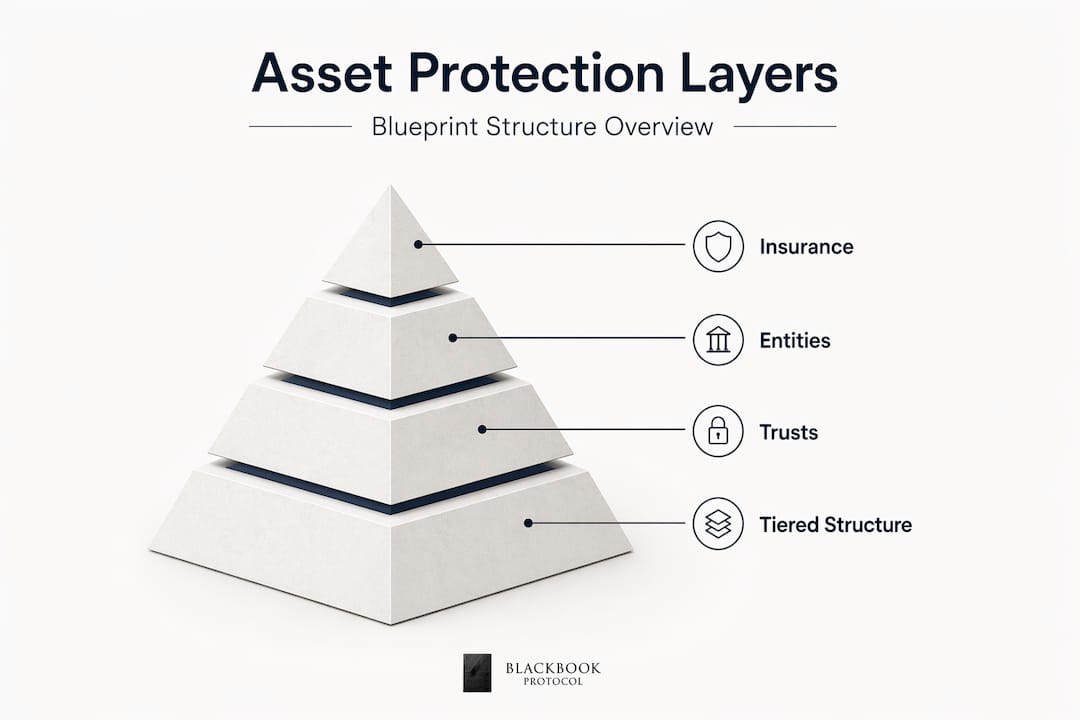
The most durable blueprints use tiered structures combining trusts, holding companies, and LLCs to create multiple protection layers. A family trust might own a holding company, which in turn owns the operating LLCs. This preserves operational control and liquidity whilst keeping core wealth at a safe remove from front-line risk.
How to create an asset protection plan
Building your blueprint is a sequential process. Skipping steps or starting in the middle produces plans with gaps that will matter at the worst possible moment.
- Inventory every asset. List all property, bank accounts, investment portfolios, business interests, vehicles, and intellectual property. Note current titling for each one.
- Rank by exposure and value. Some assets carry higher litigation risk than others. Rental property, for instance, generates far more liability than a personal savings account. Prioritise accordingly.
- Review existing protections. Identify insurance policies, existing legal entities, and any statutory exemptions already in place. A UK trust law compliance checklist can help you spot gaps in existing structures.
- Build from simple to complex. Start with insurance. Add entity separation for business and investment assets. Layer trusts for long-term legacy wealth. Avoid over-engineering early.
- Consult qualified legal and financial advisers. Asset protection intersects tax law, property law, and trust law. A specialist can identify opportunities and prevent costly errors before they are made.
- Document operational standards. Each entity in your plan requires proper governance: minutes, resolutions, separate banking, and consistent record-keeping.
- Schedule annual reviews. A blueprint without regular maintenance loses effectiveness as laws change, assets shift, and personal circumstances evolve.
Planning for liquidity is a step that many people miss entirely. Effective blueprints balance protection with flexibility, ensuring that capital is not entirely locked away in irrevocable structures when you may need access for business operations or personal needs.
Pro Tip: Do not attempt asset transfers once a creditor claim or legal threat has emerged. Courts can void these transfers under fraudulent conveyance rules, and the attempt itself can damage your credibility in proceedings.
For entrepreneurs specifically, the founder legacy planning checklist at Blackbookprotocol covers the practical steps for separating personal and business risk from the outset.
Why ongoing maintenance matters
Asset protection is not a one-time event. A blueprint created five years ago and never revisited may leave you substantially exposed today. The legal environment shifts, assets accumulate, and personal circumstances change in ways that directly affect what your plan covers.
The life events that most commonly require blueprint updates include:
- Marriage, divorce, or a change in beneficiaries
- Acquisition of new property or significant investment assets
- Starting, acquiring, or closing a business
- Moving between jurisdictions or countries
- A significant increase in personal or business wealth
- Changes in trust or corporate governance law
Courts may void post-threat transfers and pierce the corporate veil when entities are not maintained correctly. An LLC that has not held its annual meetings, kept separate accounts, or documented decisions properly can lose its protective status entirely.
Annual reviews with your legal adviser accomplish several things at once. They catch administrative errors before they become vulnerabilities, identify new statutory protections you may not be utilising, and align your plan with any changes in estate or tax planning priorities.
The focus in estate and asset planning in 2026 is shifting toward cost basis management alongside creditor protection, particularly with the federal estate tax exemption sitting at $15 million per individual. Your blueprint should reflect that evolution, not remain anchored to assumptions from earlier planning periods.
For existing trust holders, the trust review process for UK high-net-worth clients at Blackbookprotocol provides a structured framework for assessing whether current arrangements still serve their original purpose.
Common misconceptions in asset protection planning
Several persistent misunderstandings lead people to either delay planning or rely on inadequate structures.
“A single company or insurance policy is sufficient protection.” This is one of the most common and costly assumptions in asset protection. A single entity creates one wall. A creditor who successfully challenges or bypasses that wall reaches everything behind it. Layered structures exist precisely because no single tool is impenetrable.
The belief that asset protection is reserved for the very wealthy is equally damaging. Anyone who owns property, runs a business, or holds investment assets has something worth protecting. Early identification of exposure, before significant wealth accumulates, is actually when protection costs least and works best.
Fraudulent conveyance is another misunderstood area. Many people assume that moving assets away from their name once a problem appears is a legitimate protective measure. It is not. Transfers made with the intent to hinder creditors are voidable by courts, and failing to act early removes this option entirely.
Finally, statutory protections are frequently ignored simply because they exist without requiring active steps. Retirement accounts, for example, carry strong default protections under relevant legislation. Knowing what you already have protects you from paying for unnecessary duplication.
My perspective on why blueprints get built too late
In my experience, the single most consistent failure I observe is timing. People seek out asset protection advice after receiving a legal letter, after a business dispute emerges, or after a property deal turns contentious. At that point, the options narrow considerably and the cost of what could have been done years earlier becomes painfully clear.
I have also seen what happens when someone relies on a single entity or a boilerplate structure bought off the shelf. It works until it does not. The fraudulent conveyance trap catches people who understood the concept intellectually but assumed it would not apply to them personally. It does.
What actually works is a bespoke plan built with an adviser who understands both your asset profile and the relevant legal environment. Generic templates have their place in initial education, but they are not a finished defence. The value of UK trust law expertise is not in the paperwork. It is in knowing which structure fits your specific circumstances and what to avoid.
My strongest recommendation is this: start before you need to. The cost of a thorough blueprint built when your affairs are orderly is a fraction of the cost of defending assets without one.
— Blackbook
Build your protection blueprint with Blackbookprotocol
If this article has clarified what you need and you are ready to act on it, Blackbookprotocol provides the resources to take the next step with precision.

The Blackbook Protocol Hardback is a structured reference covering UK trust law, 95/5 equity splits, corporate governance, and layered protection strategies. It is written for individuals and business owners who want to build a blueprint that goes beyond generic advice. For those who prefer digital formats, the asset protection blueprint templates include audio, ebook, and governance documents designed to be implemented directly. Whether you are starting from scratch or reviewing existing arrangements, Blackbookprotocol gives you the framework to build protection that is both legally sound and operationally practical.
FAQ
What is an asset protection blueprint?
An asset protection blueprint is a structured, multi-layered legal and financial plan that combines insurance, legal entities, and ownership strategies to shield assets from creditors, litigation, and unforeseen threats before they arise.
Who needs an asset protection plan?
Anyone who owns property, operates a business, or holds significant investment assets benefits from a formal plan. Asset protection is not limited to high-net-worth individuals; the earlier a plan is built, the more options are available.
What are the main asset protection strategies?
The core strategies include umbrella insurance, entity separation through LLCs or corporations, irrevocable trusts, domestic asset protection trusts, and utilising statutory exemptions for retirement accounts and similar assets.
Can I transfer assets for protection after a threat arises?
No. Transfers made after a creditor claim or legal threat emerges can be voided by courts as fraudulent conveyance. Effective protection must be established well before any dispute materialises.
How often should an asset protection blueprint be reviewed?
A blueprint should be reviewed annually as a minimum, and immediately following major life or business changes such as marriage, property acquisition, or a shift in applicable law.
0 comments