

TL;DR:
- An exit planning trust structure is an irrevocable legal arrangement that safeguards business proceeds from estate tax and capital gains. Most entrepreneurs delay establishing these trusts, risking lost tax benefits and potential legacy loss during exit events. Proper timing, professional administration, and tailored trust combinations are essential for effective wealth preservation and tax reduction.
An exit planning trust structure is a legal arrangement that transfers business equity into one or more irrevocable trusts before a sale, IPO, or liquidity event, shielding proceeds from estate tax and capital gains exposure. Approximately 83% of business owners lack a written exit plan, yet implementing one can increase sale price by 20%–50%. That gap represents an enormous amount of wealth left unprotected. For entrepreneurs, the difference between a well-structured exit and an unplanned one is not just tax efficiency. It is the difference between preserving a legacy and handing a significant portion of it to the taxman.
What is an exit planning trust structure for entrepreneurs?
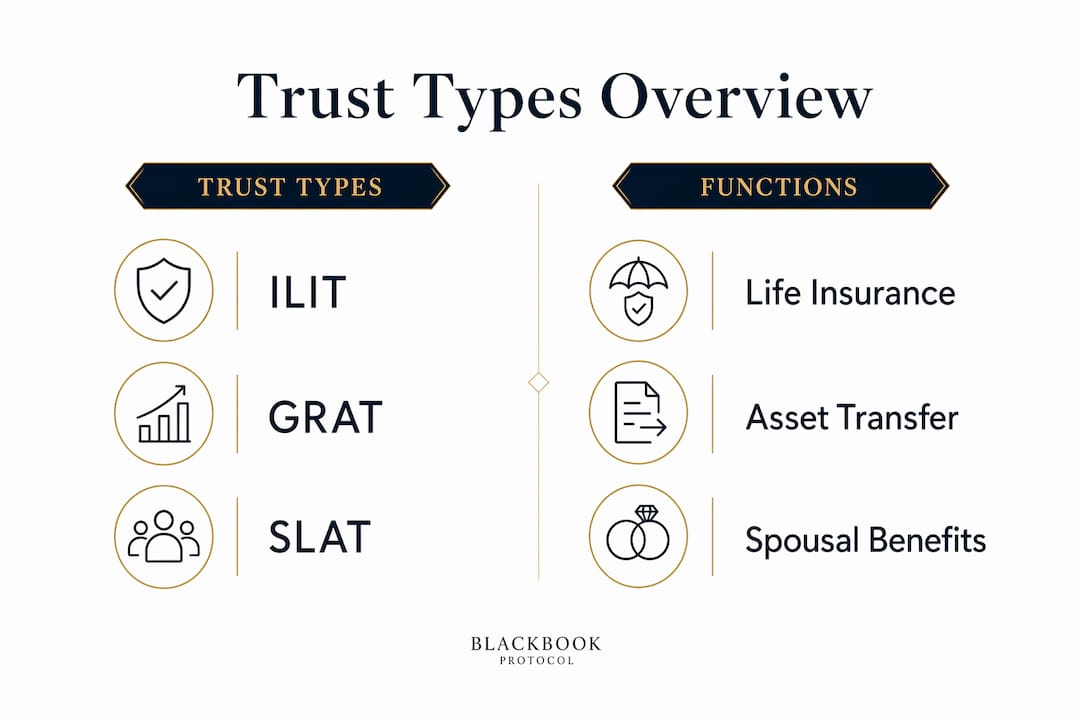
Exit planning trust structures are not a single instrument. They are a suite of distinct legal vehicles, each solving a specific problem, and successful exit planning requires using multiples to address overlapping issues simultaneously. The five most relevant trusts for entrepreneurs are the Irrevocable Life Insurance Trust (ILIT), the Grantor Retained Annuity Trust (GRAT), the Intentionally Defective Grantor Trust (IDGT), the Charitable Remainder Trust (CRT), and the Spousal Lifetime Access Trust (SLAT).

A critical distinction separates revocable from irrevocable trusts. Revocable trusts only avoid probate. They offer no capital gains shelter and no estate tax reduction. Many entrepreneurs believe their existing revocable living trust protects them on exit. It does not. Advanced irrevocable structures are necessary for meaningful tax savings.
The table below maps each trust type to its primary function.
| Trust type | Primary function | Best used for |
|---|---|---|
| ILIT | Holds life insurance outside taxable estate | Liquidity for estate taxes |
| GRAT | Transfers appreciation to heirs tax-free | High-growth equity before exit |
| IDGT | Sells assets to trust without capital gains | Large equity transfers pre-sale |
| CRT | Defers capital gains via charitable split | Entrepreneurs with philanthropic goals |
| SLAT | Gifts equity while retaining spousal access | Married founders preserving flexibility |
Pro Tip: Match each trust to a specific planning problem before you select it. Using a GRAT when you need liquidity, or a CRT when you have no charitable intent, creates unnecessary complexity without corresponding benefit.
Stacking multiple trusts is standard practice for business owners with revenues between £500,000 and £10 million. Each trust addresses a different layer of the exit, from estate tax reduction to income deferral to legacy giving.
When should entrepreneurs fund and structure trusts before exit?
Timing is the single most common failure point in trust-based exit planning. Experts recommend starting exit planning 3–5 years before the transaction to satisfy trust seasoning periods and IRS requirements. That window is not arbitrary. It reflects the time needed to establish economic substance, complete valuations, and avoid IRS scrutiny.
The sequence matters as much as the timeline. Follow these steps to structure trusts correctly before a liquidity event.
- Engage a specialist team. Appoint a tax attorney, estate planning counsel, and an independent valuation firm at least three years before your target exit date.
- Complete a business valuation. Obtain a formal valuation before transferring any equity into a trust. Discounts for lack of control and marketability reduce the taxable gift value.
- Draft and execute trust documents. Establish each irrevocable trust with independent trustees, distinct beneficiaries, and separate terms.
- Fund the trusts. Transfer business equity or other assets into each trust before any binding sale agreement is signed.
- Avoid deal certainty before funding. Trust funding must precede binding sale agreements, or the IRS assignment of income doctrine taxes proceeds as if still personally held, negating all benefits.
- Maintain trust administration records. Document trustee decisions, distributions, and investment rationale throughout the seasoning period.
The IRS assignment of income doctrine is the most dangerous pitfall in this process. If you sign a letter of intent before funding your trust, the IRS treats the sale proceeds as your personal income. The trust structure becomes irrelevant at that point. Timing the funding before deal certainty is non-negotiable.
Pro Tip: Co-ordinate your valuation date with your legal team before approaching any buyer. The valuation locks in the gift value for tax purposes. Doing it after initial buyer conversations creates unnecessary risk.
How do trust structures reduce tax exposure during a business exit?
Trust structures reduce tax exposure through three mechanisms: removing assets from the taxable estate, deferring or eliminating capital gains, and using gift exemptions before they shrink. The 2026 US federal estate tax exemption sits at approximately $13.99 million but is scheduled to decrease to approximately $7 million unless Congress acts. Entrepreneurs with significant equity must act before that sunset to lock in the higher exemption.
SLATs enable use of federal gift exemptions while retaining indirect access through a spouse, removing business equity from the taxable estate before a liquidity event. That means the appreciation occurring between the trust funding date and the sale date falls entirely outside the estate. For a fast-growing business, that appreciation can be substantial.
Key tax planning considerations for entrepreneurs using trust structures:
- IDGTs allow the grantor to pay income tax on trust earnings, which is itself a tax-free gift to beneficiaries and accelerates wealth transfer.
- GRATs transfer appreciation above the IRS hurdle rate (Section 7520 rate) to heirs with no gift tax, making them powerful in low-interest-rate environments.
- CRTs defer capital gains on appreciated assets by spreading income over a term, with a charitable remainder reducing the taxable estate.
- ILITs keep life insurance death benefits outside the estate, providing liquidity to pay estate taxes without forcing a business sale.
- Gifting shares into an irrevocable trust before exit locks in today’s valuation, including any applicable discounts, rather than the higher post-sale value.
The UK trust advantages for founders differ from the US framework, but the core principle holds in both jurisdictions. Transferring assets before a liquidity event, rather than after, is where the tax saving occurs.
What governance challenges arise in trust-based exit planning?
Governance is where well-designed trust structures often break down in practice. The trustee holds legal authority over trust assets, but the entrepreneur typically continues running the business. That separation creates friction, particularly when the business needs capital that is now held inside an irrevocable trust.
Directed trusts allow separation of administrative, investment, and fiduciary roles to reduce conflicts and improve governance. A directed trust appoints a trust protector or investment adviser who directs the trustee on specific decisions, while the trustee handles administration. This structure is particularly effective when the trust holds illiquid business equity.
Common governance challenges entrepreneurs face after funding trusts:
- Liquidity mismatches. The trust holds equity but the business needs cash. Forced distributions or loans from the trust can trigger adverse tax treatment.
- Trustee conflicts. A family member acting as trustee may lack the independence to make difficult decisions, such as refusing a distribution request from the grantor.
- Operating agreement misalignment. If the business’s shareholder agreement does not account for trust ownership, voting rights and transfer restrictions can create deadlock.
- Ongoing administration gaps. Trusts require annual accountings, trustee resolutions, and tax filings. Neglecting these creates IRS exposure and potential trust invalidation.
A founder who transferred 40% of his company into an IDGT three years before sale discovered at closing that his operating agreement required unanimous consent for share transfers. The trust was valid, but the sale was delayed six months while counsel renegotiated the agreement. The lesson: trust execution and shareholder agreement review must happen simultaneously.
Professional trustees, particularly in flexible jurisdictions, reduce these risks considerably. The shareholder agreements and trust interaction is a detail that founders consistently underestimate until it becomes a problem.
What trust combinations work best for a successful business exit?
The most effective exit plans combine two or three trusts to address different problems without creating conflicts between them. A common pattern pairs an IDGT for equity transfer with a SLAT for spousal access and an ILIT for estate liquidity. Each trust operates independently, solving a distinct problem.
Stacking multiple irrevocable trusts for QSBS exclusion requires each trust to have independent economic substance to avoid IRS aggregation under Section 643(f). Trusts must differ in timing, trustee, beneficiaries, and terms to be respected individually. Using identical structures with the same trustee and beneficiaries defeats the purpose and invites IRS challenge.
The reciprocal trust doctrine is a related risk when spouses each create trusts for the other. If the structures mirror each other too closely, the IRS collapses them and treats the assets as if never transferred. Varying the terms, funding dates, and beneficiary classes avoids this outcome.
| Trust combination | Problems addressed | Key risk to manage |
|---|---|---|
| IDGT + SLAT | Equity transfer + spousal access | Reciprocal trust doctrine |
| GRAT + ILIT | Appreciation transfer + estate liquidity | GRAT mortality risk |
| IDGT + CRT | Equity transfer + capital gains deferral | Charitable intent requirement |
| SLAT + ILIT | Spousal access + insurance outside estate | Divorce risk for SLAT |
Before selecting any combination, complete these prerequisites: obtain a formal business valuation, review and update your shareholder agreement, confirm your jurisdiction’s trust laws, and appoint independent professional trustees for each irrevocable trust. The founder legacy planning checklist covers these steps in detail.
Key takeaways
Combining irrevocable trust structures with disciplined pre-exit timing is the most reliable method for entrepreneurs to protect wealth, reduce tax exposure, and preserve a lasting legacy.
| Point | Details |
|---|---|
| Start planning 3–5 years early | Trust seasoning periods and IRS requirements demand a long runway before any exit transaction. |
| Fund trusts before deal certainty | Signing any binding agreement before funding triggers the IRS assignment of income doctrine. |
| Use multiple trust types | Each trust solves a distinct problem; no single structure addresses estate tax, capital gains, and liquidity simultaneously. |
| Revocable trusts offer no tax shelter | Only irrevocable structures reduce estate tax and capital gains exposure on exit. |
| Governance requires professional trustees | Independent trustees and directed trust structures prevent conflicts between fiduciary duties and business management. |
Why most entrepreneurs get trust-based exit planning wrong
Most founders I work with arrive too late. They have a buyer, a term sheet, and a vague sense that they should “do something with trusts.” At that point, the most powerful tools are already off the table. The IDGT cannot be funded after a letter of intent is signed. The GRAT cannot transfer appreciation that has already been crystallised in a sale price. The window closes faster than most people expect.
The second mistake is treating trust planning as a one-time event. Trusts require ongoing administration, annual trustee resolutions, and co-ordination with your operating agreements. I have seen well-drafted trusts become liabilities because nobody maintained the paperwork after execution. The IRS does not care how good your documents looked on day one.
The third mistake is appointing a family member as trustee to save fees. A professional trustee costs money. A family member who cannot say no to the founder costs far more when the trust is challenged. Independence is not a formality. It is the structural feature that makes the trust defensible.
The evolving tax landscape adds urgency. The scheduled reduction in estate tax exemptions means the planning window for high-value exits is narrowing. Entrepreneurs who act now, with co-ordinated legal, tax, and valuation counsel, will preserve options that simply will not exist in two years. The pre-IPO trust planning guide outlines what that co-ordination looks like in practice.
Start early. Use professional trustees. Keep your shareholder agreement aligned with your trust structure. Those three disciplines separate the exits that work from the ones that do not.
— Blackbook
Blackbookprotocol: asset protection blueprints for entrepreneurs
Blackbookprotocol provides structured resources for entrepreneurs who want to implement trust-based exit planning without relying solely on expensive advisory hours.

The asset protection audio, eBook, and templates package gives you the frameworks, document templates, and step-by-step guidance to understand UK Trust Law, 95/5 equity splits, and tax-efficient structuring before you sit down with counsel. The Blackbookprotocol hardback covers corporate governance and asset protection in depth, written specifically for founders navigating exit decisions. Both resources are designed to close the knowledge gap that leaves most entrepreneurs exposed at the point of sale.
FAQ
What is an exit planning trust structure?
An exit planning trust structure is an irrevocable legal arrangement that holds business equity before a sale or liquidity event, reducing estate tax and capital gains exposure for the entrepreneur.
How early should entrepreneurs set up trusts before exit?
Experts recommend establishing and funding irrevocable trusts 3–5 years before the planned exit to satisfy seasoning periods and avoid IRS assignment of income challenges.
Do revocable trusts protect assets during a business sale?
Revocable trusts only avoid probate. They provide no capital gains shelter and no estate tax reduction, making irrevocable structures necessary for meaningful exit tax planning.
What happens if you fund a trust after signing a sale agreement?
The IRS assignment of income doctrine applies, treating sale proceeds as if personally received by the founder. The trust structure provides no tax benefit in that scenario.
Which trust type is best for entrepreneurs who want to retain some access to assets?
A Spousal Lifetime Access Trust (SLAT) allows an entrepreneur to gift equity out of the taxable estate while retaining indirect access to funds through a spouse, preserving flexibility without sacrificing estate tax benefits.
0 commenti