

TL;DR:
- HMRC closely examines founder trusts to prevent disguised remuneration and ensure compliance.
- Most non-exempt trusts must register within 90 days to avoid penalties and increased scrutiny.
HMRC scrutinises founder trusts to detect disguised remuneration, enforce trust registration obligations, and close the tax gap between what founders declare and what HMRC believes is owed. The term “founder trust” is informal. The recognised legal category is a discretionary or family trust settled by a business founder, often used alongside a business sale or equity restructure. HMRC’s focus on these arrangements has sharpened considerably in 2026, with 30,000 high-street tax interventions planned for the year, targeting arrangements that appear formulaic or lack clear commercial justification. Understanding why HMRC scrutinises founder trusts is the first step to protecting your position.
Why HMRC scrutinises founder trusts during business sales
HMRC’s primary concern is that founders use trust structures to convert what is effectively employment income into capital gains, which attracts a lower tax rate. This is the core of the disguised remuneration problem. When a founder sells a business but remains involved, any payment tied to that continued involvement becomes suspect.

Specialist HMRC technical teams now handle complex cases and request detailed documentation including board minutes, sale agreements, and trust deeds. That level of resource signals HMRC treats these cases as high-value, not routine. Founders who assume a standard trust structure will pass without scrutiny are taking a significant risk.
The triggers HMRC looks for include:
- Formulaic structures with no clear commercial purpose beyond tax reduction
- Earn-outs or deferred payments linked to the founder’s continued role or personal performance targets
- Poorly drafted trust deeds that lack a credible rationale for the payment structure
- Inconsistencies between the sale agreement, board minutes, and tax filings
- Offshore elements added without genuine international business reasons
Pro Tip: Review your sale agreement and trust deed side by side before any HMRC query arrives. Inconsistencies between these two documents are the single most common trigger for a deeper investigation.
How does HMRC assess disguised remuneration in founder trust arrangements?
HMRC applies a substance-over-form test. The question is not what the documents call a payment, but what the payment actually rewards. If a founder receives money from a trust following a business sale and that money depends on continued work or hitting personal targets, HMRC treats it as income.
Payments contingent on continued employment or performance targets are commonly reclassified from capital gains to employment income. That reclassification carries a significant tax impact, since employment income attracts income tax and National Insurance rather than Capital Gains Tax. The difference in liability can be substantial.
HMRC’s assessment follows a structured approach:
- Identify the payment source. Does the payment come from the trust as a genuine capital distribution, or does it flow from the buyer as deferred consideration tied to service?
- Test the dependency. Would the founder have received the same amount regardless of their post-sale role? If not, HMRC treats the conditional element as remuneration.
- Apportion mixed payments. Where a payment contains both a genuine capital element and a service element, HMRC expects each portion to be identified and taxed separately.
- Review the whole transaction. HMRC does not view transaction documents in isolation but tests the commercial purpose of each payment alongside the founder’s ongoing role.
- Engage specialist teams. Complex cases involving trusts, earn-outs, and offshore elements are escalated to technical specialists who cross-reference multiple compliance areas.
Pro Tip: If your sale includes an earn-out, document the commercial rationale for every milestone in writing before the deal closes. A clear paper trail showing why each target exists protects the capital gains treatment.
What are the trust registration and compliance obligations in 2026?
Most non-exempt trusts must now register with the Trust Registration Service. This is not optional. Failure to register risks penalties and invites direct scrutiny from HMRC. The registration requirement covers the vast majority of UK discretionary trusts, including those settled by founders as part of estate or business planning.
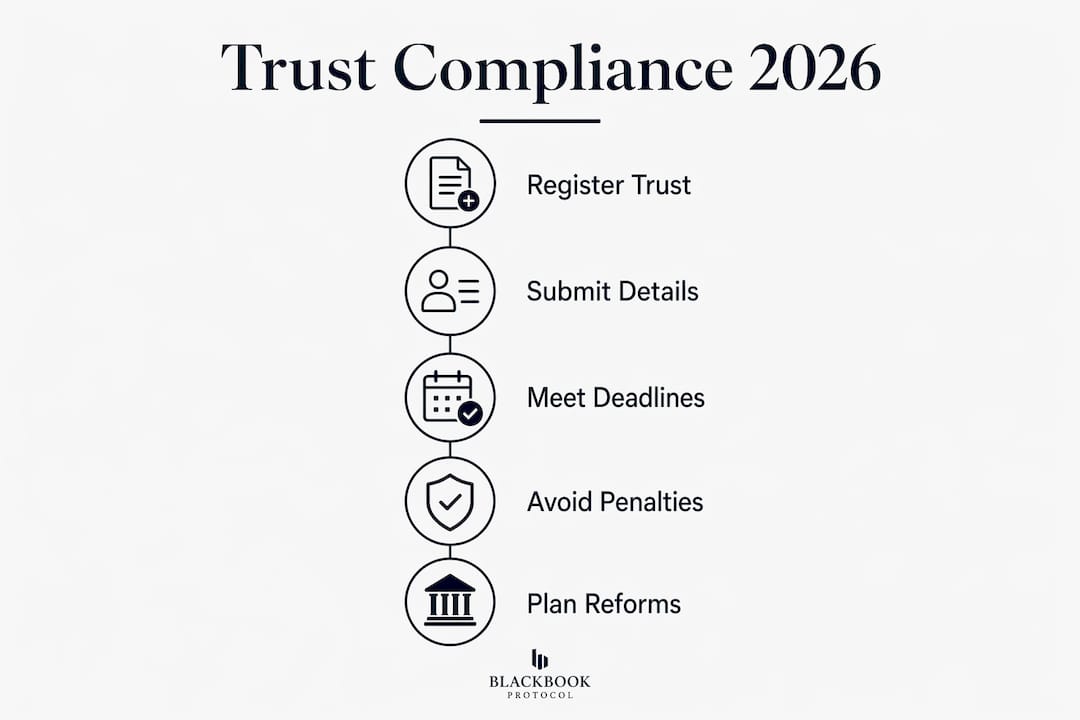
The Trust Registration Service requires settlor and beneficiary details to be submitted within 90 days of trustees becoming UK-resident or the trust generating a tax liability. Late or missing registration carries penalties of £100–£500. That range sounds modest, but a late registration also flags the trust for closer review.
The table below summarises the key compliance obligations and their consequences.
| Obligation | Deadline | Consequence of non-compliance |
|---|---|---|
| Trust Registration Service registration | Within 90 days of UK residency or tax liability | Penalties of £100–£500 and increased scrutiny |
| Annual tax return filing | Standard self-assessment deadlines | Interest, penalties, and investigation risk |
| Offshore trust attribution reporting | Ongoing, reviewed 2026–2028 | Reclassification of income and penalties |
| Inheritance tax periodic charge review | Every 10 years | Underpayment penalties and back-tax liability |
Reforms scheduled between 2026 and 2028 will affect inheritance tax periodic charges and tighten offshore trust attribution rules. Founders with existing trusts need to review their structures now, not when a reform takes effect. The trust registration service guide from Blackbookprotocol covers the current obligations in detail.
How can founders manage the risks of HMRC scrutiny?
Risk management starts before the sale completes. Founders who coordinate their tax adviser, solicitor, and payroll team early in the transaction process are far better placed to withstand HMRC queries. Holistic preparation addresses the complex, multi-area queries HMRC now raises, where a question about a trust deed can quickly expand into a review of payroll records and board decisions.
The most common avoidable mistakes include:
- Exceptional-hardship clauses in trust deeds. These clauses can cause HMRC to treat the trust as settlor-interested, which denies capital gains holdover relief and triggers immediate inheritance tax exposure. Founders often discover this problem only when attempting to claim relief.
- Inconsistent documentation. If the trust deed says one thing and the sale agreement implies another, HMRC will use the inconsistency against you.
- No commercial rationale on record. Every payment structure needs a documented business reason that existed before the transaction, not one constructed after an HMRC query arrives.
- Ignoring upcoming reforms. The 2026–2028 changes to offshore trust rules and inheritance tax charges will affect existing structures. A trust that is compliant today may not be compliant in 2027 without adjustment.
Pro Tip: Use the UK trust law compliance checklist from Blackbookprotocol to audit your trust structure against current HMRC requirements before any transaction completes.
Periodic review of your trust structure is not a one-off exercise. Tax law changes, your personal circumstances change, and HMRC’s enforcement priorities shift. A trust that was well-structured in 2022 may carry unintended risk in 2026. Build a review cycle into your annual compliance calendar and treat it with the same seriousness as your tax return.
Key takeaways
HMRC scrutinises founder trusts primarily to detect disguised remuneration and enforce compliance, and the risk is highest when payments depend on a founder’s continued role or when documentation is inconsistent.
| Point | Details |
|---|---|
| Disguised remuneration is the core risk | Payments tied to continued work are reclassified as income, not capital gains. |
| Documentation is your primary defence | Board minutes, trust deeds, and sale agreements must tell a consistent story. |
| Trust registration is mandatory | Most non-exempt trusts must register within 90 days or face penalties and scrutiny. |
| Exceptional-hardship clauses are dangerous | These provisions can make a trust settlor-interested, removing key tax reliefs. |
| Reforms require ongoing review | Changes between 2026 and 2028 will affect inheritance tax and offshore trust rules. |
What I have seen working with founder trusts
HMRC’s approach has shifted from broad-brush audits to technically precise, document-intensive investigations. The cases I see now involve specialist teams who understand trust law, employment tax, and corporate transactions simultaneously. That is a different challenge from a standard tax enquiry.
The founders who fare best are those who treated compliance as part of the deal structure, not an afterthought. They had clear commercial rationales documented before the sale, consistent paperwork across every adviser, and a trust deed reviewed specifically for settlor-interest traps. The founders who struggle are those who relied on a structure that worked for someone else without checking whether it suited their specific circumstances.
The uncomfortable truth is that HMRC does not need to prove bad intent to reclassify a payment. A poorly drafted clause or an undocumented earn-out milestone is enough. The advantages of UK trusts for founders are real, but they require precise execution to hold up under scrutiny. Preparation is not optional. It is the only thing that separates a clean transaction from a multi-year investigation.
— Blackbook
Protecting your position with Blackbookprotocol
Founder trust compliance is not a subject where general reading is enough. You need structured, practical guidance built specifically for UK founders navigating HMRC’s current enforcement environment.

Blackbookprotocol provides the Asset Protection Audio, eBook and Templates package, which covers UK trust law, 95/5 equity splits, and tax-efficient structuring in a format you can apply directly to your situation. The materials address the exact compliance areas HMRC now targets, from trust registration to earn-out documentation. For founders who want a physical reference, the Blackbook Protocol Hardback covers asset protection and corporate governance in depth. Both resources are built for founders who want to act before HMRC asks the first question.
FAQ
What does HMRC look for in a founder trust investigation?
HMRC looks for payments that depend on a founder’s continued role or performance, inconsistent documentation across sale agreements and trust deeds, and trust structures that lack a clear commercial purpose beyond tax reduction.
What triggers an HMRC audit of a founder trust?
Formulaic trust structures, earn-outs tied to personal targets, and missing or late Trust Registration Service filings are the most common triggers for HMRC to open a formal enquiry into a founder trust.
What are the penalties for failing to register a trust with HMRC?
Late or missing registration with the Trust Registration Service carries penalties of £100–£500 and typically results in the trust being flagged for closer review by HMRC.
Can an earn-out be treated as capital gains rather than income?
An earn-out can qualify for capital gains treatment if it is not contingent on the founder’s continued employment or personal performance. Clear commercial documentation prepared before the deal closes is the key requirement.
What is a settlor-interested trust and why does it matter?
A settlor-interested trust is one where the settlor or their spouse can benefit from the trust assets. This status removes capital gains holdover relief and triggers immediate inheritance tax exposure, making certain trust deed clauses extremely costly.
0 comments