

TL;DR:
- Pre-IPO trust planning involves establishing legal structures before a company goes public to protect assets and minimize taxes. Proper timing, structure choice, and professional coordination are essential to maximize benefits, especially when transferred equity is valued low. Delaying planning until late stages risks losing leverage and exposes founders to higher taxes and legal vulnerabilities.
A pre-IPO trust is a legal entity established before a company goes public to hold founder or key shareholder equity, enabling asset protection and tax optimisation. Understanding how pre-IPO trust planning works is the difference between preserving generational wealth and surrendering a significant portion of it to estate and gift taxes at the point of maximum valuation. Structures such as Grantor Retained Annuity Trusts (GRATs) and Intentionally Defective Grantor Trusts (IDGTs) allow founders to transfer equity at lower pre-IPO valuations, locking in tax advantages before the share price rises. The IRS, HMRC, and international listing regulators all scrutinise these arrangements, which is why timing and professional coordination are non-negotiable.
What are the primary benefits of pre-ipo trust planning?
Pre-IPO trust planning delivers three distinct advantages: estate tax reduction, asset protection, and structural compliance ahead of a public listing. Each benefit compounds the others when the planning is executed correctly.
Tax efficiency is the most immediate benefit. The federal lifetime gift tax exemption stands at $15 million per individual ($30 million for married couples) as of 2026. Gifting equity into a trust at a low pre-IPO valuation means the exemption absorbs far more shares than it would post-listing, when the price may have multiplied several times over.
Asset protection is equally significant. Legal ownership placed in trust with an independent trustee shields those shares from personal risks including divorce proceedings, creditor claims, and incapacity. The founder retains economic benefit while the trust holds legal title. This separation is critical during the volatile period surrounding a public listing.
Regulatory flexibility is a less-discussed but material benefit. Pre-IPO share transfers face fewer mandatory offer and disclosure requirements under listing rules than post-IPO restructuring. Acting before the listing preserves options that simply disappear once the company is public.
Additional benefits of trust planning include:
- Removing future share appreciation from the founder’s taxable estate entirely
- Enabling structured succession planning without triggering a change-of-control event
- Protecting ownership concentration from dilution through personal legal disputes
- Aligning the shareholding structure with compliance requirements before regulators scrutinise it
“Founders who delay trust planning until post-exit miss their highest leverage opportunity to preserve generational wealth.” — Estate Planning for Founders
The pre-IPO trust benefits available to a founder at a $10 million private valuation are categorically different from those available at a $500 million post-IPO valuation. The window is finite, and it closes at listing.
Which trust types are used in pre-ipo planning?
Three trust structures dominate pre-IPO financial strategies: GRATs, IDGTs, and non-grantor trusts. Each serves a different objective and carries distinct tax treatment.

Grantor retained annuity trusts (grats)
A GRAT allows a founder to transfer assets into a trust while retaining an annuity payment for a fixed term. If the assets appreciate faster than the IRS hurdle rate (the Section 7520 rate), the excess passes to beneficiaries free of gift tax. Two-year rolling GRATs are the standard structure because they limit the mortality risk of the grantor dying during the trust term, which would unwind the tax benefit.
Intentionally defective grantor trusts (idgts)
An IDGT is treated as a separate entity for estate tax purposes but as the grantor’s own property for income tax purposes. This means the grantor pays income tax on trust earnings, which further reduces the taxable estate without triggering additional gift tax. IDGTs are particularly effective when combined with instalment sales of pre-IPO shares at discounted valuations.
Non-grantor trusts
Non-grantor trusts are fully separate tax entities. They are used when founders want to shift income tax liability to the trust or its beneficiaries, particularly in lower-tax jurisdictions. However, these structures carry a critical risk: the substitution power, if included by mistake, destroys both the tax and asset protection objectives. This is known in practice as the “silent killer” clause.
Pro Tip: Review every non-grantor trust draft specifically for substitution powers before execution. One misplaced clause can void years of planning.
| Trust Type | Key Feature | Primary Benefit | Typical Use Case |
|---|---|---|---|
| GRAT | Annuity retained by grantor | Transfers appreciation tax-free | High-growth pre-IPO equity |
| IDGT | Grantor pays income tax | Reduces estate without gift tax cost | Instalment sales of founder shares |
| Non-Grantor Trust | Separate tax entity | Income shifting, asset protection | Multi-jurisdictional founders |
| Spousal Lifetime Access Trust (SLAT) | Spouse is beneficiary | Retains indirect access to assets | Married founders using full exemption |
The right structure depends on the founder’s tax residency, marital status, share class, and the anticipated IPO timeline. Trust planning for startups at seed stage looks very different from planning at Series C, where valuations are already elevated.
How does timing affect pre-ipo trust outcomes?
Timing is the single variable that determines whether pre-IPO trust planning delivers its full benefit or fails entirely. Starting at least 18 months before a liquidity event is the accepted minimum. The execution window itself typically runs 3–6 months, covering legal drafting, qualified appraisals, company approvals, and gift tax filings.
The IRS applies the substance-over-form and assignment-of-income doctrines to pre-IPO transfers. Rushing trust establishment too close to an IPO gives the IRS grounds to disregard the transaction entirely, treating the transfer as if it never occurred for tax purposes. The financial consequence of that outcome is severe.
Pro Tip: Set your trust planning start date in the calendar the moment you begin Series B fundraising. By Series C, your valuation may already be too high to maximise the gift tax exemption.
| Milestone | Recommended Timing | Key Action |
|---|---|---|
| Initial planning review | 18+ months before IPO | Engage estate counsel and CPA |
| Valuation and appraisal | 12–15 months before IPO | Commission qualified independent appraisal |
| Trust drafting and execution | 9–12 months before IPO | Finalise trust documents and fund the trust |
| Gift tax return filing | Within 12 months of transfer | File IRS Form 709 accurately |
| Ongoing administration | Throughout pre-IPO period | Monitor compliance and adapt to valuation changes |
Integrated advisory coordination across estate counsel, CPAs, and financial advisors is not optional. Each discipline manages a different risk. Estate counsel handles document integrity. CPAs model the Alternative Minimum Tax (AMT) exposure that early incentive stock option exercises can trigger. Financial advisors manage liquidity timing and residency considerations. A gap between any of these functions creates exposure.
What practical steps should entrepreneurs take?
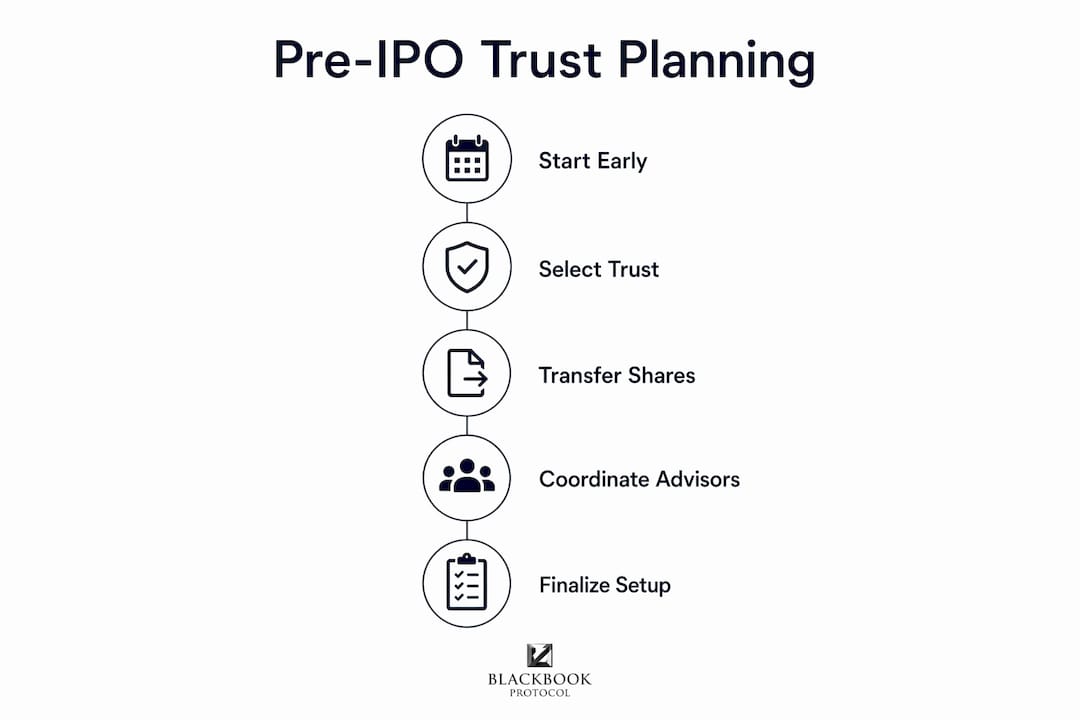
Implementing pre-IPO trust planning effectively requires a sequenced approach. Skipping steps or reordering them creates legal and tax risk.
-
Evaluate your asset base. Identify which share classes, options, and warrants are candidates for trust transfer. Not all equity is equally suited. Restricted stock units (RSUs) and incentive stock options (ISOs) have different tax treatment and transfer restrictions.
-
Engage qualified professionals early. Appoint an estate planning solicitor with IPO experience, a CPA who can model AMT and gift tax scenarios, and a financial advisor who understands liquidity event sequencing. Pre-IPO planning is most effective when these advisors coordinate on estate, tax, and financial considerations simultaneously.
-
Secure company approvals. Most shareholder agreements and articles of association require board or shareholder consent for share transfers. Obtain these approvals before executing any trust transfer to avoid voiding the transaction.
-
Commission a qualified independent appraisal. The IRS and HMRC both require defensible valuations for gifted equity. An appraisal from a qualified business valuer establishes the gift tax basis and protects against later challenge.
-
Draft trust documents with precision. Work with counsel to tailor the trust deed to your specific objectives. For non-grantor trusts, confirm the absence of substitution powers. For GRATs, confirm the annuity calculation aligns with current Section 7520 rates.
-
File gift tax returns accurately and on time. In the US, IRS Form 709 must be filed for any taxable gift. Accurate disclosure starts the statute of limitations clock, limiting the IRS’s window to challenge the valuation.
-
Model AMT exposure before exercising ISOs. AMT triggered by early ISO exercise can create significant cash flow risk. Model this alongside the gifting benefit before committing to a strategy.
-
Plan for ongoing administration. A trust is not a one-time filing. It requires annual accounting, trustee decisions, and adaptation as the IPO timeline evolves. Build administrative capacity into the plan from the outset.
The founder legacy planning checklist from Blackbookprotocol provides a structured framework for working through these steps in sequence, which is particularly useful when coordinating across multiple advisors.
Key takeaways
Pre-IPO trust planning works by transferring equity into legal structures before a listing, locking in lower valuations and removing future appreciation from the taxable estate.
| Point | Details |
|---|---|
| Start 18 months early | Beginning trust planning at least 18 months before IPO protects against IRS substance-over-form challenges. |
| Use the right trust structure | GRATs, IDGTs, and non-grantor trusts each serve different tax and protection objectives. |
| Gifting at low valuation is critical | Transferring shares before the IPO price rise maximises the value moved outside the taxable estate. |
| Avoid the substitution power error | Including substitution powers in non-grantor trusts destroys both tax and asset protection benefits. |
| Coordinate all advisors | Estate counsel, CPAs, and financial advisors must work together to avoid gaps in tax and compliance coverage. |
Why most founders get this wrong
Most founders treat trust planning as a post-liquidity task. They spend years building a company and then, in the final months before IPO, ask their accountant to “sort out the tax.” That approach is not just suboptimal. It is the single most expensive mistake a founder can make.
The leverage in pre-IPO trust planning comes from the valuation gap between private and public markets. A founder holding shares worth £2 million at Series B and £40 million at IPO has a narrow window in which to transfer equity at the lower value. Once that window closes, it does not reopen. The tax bill on the difference is permanent.
What I have observed consistently is that founders who engage estate counsel and CPAs at Series A, not Series C, retain materially more wealth. They also avoid the rushed, error-prone execution that characterises last-minute planning. The share trust agreement frameworks that work best are those built with time, not under deadline pressure.
The other failure mode is treating the advisory team as separate functions. Estate counsel drafts the documents. The CPA files the returns. The financial advisor manages the portfolio. None of them speaks to the others. The result is a plan that is technically correct in each discipline and strategically incoherent as a whole. Integrated planning is not a luxury. It is the mechanism by which the plan actually works.
Founders who protect generational wealth do so by treating the IPO as a planning deadline, not a starting point. The 2026 guide to founder wealth protection from Blackbookprotocol covers this in detail for UK-based founders navigating the specific requirements of HMRC and the FCA.
— Blackbook
Build your pre-ipo strategy with Blackbookprotocol
Blackbookprotocol provides structured resources for founders who want to implement pre-IPO trust planning with precision. The protocols cover UK Trust Law, 95/5 equity splits, and tax-efficient asset protection in formats designed for practical use, not academic reading.

The Blackbook Protocol hardback is the definitive resource for entrepreneurs building corporate governance and asset protection frameworks ahead of a liquidity event. It covers trust structures, equity architecture, and the legal mechanics that determine whether a founder retains or surrenders wealth at IPO. For those who prefer a digital format, the Kindle eBook delivers the same depth with immediate access. Both are built for founders who treat wealth preservation as a discipline, not an afterthought.
FAQ
What is pre-ipo trust planning?
Pre-IPO trust planning is the process of placing founder or shareholder equity into a legal trust structure before a company goes public. The primary objectives are reducing estate and gift tax exposure and protecting shares from personal legal risks.
How early should i start pre-ipo trust planning?
Trust planning should begin at least 18 months before a planned liquidity event. The execution window alone runs 3–6 months, and starting too close to the IPO risks IRS challenges on substance-over-form grounds.
What is the difference between a GRAT and an IDGT?
A GRAT transfers appreciation above the IRS hurdle rate to beneficiaries free of gift tax, while the grantor retains an annuity. An IDGT is treated as a separate estate tax entity but as the grantor’s asset for income tax, allowing the grantor to pay income tax on trust earnings and further reduce the taxable estate.
Can a trust protect my shares from divorce or creditor claims?
Yes. Placing legal ownership with an independent trustee removes the shares from the founder’s personal estate, shielding them from divorce proceedings and creditor claims while the founder retains economic benefit.
What is the substitution power risk in non-grantor trusts?
Including a power to substitute trust assets in a non-grantor trust inadvertently reclassifies it as a grantor trust, destroying both the income tax shifting benefit and the asset protection structure. This clause must be explicitly excluded during drafting.
0 comments