

TL;DR:
- An angel investment asset protection strategy combines legal safeguards, tax planning, and portfolio management to minimize financial risk. Securing key legal agreements such as stockholders’ rights, side letters, and board observer rights before funding is essential for effective protection. Using tax tools like QSBS, Section 1244, and structured investments can significantly enhance gains and mitigate losses.
An angel investment asset protection strategy is a structured approach that combines legal safeguards, tax planning, and portfolio risk management to shield your capital from liability and financial loss. Most angel investors focus on deal flow and valuations. Far fewer build the legal and tax architecture that actually preserves what they earn. This guide covers the core provisions in stockholders agreements, the Section 1202 QSBS tax framework, and the portfolio disciplines that separate protected investors from exposed ones.
What legal agreements should angel investors prioritise?
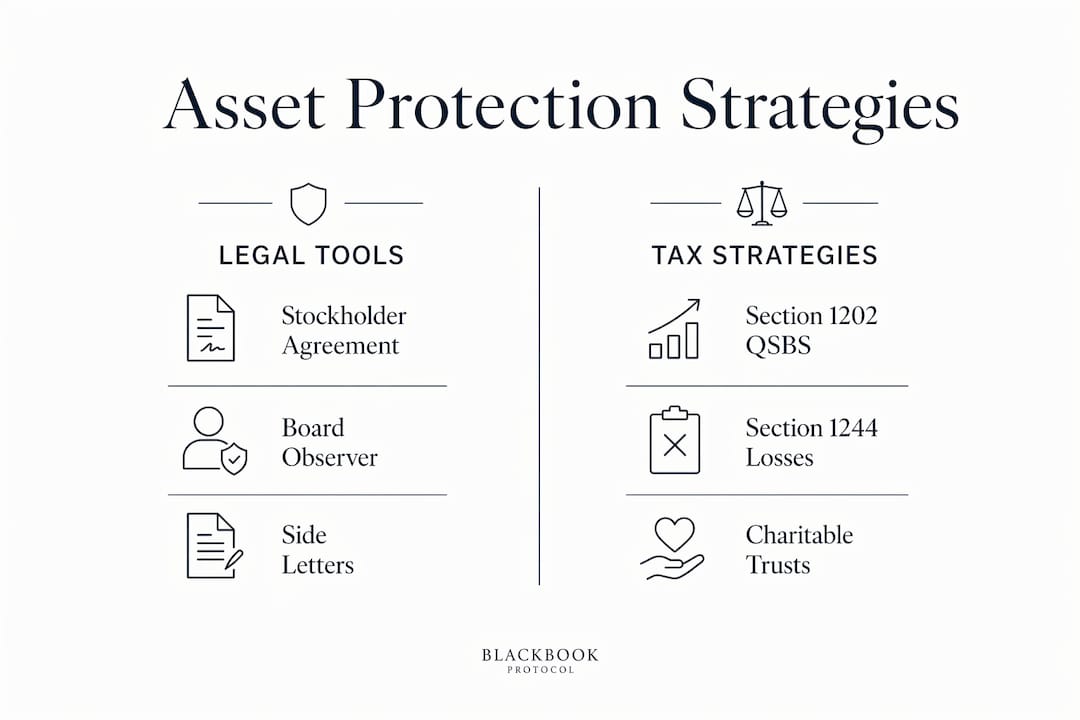
The foundation of any sound angel investor safeguard is a well-drafted stockholders agreement. Standard protective provisions include co-sale rights, pro-rata rights, and investor approval requirements for significant decisions such as liquidation, asset transfers, or share redemptions. These provisions prevent dilution and block founders from making high-risk moves without investor consent.
Board observer rights are a particularly underused tool. Observer rights let angels monitor burn rate and strategy without taking on the fiduciary duties and legal liabilities that come with a formal board seat. For smaller cheques, this is the right balance. A board seat gives you a vote but also exposes you to personal liability if the company faces legal action.
Side letters are where individual protections get codified. Leverage before funding is decisive. Once the wire clears, your negotiating position weakens considerably. Side letters negotiated before closing can include information rights, most-favoured-nation clauses, and QSBS compliance certifications that standard SAFE or convertible note templates simply do not provide.
Key provisions to secure before any funding closes:
- Co-sale rights: the right to sell your shares alongside founders in any secondary transaction
- Pro-rata rights: the right to maintain your ownership percentage in future funding rounds
- Board observer rights: access to board meetings and materials without fiduciary exposure
- Investor approval rights: veto power over liquidation, asset sales, or major debt issuance
- Annual QSBS certification: a written confirmation signed by the company’s principal financial officer each year
Pro Tip: Secure your side letter before you wire funds. Legal experts confirm that post-funding amendments are difficult to negotiate and rarely match the protections available at closing.
How can angel investors use tax law to protect investment gains?
Tax law is one of the most powerful tools in startup investment risk management, yet most angels use only a fraction of what is available. Section 1202 of the US Internal Revenue Code offers a tiered capital gains exclusion for qualifying small business stock (QSBS). The exclusion tiers are 50% after 3 years, 75% after 4 years, and 100% after 5 years, with a per-taxpayer cap of $15 million. Spouses filing jointly can exclude up to $30 million. That is a material sum to leave unprotected through poor planning.

Section 1244 provides a complementary loss protection. If a qualifying startup fails, Section 1244 allows ordinary loss deductions of up to $100,000 for married couples filing jointly, or $50,000 for single filers. The company’s equity must have been under $1 million at the time of stock issuance. This converts what would otherwise be a capital loss, limited in its deductibility, into a far more tax-efficient ordinary loss.
Stacking is the advanced move. Tax professionals recommend routing investments through multiple legal entities such as trusts and partnerships to multiply the QSBS exclusion cap across taxpayers. Each eligible entity can claim its own per-taxpayer limit. Anti-abuse rules apply, so structures must be established well before any exit event. Early planning is not optional here. It is the difference between a full exclusion and a disqualified claim.
Charitable remainder trusts add another layer for high-net-worth angels. A charitable remainder trust can sell appreciated startup shares tax-exempt and then pay income to the investor over a fixed term or for life. Capital gains taxes are deferred, and the trust provides a steady income stream post-exit.
| Tax tool | Core benefit | Key condition |
|---|---|---|
| Section 1202 QSBS | Up to 100% capital gains exclusion | Hold for 5+ years; company under $75M gross assets |
| Section 1244 | Ordinary loss deduction up to $100,000 | Company equity under $1M at issuance |
| QSBS stacking | Multiply exclusion caps across entities | Structures set before exit; anti-abuse rules apply |
| Charitable remainder trust | Tax-exempt sale; deferred income stream | Trust established before sale of appreciated stock |
Pro Tip: Verify QSBS eligibility at or before the point of investment. Many startups now qualify at the $75 million gross assets threshold, but eligibility must be confirmed in writing before you invest, not after.
What portfolio practices strengthen asset protection for angel investors?
Portfolio asset protection is not just about individual deals. It is about how you manage the collection of bets as a whole. The most common failure mode for angel investors is concentration risk: putting too much capital into a single startup or sector, then facing a liquidity crisis when that position turns against them.
Maintaining a cash buffer of 3–6 months of personal expenses is the baseline discipline. Without it, a down market can force you to liquidate positions at the worst possible time, triggering tax events and destroying the holding periods required for QSBS qualification. Cash reserves are not idle money. They are the insurance policy that keeps your tax strategy intact.
Practical portfolio management disciplines for angel investors:
- Diversify across stages and sectors: spread capital across pre-seed, seed, and Series A deals in different industries to reduce correlated losses
- Set a maximum position size: no single investment should represent more than a defined percentage of your total angel portfolio
- Schedule quarterly reviews: track burn rates, runway, and any material changes to QSBS eligibility across your portfolio companies
- Align exit timing with tax milestones: avoid selling before the five-year QSBS threshold unless the financial case is overwhelming
- Run annual compliance audits: confirm that each portfolio company still meets the active business and gross assets tests required for QSBS status
Regular review cycles also catch problems early. A company that pivots into a disqualifying business category, such as financial services or hospitality, can lose QSBS status mid-hold. Catching that shift in year two is far better than discovering it at exit. An asset protection blueprint built around scheduled reviews prevents these costly surprises.
What mistakes do angel investors make with asset protection?
The most expensive mistake is assuming that a standard SAFE or convertible note is sufficient. SAFEs and convertible notes rarely include the investor rights or QSBS compliance certifications that protect you at exit. Without a side letter, you have no mechanism to enforce annual certification or access information rights.
The second mistake is negotiating too late. Once funding closes, founders have little incentive to grant additional rights. The time to negotiate is before the wire, not after the term sheet is signed.
Common mistakes that cost angel investors the most:
- Relying on template documents without adding a side letter for individual protections
- Accepting verbal commitments from founders instead of written provisions
- Failing to verify QSBS eligibility before investment, then discovering disqualification at exit
- Skipping annual compliance audits that would catch eligibility drift in portfolio companies
- Demanding excessive rights early in a relationship, which damages founder trust and can kill deals
“Negotiating protections before wiring funds is crucial because leverage erodes after closing, making post-funding amendments difficult.” — Primum Law
Overloading founders with demands is also a real risk. Angels who ask for board seats, veto rights, and liquidation preferences on a pre-seed cheque often find that founders route future rounds away from them. The goal is to secure the protections that matter most, not to maximise every possible right. A guide to legally shielding startup equity helps you identify which provisions are worth fighting for at each stage.
Key takeaways
A complete angel investment asset protection strategy requires legal provisions secured before funding, tax structures verified at the point of investment, and portfolio disciplines maintained throughout the holding period.
| Point | Details |
|---|---|
| Secure side letters before funding | Negotiate co-sale rights, pro-rata rights, and QSBS certification before the wire clears. |
| Verify QSBS eligibility early | Confirm the company meets the $75M gross assets test at or before investment, not at exit. |
| Use Section 1244 for loss protection | Structure qualifying investments to deduct losses as ordinary income up to $100,000 jointly. |
| Maintain a cash buffer | Keep 3–6 months of personal expenses in cash to avoid forced liquidations during volatility. |
| Run annual compliance audits | Review each portfolio company’s QSBS status and legal protections every year without exception. |
Balancing protection with partnership in angel investing
The angels I respect most treat legal protections as a sign of professionalism, not distrust. They negotiate clearly, document everything, and then get out of the founder’s way. That combination is rarer than it should be.
The timing of your negotiation matters as much as the substance. Asking for board observer rights during term sheet discussions is normal. Asking for them six months after closing signals that you did not do your homework. Founders notice. Future co-investors notice too.
I have seen investors lose QSBS eligibility not because the law changed, but because they never asked the company to certify compliance annually. A single side letter clause requiring a signed annual certification from the CFO would have protected them. The cost of that clause is one conversation. The cost of skipping it can be millions in unexpected tax.
The wealth advisory compliance checklist is worth running through every year. Tax regulations shift, company circumstances change, and what qualified at investment may not qualify at exit. Discipline in the holding period is where most protection strategies either hold or fall apart.
The best approach is focused negotiation on a short list of genuinely important provisions, early legal counsel, and a portfolio review schedule you actually follow. Everything else is noise.
— Blackbook
Blackbookprotocol resources for angel investor protection
Angel investors who want a structured framework for protecting their assets do not need to piece it together from scattered sources. Blackbookprotocol has built a complete set of resources covering UK Trust Law, equity structuring, and tax-efficient asset protection in a format you can apply directly.

The asset protection audio, eBook, and templates bundle gives you the full Blackbookprotocol framework in one place, including corporate governance blueprints and legal structures designed for investors operating in the startup ecosystem. For those who prefer a physical reference, the Blackbookprotocol hardback covers the same frameworks in depth. Both formats are built for investors who want financial sovereignty, not just financial exposure.
FAQ
What is an angel investment asset protection strategy?
An angel investment asset protection strategy is a structured combination of legal agreements, tax planning, and portfolio management designed to protect an investor’s capital from liability and financial loss in startup investing.
What does Section 1202 QSBS offer angel investors?
Section 1202 QSBS provides a tiered capital gains exclusion of 50% after three years, 75% after four, and 100% after five years, with a per-taxpayer cap of $15 million. Spouses filing jointly can exclude up to $30 million.
Why are side letters important for angel investor safeguards?
Side letters codify individual investor rights that standard SAFE and convertible note templates do not include. They must be negotiated before funding closes, as leverage erodes significantly once the wire has been sent.
What is the difference between board observer rights and a board seat?
Board observer rights allow an angel investor to attend and monitor board meetings without taking on the fiduciary duties and legal liabilities of a formal board member. For smaller investments, observer rights provide oversight with far less personal risk.
How does Section 1244 protect angel investors from startup losses?
Section 1244 allows investors to deduct losses on qualifying small business stock as ordinary losses rather than capital losses, up to $100,000 for married couples filing jointly or $50,000 for single filers, provided the company’s equity was under $1 million at the time of stock issuance.
0 commenti