

TL;DR:
- Integrating a trust with a shareholder agreement provides strong protection for business ownership and ensures smooth succession. Trusts separate personal assets from business shares, shielding them from creditors, divorce claims, and litigation. Regular review and proper coordination of both documents prevent conflicts and maintain asset protection and operational continuity.
A shareholder agreement integrated with a trust structure is the most effective legal arrangement for protecting business ownership and ensuring clear succession. Together, these two instruments address what neither can achieve alone: the shareholder agreement governs commercial operations, while the trust governs personal estate and ownership continuity. Understanding why shareholder agreements need trusts means recognising that asset protection, probate avoidance, and succession planning all depend on both documents working in concert. Over half of estate planning respondents cite asset protection as the primary reason for holding family business interests in trusts. That figure alone tells you this is not a niche concern.
Why shareholder agreements need trusts for asset protection
Trusts separate your personal assets from your business ownership interests. That separation is the core of what makes a shareholder trust structure so powerful. When shares are held inside a trust, claims arising from personal bankruptcy, divorce proceedings, or civil litigation cannot easily reach those shares. The trust holds legal title, not you personally, so creditors pursuing you as an individual face a structural barrier.
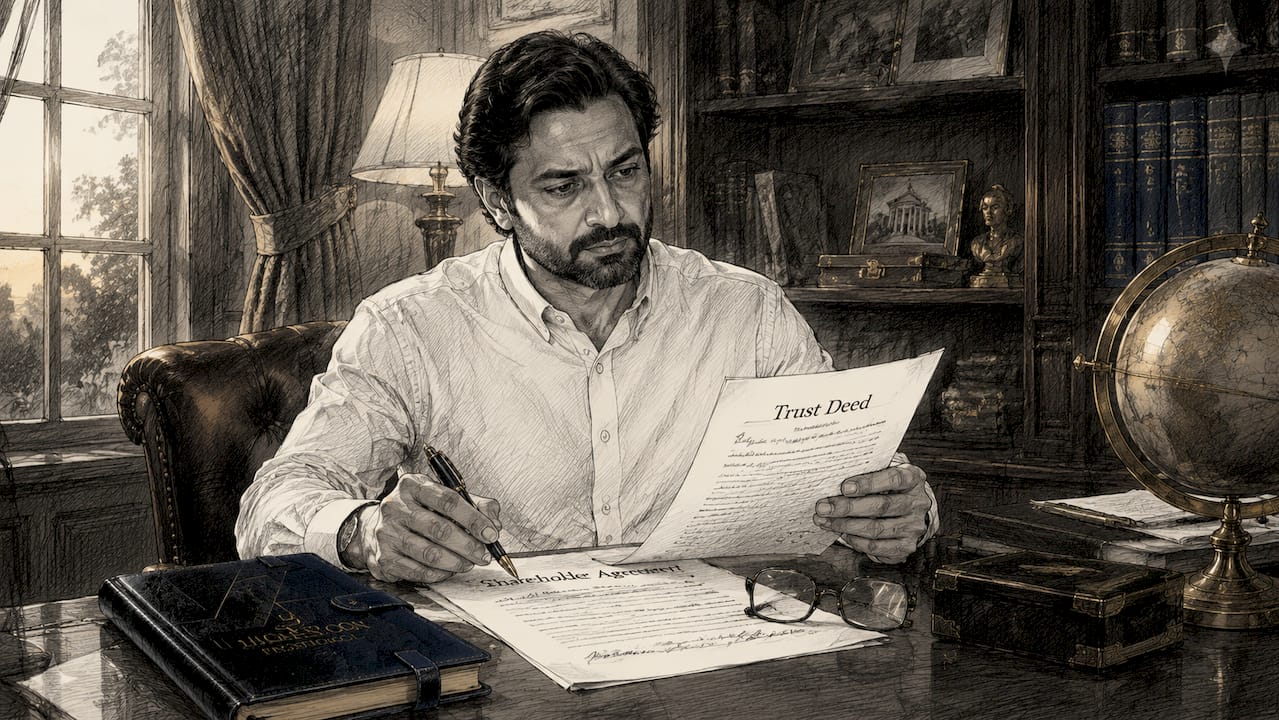
Over 50% of business owners who use trusts in business ownership do so specifically for this protection. That majority reflects a hard lesson many founders learn too late: personal liability events can destroy a business stake built over decades.
The key asset protection benefits of combining trusts with shareholder agreements include:
- Creditor insulation. Shares held in trust are generally outside the reach of personal creditors, preserving business continuity even during personal financial difficulty.
- Divorce protection. Trust ownership can prevent a spouse from claiming a direct share of the business in matrimonial proceedings.
- Litigation shielding. A trust structure limits exposure when personal legal judgements are made against a founder or shareholder.
- Controlled distribution. The trust deed governs how and when benefits flow to beneficiaries, preventing forced or premature payouts.
- Fiduciary oversight. A trustee’s legal duty to act in beneficiaries’ interests adds a layer of governance that direct personal ownership lacks.
Business trusts are ownership vehicles, not operating entities. That distinction matters because a trustee’s fiduciary duties can conflict with a founder’s desire to retain direct control. The trustee holds legal shareholder rights and must act in the interests of the trust’s beneficiaries, not the founder’s personal preferences. Founders who want to retain operational influence must address this tension explicitly in the trust deed.
Pro Tip: Draft the trust deed to include specific powers authorising the trustee to hold, vote, and transfer shares. Without that explicit authority, the trustee may be unable to act on your behalf at shareholder meetings, leaving the company in a governance gap.
For a deeper look at how protective trusts function in practice, Blackbookprotocol’s guide on protective trust strategies covers the mechanics in plain terms.
How do shareholder agreements and trust documents interact?
Shareholder agreements and trust deeds operate in different legal spheres. A trust manages personal estate and beneficiary distribution; a shareholder agreement manages company governance and commercial operations. When these two documents are not aligned, families and businesses end up in legal limbo.
The most common conflict arises from transfer restrictions. Most shareholder agreements contain clauses that prevent shares from being transferred without the consent of other shareholders. Business owners frequently fail to amend these clauses when they place shares into a trust. The result is that transfer restrictions in company documents override the trust provisions, leaving the trust holding shares it cannot legally exercise rights over.
Voting rights create a second layer of complexity. The trustee, not the beneficiary, holds legal shareholder status and signs resolutions. If the shareholder agreement does not recognise the trustee as the legitimate shareholder, voting at general meetings becomes contested. Consent requirements in the agreement may also require personal shareholder approval for decisions, which the trustee cannot give without explicit authority in the trust deed.
Shareholder agreements remain necessary even when shares are held by trusts. The trust deed does not address exit strategies, drag-along rights, or dispute resolution. The shareholder agreement fills that gap. Relying on family trust relationships without a tailored shareholder agreement leaves the business commercially exposed.
Pro Tip: When reviewing your shareholder agreement, add a clause that explicitly recognises trustee ownership and grants the trustee the same rights as any individual shareholder. Then mirror that authority in the trust deed. Both documents must reference each other to function without conflict.
Blackbookprotocol’s article on share trust agreements in the UK explains how these legal relationships are structured under English law.
How do trusts help with business succession and probate avoidance?
Probate is the legal process through which a deceased person’s estate is administered. It is public, slow, and disruptive to business operations. When shares are held personally, they pass through probate on the owner’s death. That process can freeze voting rights, dividend entitlements, and share transfers for months or longer.
Trust-based ownership of shares bypasses probate entirely. The trustee continues to hold and manage the shares without interruption. Business operations continue. Other shareholders are not left waiting for a grant of probate before decisions can be made.
Privacy is a second major benefit. Probate records are public documents. A will filed through probate discloses the value and composition of the estate to anyone who searches. A trust passes assets to beneficiaries without any public filing. For business owners who want to keep ownership structures and valuations private, this matters considerably.
Succession planning through a trust also addresses incapacity, not just death. If a founder becomes mentally or physically incapacitated, a trust with a named successor trustee ensures the shares continue to be managed without a court application for deputyship. That continuity protects the business from governance gaps that can arise during a founder’s illness.
For founders planning long-term ownership continuity, Blackbookprotocol’s UK trust advantages guide sets out the specific benefits available under English and Welsh law.
Practical steps for integrating trusts within shareholder agreements
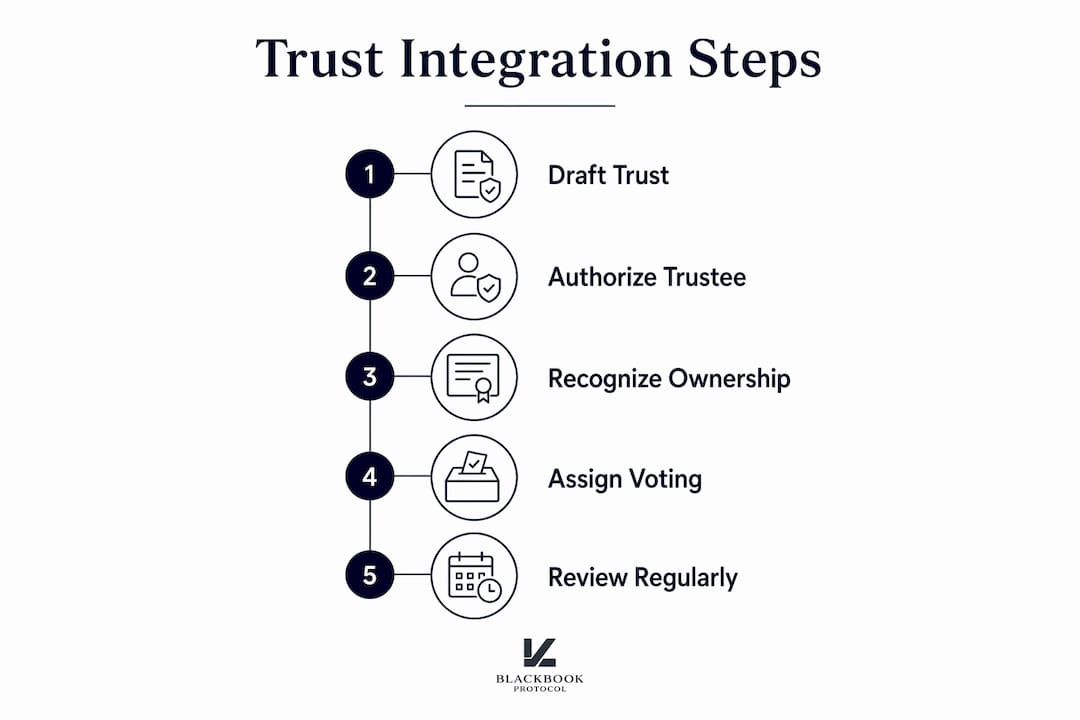
Getting the integration right requires deliberate coordination between corporate lawyers and estate planners. These two professional groups often work in isolation, producing documents that conflict with each other. The following steps reduce that risk.
- Review the existing shareholder agreement for transfer restrictions. Identify every clause that limits share transfers and determine whether trustee ownership is permitted or requires consent.
- Amend the shareholder agreement to recognise trust ownership. Add explicit provisions that permit shares to be held by a trust and that recognise the trustee as the legal shareholder.
- Draft the trust deed with specific shareholder powers. The trustee must be explicitly authorised in the trust deed to vote shares, receive dividends, and execute share transfers.
- Align distribution provisions with company cash flow. Fixed distribution requirements such as a set percentage payout can force asset liquidation when the business cannot generate sufficient cash. Match trust distributions to actual cash flows instead.
- Appoint a professional trustee where complexity demands it. Professional trustees are often needed when liquidity tightens or conflicts arise between distribution obligations and reinvestment needs.
- Schedule regular reviews. Both documents must be updated as the business grows, ownership changes, or new shareholders join. A trust deed drafted for a two-founder startup will not serve a ten-shareholder company without amendment.
Ignoring trustee fiduciary duties creates real legal risk. A trustee who acts in the founder’s personal interest rather than the beneficiaries’ interest breaches their duty. That breach can expose the trust to legal challenge and unwind the asset protection the structure was designed to provide.
Pro Tip: Instruct your corporate lawyer and estate planner to review each other’s documents before execution. A single joint review meeting prevents the document misalignment that causes most trust and shareholder agreement conflicts.
Key takeaways
Shareholder agreements and trusts must be drafted together and reviewed together to deliver genuine asset protection and succession continuity.
| Point | Details |
|---|---|
| Asset protection is the primary driver | Over 50% of business owners use trusts specifically to shield shares from personal creditors and legal claims. |
| Document alignment is non-negotiable | Transfer restrictions in shareholder agreements frequently override trust provisions unless both documents are explicitly coordinated. |
| Probate bypass protects operations | Trust ownership allows shares to pass without probate, preventing governance gaps and public disclosure of ownership. |
| Trustee authority must be explicit | The trust deed must specifically authorise the trustee to vote, manage, and transfer shares or the structure fails. |
| Distribution terms must match cash flow | Fixed percentage payouts in trust deeds can force asset liquidation; align distributions with actual company cash flow. |
What I have seen go wrong when founders skip this step
The most common mistake I see is treating the shareholder agreement and the trust deed as separate projects. A founder works with a corporate lawyer to draft a shareholder agreement, then separately instructs an estate planner to create a trust. Neither professional sees the other’s document. The result is a transfer restriction clause that blocks the trust from ever receiving the shares it was designed to hold.
The second mistake is assuming that family trust relationships replace the need for a formal shareholder agreement. Relying only on trust-based family ties without a tailored shareholders agreement leaves the business commercially exposed the moment a dispute arises. Family goodwill does not resolve drag-along rights or buyout valuations.
What actually works is treating both documents as a single governance system. The shareholder agreement defines the commercial rules. The trust deed defines the ownership and succession rules. When they reference each other and are reviewed together, the structure holds under pressure. When they are drafted in isolation, the first serious event, whether a death, a divorce, or a dispute, exposes every gap.
Ongoing review is not optional. A trust deed and shareholder agreement drafted in 2019 for a two-person company will not serve a six-shareholder business in 2026 without amendment. Business owners who build this review into their annual governance calendar protect themselves far more effectively than those who treat it as a one-time exercise.
— Blackbook
The Blackbookprotocol resources that support this structure
Building a trust and shareholder agreement structure that actually holds requires more than legal theory. It requires templates, frameworks, and clear guidance on UK Trust Law, equity splits, and tax-efficient ownership.

Blackbookprotocol’s asset protection audio, eBook, and templates give business owners the practical tools to implement these structures correctly. The resources cover UK Trust Law, the 95/5 equity split model, and governance frameworks designed for founders who want financial sovereignty without relying on generic legal advice. If you are building or reviewing a shareholder agreement and trust structure, these materials provide the blueprint.
FAQ
Do shareholder agreements require trusts to be valid?
No. A shareholder agreement is legally valid without a trust. Trusts are incorporated to add asset protection and succession planning that the shareholder agreement alone cannot provide.
What happens if a shareholder agreement does not recognise trust ownership?
Transfer restrictions in the shareholder agreement can prevent shares from legally transferring to the trust, leaving the ownership structure in conflict and potentially unenforceable.
Can a trust beneficiary vote at shareholder meetings?
No. The trustee, not the beneficiary, holds legal shareholder status and exercises voting rights. The trust deed must explicitly authorise the trustee to vote on the beneficiary’s behalf.
Does placing shares in a trust avoid probate in the UK?
Yes. Trust-based share ownership bypasses probate entirely, allowing the trustee to continue managing shares without delay or public disclosure upon the founder’s death or incapacity.
How often should a shareholder agreement and trust deed be reviewed together?
Both documents should be reviewed annually and whenever a significant change occurs, such as a new shareholder joining, a change in ownership structure, or a material shift in company value.
0 Kommentare