

TL;DR:
- A dual class share structure divides voting rights among different share classes, allowing founders to retain control. This setup enables long-term strategic planning and protection against market pressures. Critics highlight governance risks, but well-designed sunset provisions can mitigate potential downsides.
A dual class share structure is an equity arrangement where a company issues two or more classes of shares carrying different voting rights, separating financial ownership from corporate control. This structure lets founders and insiders retain decision-making authority even after selling the majority of economic interest to public investors. Understanding how this works is essential for any investor or entrepreneur evaluating governance arrangements in 2026.
What is a dual class share structure and how does it work?
A dual class share structure issues at least two distinct classes of common stock, each with different voting power attached. Class A shares, typically sold to the public, carry one vote per share. Class B shares, held by founders or insiders, commonly carry ten votes per share. This asymmetry means a founder holding a small economic stake can still control the majority of votes at shareholder meetings.

Voting ratios between classes typically range from 10:1 to 20:1, with some structures reaching as high as 50:1 for a small group of insiders. That concentration is deliberate. It allows the founding team to pursue long-term plans without being overruled by short-term shareholders. Founders can secure their shares before funding rounds to lock in this advantage from the outset.
The key roles in these structures break down as follows:
- Founders and insiders hold high-vote Class B shares, retaining operational and strategic control.
- Public investors hold low-vote Class A shares, gaining economic exposure with limited governance influence.
- Institutional investors may hold either class, depending on the IPO terms and secondary market activity.
- Boards are often structured to reflect the founder’s majority voting position, reinforcing long-term governance alignment.
Pro Tip: Review the specific voting ratio and share class definitions in any company’s articles of association before investing. A 10:1 structure carries very different governance implications than a 50:1 arrangement.
Sunset provisions are a critical mechanism within these structures. They contractually end the dual class arrangement when predefined triggers occur, such as five to ten years post-IPO or when insider ownership drops below a set threshold, commonly 5–10%. These provisions protect public investors by ensuring the structure does not persist indefinitely.
What are the benefits and advantages of dual class shares?
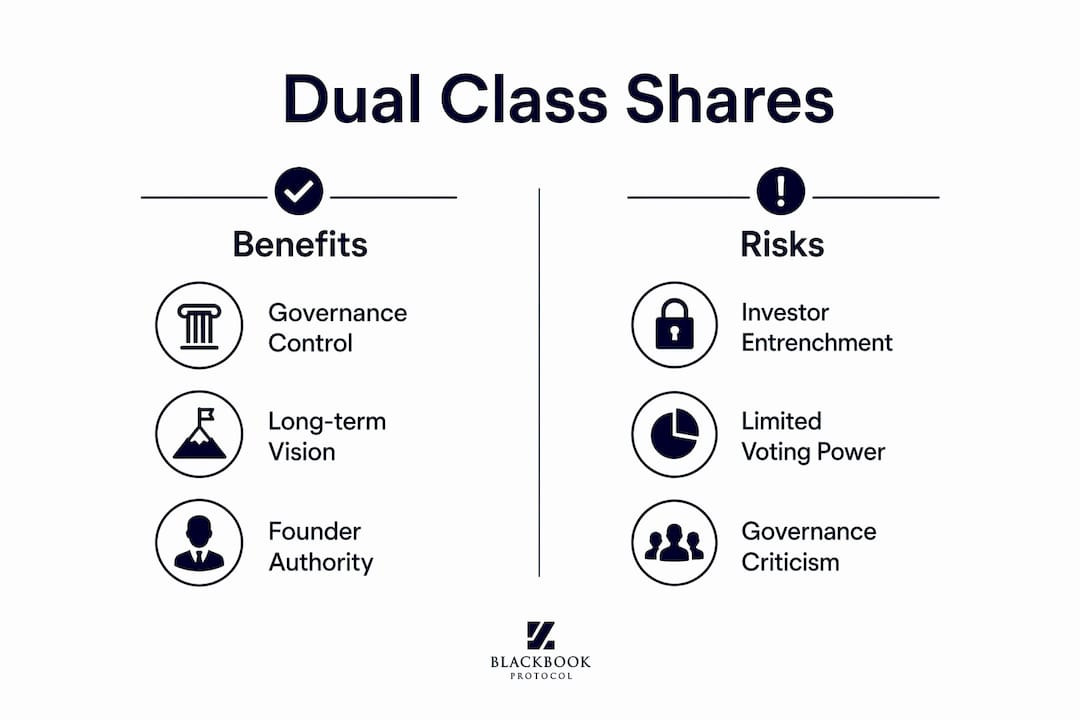
Dual class shares deliver a specific set of governance advantages that single-class structures cannot replicate. The primary benefit is protection from short-term market pressure. Public markets often reward quarterly earnings over multi-year investment cycles. A founder with superior voting rights can resist that pressure and allocate capital towards long-term research, development, and structural transformation.
The strategic value is well documented. Reinvested earnings in a dual class company proved 30 times more accretive than peers prioritising dividends. That figure illustrates the compounding effect of long-term capital allocation when founders are insulated from dividend pressure.
The numbered advantages are worth examining directly:
- Protection from hostile takeovers. A founder controlling the majority of votes can reject acquisition bids that undervalue the company’s long-term potential.
- Resistance to activist investors. Activist shareholders cannot force asset sales, leadership changes, or short-term restructuring without the founder’s consent.
- Long-term R&D investment. Founders can commit capital to multi-year projects without shareholder approval at each stage.
- Strategic transformation. Companies navigating structural industry shifts, such as moving from print to digital, can execute transformation without market interference.
- Visionary leadership continuity. The structure keeps the founding vision intact through periods of market volatility or competitive disruption.
“Dual class shares act as a strategic governance tool, not merely control devices. They allow founders to manage as if they owned the company permanently, which facilitates visionary leadership and long-term R&D investment.” — Yale Insights
Technology companies rely on these structures particularly heavily. Multi-year product cycles and platform-building strategies require capital commitments that quarterly-focused shareholders would otherwise block. The founder legacy planning process often centres on this exact question: how to preserve vision without surrendering control.
What risks and criticisms are associated with dual class share structures?
The central criticism of dual class shares is reduced accountability. When founders control the majority of votes regardless of their economic stake, the normal disciplinary mechanisms of public markets stop functioning. Boards cannot easily remove underperforming leadership. Shareholders cannot force strategic changes. This concentration of power creates real governance risk.
The main concerns raised by investors and governance bodies include:
- Entrenchment risk. A founder who performs poorly cannot be removed through normal shareholder voting processes.
- Misaligned incentives. As insider economic ownership shrinks post-IPO, their financial exposure to poor decisions decreases while their control remains intact.
- Limited recourse for minority shareholders. Public investors in low-vote share classes have little practical ability to influence corporate direction.
- Regulatory scrutiny. Several major stock exchanges and institutional investor bodies have introduced guidelines discouraging or restricting these structures.
- Succession complications. High-vote shares held by a founder create governance uncertainty when leadership transitions occur.
The evidence on financial impact is more nuanced than critics suggest. A 2025 study found no statistical disadvantage to shareholders of inferior voting classes. That finding challenges the assumption that reduced voting rights translate directly into reduced returns. Separately, 244 Russell 3000 companies with dual class shares showed superior financial performance over five and ten-year periods compared to single-class peers. The data suggests the governance risk is real but the financial risk is less clear-cut.
How do governance and regulatory frameworks address dual class share structures?
Governance frameworks for dual class shares vary significantly by jurisdiction. In the United Kingdom, the Financial Conduct Authority has historically been cautious about these structures in premium-listed companies, though recent reforms have relaxed restrictions to attract high-growth technology firms. In the United States, major exchanges including the NYSE and Nasdaq permit dual class listings with disclosure requirements. Hong Kong and Singapore have both introduced frameworks specifically designed to accommodate these structures for technology IPOs.
| Governance mechanism | Purpose | Typical trigger |
|---|---|---|
| Sunset provisions | End dual class rights automatically | 5–10 years post-IPO or ownership below 5–10% |
| Ownership thresholds | Reduce high-vote rights as insider stake falls | Founder stake drops below defined percentage |
| Board independence requirements | Limit founder influence on board composition | Regulatory listing rules |
| Mandatory disclosure | Inform investors of voting asymmetry | IPO prospectus and annual reporting |
The Canadian Coalition for Good Governance promotes specific best practices, including subordinated voting rights and mandatory sunset provisions, as balance measures that protect public investors without eliminating the structure entirely. These policies reflect a broader institutional consensus: the structure is acceptable when accompanied by clear limits and exit mechanisms.
Pro Tip: When evaluating a dual class company, check whether sunset provisions are time-based or ownership-based. Time-based provisions offer more predictable governance transitions for investors.
Institutional investors have developed their own control retention frameworks for assessing these structures. Many will invest in dual class companies but apply a governance discount to their valuation, reflecting the reduced influence they accept as shareholders.
How should investors and business leaders approach dual class share structures?
Investors and founders face different but related questions when engaging with dual class shares. The key trade-off is between control and investor influence. Many investors accept reduced voting rights as the cost of accessing a founder’s unique vision and execution capability. The question is whether that trade-off is priced correctly.
For investors, the practical evaluation checklist covers these areas:
- Assess the founder’s track record. Voting power concentration is only justified when the founder has demonstrated the ability to allocate capital well over time.
- Review the specific voting ratio. A 10:1 structure is materially different from a 50:1 arrangement in terms of minority shareholder exposure.
- Examine sunset provision terms. Understand exactly when and how the dual class structure ends, and what triggers apply.
- Evaluate the business model. Dual class structures add most value in businesses requiring long-term capital commitment, such as technology, media, and pharmaceutical companies.
- Check shareholder rights in the articles of association. Some structures include protective provisions for minority shareholders; others do not.
For founders and business leaders, the decision to implement a dual class structure requires careful planning. Legally shielding startup equity from the outset is far simpler than restructuring after external investors have taken positions. The structure must align with the company’s long-term strategy, not simply reflect a desire to retain control for its own sake.
Understanding share trust agreements in the UK is also relevant here, particularly for founders who want to combine dual class voting rights with trust-based ownership structures for succession and tax planning purposes.
Key takeaways
A dual class share structure separates voting control from economic ownership, giving founders the authority to execute long-term strategies while public investors gain financial exposure with limited governance rights.
| Point | Details |
|---|---|
| Core definition | Two or more share classes carry different voting rights, separating control from economic ownership. |
| Voting ratios matter | Ratios typically range from 10:1 to 20:1, with higher ratios concentrating control more sharply. |
| Financial performance | Research shows dual class companies have outperformed single-class peers over five and ten-year periods. |
| Sunset provisions are critical | These provisions end dual class rights on predefined triggers, protecting long-term investor interests. |
| Due diligence is non-negotiable | Investors must review voting ratios, sunset terms, and shareholder rights before committing capital. |
The governance question most investors get wrong
Most commentary on dual class shares focuses on the wrong risk. Investors worry about entrenchment, but the real question is whether the founder’s vision justifies the control premium. I have reviewed dozens of these structures, and the ones that destroy value share a common feature: the founder retained control long after the original strategic rationale had expired.
The structure itself is not the problem. A 10:1 voting ratio in a company building a ten-year technology platform is a rational governance choice. The same ratio in a mature business with no clear long-term investment thesis is simply entrenched management. The difference is the business model, not the share class.
Governance bodies and institutional investors are right to push for sunset provisions and ownership thresholds. These mechanisms do not undermine the structure’s purpose. They prevent it from outlasting its usefulness. The founders who resist sunset provisions are often the ones who should worry investors most.
For entrepreneurs, the lesson is straightforward. Build the dual class structure around a specific strategic commitment, not around personal control. Define the conditions under which you would accept a return to single-class governance. That clarity signals confidence in the vision, not weakness.
— Blackbook
Blackbookprotocol: governance frameworks for founders and investors
Dual class share structures sit at the intersection of equity design, corporate governance, and long-term asset protection. Getting the structure right from the start requires more than legal templates. It requires a clear framework for how control, ownership, and succession interact.

Blackbookprotocol provides the asset protection hardback covering UK Trust Law, equity splits, and corporate governance in one authoritative reference. For founders and investors who want practical tools alongside the theory, the audio, eBook, and templates bundle delivers ready-to-use frameworks for structuring and protecting equity positions. Both resources are built for professionals who need to act on governance decisions, not just understand them.
FAQ
What is a dual class share structure in simple terms?
A dual class share structure issues two or more classes of shares with different voting rights. Founders hold high-vote shares to retain control, while public investors hold low-vote shares for economic exposure.
How do dual class shares differ from ordinary common shares?
Ordinary common shares carry one vote per share for all holders. Dual class shares assign different voting weights to different share classes, typically giving insiders ten or more votes per share compared to one vote for public shareholders.
Do dual class shares harm investor returns?
A 2025 study found no statistical disadvantage to shareholders of inferior voting classes. Research on 244 Russell 3000 companies showed dual class firms outperformed single-class peers over five and ten-year periods.
What is a sunset provision in a dual class structure?
A sunset provision is a contractual term that ends the dual class arrangement when specific triggers occur, such as five to ten years after IPO or when insider ownership falls below a defined threshold.
Which types of companies use dual class share structures most often?
Technology, media, and pharmaceutical companies use these structures most frequently. These sectors require long-term capital commitments and multi-year strategies that benefit from insulation against short-term shareholder pressure.
0 commentaire