

TL;DR:
- A nominee director is appointed to represent another party on a company’s board and bears full statutory responsibilities. They owe fiduciary duties directly to the company, not the appointing party, under laws like the UK Companies Act 2006. Proper legal structuring, documentation, and due diligence are essential to manage risks and ensure compliance in nominee arrangements.
A nominee director is an individual legally appointed to a company’s board to represent the interests of another party, while bearing full statutory responsibility to the company itself. Understanding what does nominee director mean matters because the role carries identical legal weight to any other directorship. The nominee director definition is not a loophole or a formality. Under the UK Companies Act 2006, nominee directors owe fiduciary duties directly to the company, not to the person who appointed them. Blackbookprotocol covers this distinction in depth because misunderstanding it creates serious legal exposure for business owners.
What does nominee director mean in corporate law?
A nominee director is a formally appointed board member who holds the position on behalf of a nominating party, such as a beneficial owner or investor. The word “nominee” describes the appointment mechanism, not the level of legal accountability. Directors’ duties are owed strictly to the company, regardless of who arranged the appointment. That single fact overturns the most common misconception about the role.

Many business owners assume a nominee director is a passive figurehead who simply signs documents on instruction. Courts reject that view entirely. The “following orders” defence carries no weight when a court assesses whether a director breached their duties. Personal liability attaches to the nominee director, not to the appointing party.
The nominee director definition applies across major jurisdictions. The UK Companies Act 2006 (sections 171 to 177) sets out seven statutory duties. Singapore’s Companies Act and Malaysia’s Companies Act 2016 impose equivalent obligations. The legal framework is consistent: the title “nominee” changes nothing about the duties owed.
What are the key responsibilities and legal duties of a nominee director?
Nominee director responsibilities mirror those of any executive director. The UK Companies Act 2006 codifies seven duties that apply without exception.
- Duty to act within powers (section 171): the director must follow the company’s constitution and exercise powers only for their proper purpose.
- Duty to promote the success of the company (section 172): decisions must benefit the company’s members as a whole, not the nominator.
- Duty to exercise independent judgement (section 173): the nominee cannot simply rubber-stamp instructions from the appointing party.
- Duty to exercise reasonable care, skill, and diligence (section 174): the standard applied is both objective and subjective.
- Duties to avoid conflicts, not accept benefits from third parties, and declare interests (sections 175 to 177): these apply even when the conflict arises from the nominator’s own instructions.
The tension between sections 172 and 173 is where nominee arrangements most often break down. A nominator may instruct the nominee to vote in a particular way. If that vote damages the company, the nominee director bears the legal consequences. Statutory duties apply regardless of the nominee’s actual involvement level. Low involvement does not reduce liability.
Pro Tip: Before accepting a nominee directorship, obtain written legal advice on the specific duties that apply in the relevant jurisdiction. Verbal assurances from the appointing party carry no legal weight.
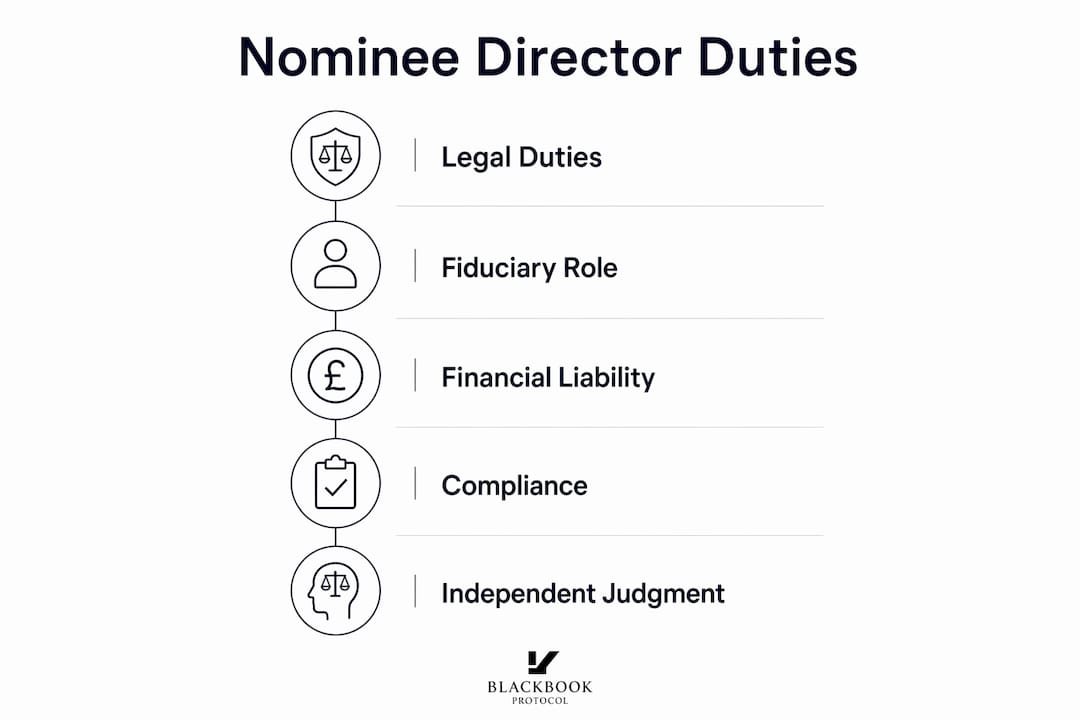
The role of nominee director also carries financial liability. A nominee director can be personally liable for wrongful trading, fraudulent trading, and breach of fiduciary duty. These risks exist whether the nominee attends board meetings weekly or once a year.
Why do businesses appoint nominee directors?
Businesses appoint nominee directors for practical, compliance-driven reasons rather than to obscure ownership. The most common purposes include meeting local directorship requirements, maintaining beneficial owner confidentiality on public registers, and reducing administrative burden on senior personnel who are based abroad.
The benefits of nominee directors are clearest in international business structures. Many jurisdictions require at least one locally resident director. Singapore, for example, mandates a resident director for every registered company. A nominee director satisfies that requirement without relocating a founder or senior executive.
The practical benefits fall into four categories:
- Residency compliance: meeting mandatory local director or residency rules in jurisdictions such as Singapore, Malaysia, and Hong Kong.
- Confidentiality: keeping the beneficial owner’s name off publicly accessible company registers, which is lawful where permitted by local law.
- Administrative efficiency: handling local filings, signing documents, and attending regulatory meetings without requiring the beneficial owner to be present.
- Governance structure: supporting investment vehicles and multinational holding companies that require a formal local board presence.
The beneficial owner retains economic interest and control through shareholder mechanisms. Appointing a nominee director affects the governance structure, not the ownership of the company. Understanding this distinction is central to why use a nominee director in the first place.
A nominee director arrangement also suits founders who want to understand control retention mechanics before committing to a governance structure. The nominee sits on the board; the beneficial owner retains voting rights and economic interest through shares.
What are the potential risks and regulatory challenges?
Nominee director arrangements attract heightened scrutiny from financial institutions and regulators. The risks are real and must be managed before the appointment is made, not after.
- Statutory liability cannot be contracted away. A nominee director agreement may allocate costs and responsibilities between parties, but it cannot override the Companies Act. The nominee remains personally liable for any breach of statutory duty.
- KYB and AML scrutiny. Financial institutions treat nominee-directed companies as higher risk in Know Your Business and Anti-Money Laundering processes. Banks may refuse to open accounts or may request extensive disclosure before proceeding.
- Beneficial owner transparency. Nominees do not hide beneficial owners from regulators. The UK’s Persons with Significant Control register, and equivalent registers in other jurisdictions, require disclosure of the ultimate beneficial owner. Failure to disclose is a criminal offence.
- Reputational risk. A nominee director associated with a company that breaches regulations faces personal reputational damage, regardless of their level of involvement in the breach.
- Banking complications. Increasing regulatory scrutiny means nominee structures are less of a privacy shield and more a governance role subject to full disclosure. Banks routinely request nominee agreements, beneficial owner declarations, and source of funds documentation.
Pro Tip: If you are appointing a nominee director for a UK company, register the beneficial owner on the Persons with Significant Control register before the company opens a bank account. Attempting to do so afterwards creates delays and compliance flags.
Clear internal controls and documented mandates are the primary tools for managing these risks. Singapore governance experts emphasise that documented instructions, reporting protocols, and governance frameworks are not optional extras. They are the foundation of a compliant nominee arrangement.
How are nominee director agreements structured?
A nominee director agreement defines the operational relationship between the nominee and the beneficial owner. It does not override statute, but it does allocate responsibilities, costs, and protections clearly.
| Agreement component | Purpose |
|---|---|
| Service agreement | Sets out the scope of the nominee’s duties, fees, and reporting obligations |
| Power of attorney | Authorises the beneficial owner to act on behalf of the company in defined circumstances |
| Indemnity clause | Commits the beneficial owner to cover costs and liabilities incurred by the nominee acting in good faith |
| Undated resignation letter | Allows the beneficial owner to remove the nominee at any time without requiring a formal board resolution |
| Operational mandate | Documents the instructions the nominee is authorised to follow, within the limits of their statutory duties |
Nominee packages typically include all five components. Each element serves a distinct purpose, and omitting any one of them creates gaps in the governance structure. The indemnity clause is particularly important. It does not protect the nominee from statutory liability, but it does ensure the beneficial owner bears the financial cost of any claims arising from the nominee’s authorised actions.
The undated resignation letter is a practical control mechanism. Exit mechanisms triggered at the beneficial owner’s discretion give the appointing party the ability to change the nominee quickly if the relationship breaks down. This protects the company’s operational continuity.
Strong documentation supports compliance but does not replace governance. The nominee must still exercise independent judgement on every decision that comes before the board.
What should you consider before appointing a nominee director?
Appointing a nominee director is a governance decision with legal consequences. The following checklist covers the minimum due diligence required before proceeding.
- Verify the candidate’s suitability. Check the nominee’s professional background, regulatory standing, and any history of disqualification. Companies House and equivalent registers publish disqualification orders publicly.
- Confirm jurisdiction-specific requirements. Residency rules, disclosure obligations, and permitted nominee structures vary by country. Legal advice specific to the jurisdiction is not optional.
- Draft a complete agreement. A nominee arrangement without a written service agreement, indemnity, and operational mandate is a governance failure waiting to happen.
- Register the beneficial owner correctly. UK companies must file Persons with Significant Control information accurately. Errors attract fines and can trigger regulatory investigations.
- Understand the liability position. The nominee director carries personal liability. The beneficial owner should understand that an indemnity is only as strong as their ability to honour it.
- Review the arrangement regularly. Regulatory requirements change. An arrangement that was compliant in 2023 may not meet 2026 standards. Annual reviews are good practice.
A nominee shareholder trust is a related structure that business owners often consider alongside a nominee director appointment. The two serve different functions and should be evaluated separately with legal counsel.
Key takeaways
A nominee director holds full statutory duties to the company under laws such as the UK Companies Act 2006, regardless of who appointed them or how actively they participate.
| Point | Details |
|---|---|
| Legal duties are non-negotiable | Nominee directors owe fiduciary duties to the company, not the appointing party, under sections 171 to 177 of the Companies Act 2006. |
| Liability cannot be contracted away | Indemnity agreements protect against costs but do not remove personal statutory liability from the nominee director. |
| Regulatory scrutiny is high | Banks and regulators treat nominee structures as higher risk, requiring full beneficial owner disclosure to pass KYB and AML checks. |
| Agreements must be complete | A compliant nominee arrangement requires a service agreement, power of attorney, indemnity, operational mandate, and resignation letter. |
| Due diligence is mandatory | Verify the nominee’s background, confirm jurisdiction requirements, and register the beneficial owner correctly before the appointment takes effect. |
The governance reality most business owners miss
The most common mistake I see is treating a nominee director appointment as an administrative checkbox. Business owners focus on the residency requirement or the confidentiality benefit, and they overlook the fact that they have placed a person in a position of full legal accountability for their company.
The regulatory environment has shifted significantly. Transparency requirements now mean nominee structures offer far less privacy than they did a decade ago. The Persons with Significant Control register in the UK, and equivalent registers across the EU and Commonwealth jurisdictions, require disclosure of the ultimate beneficial owner. A nominee director does not conceal ownership from regulators. It never did, but the enforcement of that principle is now far stricter.
What nominee directors do provide, when structured correctly, is genuine governance utility. A qualified local director who understands the regulatory environment, maintains proper records, and exercises independent judgement adds real value to an international structure. That is the version of the role worth appointing.
The documentation matters as much as the person. I have reviewed nominee arrangements that had no operational mandate, no indemnity, and no clear exit mechanism. Those arrangements expose both the nominee and the beneficial owner to unnecessary risk. A director loan account asset protection strategy and a nominee director arrangement can coexist, but only when both are documented to the same standard.
Get the governance right first. The compliance benefits follow.
— Blackbook
Governance tools from Blackbookprotocol
Understanding nominee directors is one part of a broader asset protection and governance picture. Blackbookprotocol has built a set of practical resources for business owners who want to structure their affairs correctly, not just compliantly.

The Blackbookprotocol asset protection audio, eBook, and templates cover UK Trust Law, 95/5 equity splits, and tax-efficient structures in plain language. The resources are designed for founders and business owners who need to understand the legal mechanics, not just the headlines. If you are working through a nominee director appointment, a trust structure, or a shareholder agreement, the Blackbookprotocol hardback guide gives you the governance frameworks to do it properly.
FAQ
What does nominee director mean in the UK?
A nominee director is a person legally appointed to a company’s board on behalf of another party, such as a beneficial owner. Under the UK Companies Act 2006, they hold the same statutory duties as any other director.
Can a nominee director be held personally liable?
Yes. Statutory liability applies regardless of the nominee’s level of involvement in company operations. An indemnity agreement may cover costs but does not remove personal legal liability.
Do nominee directors have to be disclosed to regulators?
Yes. UK companies must register the ultimate beneficial owner on the Persons with Significant Control register. Nominee directors do not replace that disclosure obligation.
What is the difference between a nominee director and a regular director?
The appointment mechanism differs. A nominee director is appointed by or on behalf of another party, whereas a regular director is typically appointed on their own account. The legal duties owed to the company are identical in both cases.
What should a nominee director agreement include?
A complete agreement covers a service agreement, power of attorney, indemnity clause, operational mandate, and an undated resignation letter. Singapore governance practice treats all five components as standard.
0 commentaire