

TL;DR:
- Generational wealth preservation relies on a combination of legal structures, family governance, and proactive communication to succeed over multiple generations. Irrevocable trusts, annual gifting strategies, and clear heir education are essential tools to reduce estate taxes and prevent wealth leaks. Effective governance, dialogue, and early planning are critical for maintaining wealth and avoiding common pitfalls that cause most families to lose their fortunes by the second generation.
Generational wealth protection is defined as the coordinated use of legal structures, financial planning, and family governance to preserve and transfer assets across multiple generations. For founders and entrepreneurs, this goes far beyond holding assets in a company or savings account. Nearly 70% of wealthy families lose their wealth by the second generation, not because of poor investments, but because of absent governance and weak communication. How founders protect generational wealth determines whether a business exit becomes a lasting legacy or a one-generation windfall. The tools available in 2026, including irrevocable trusts, annual gifting strategies, and structured family councils, make that outcome a deliberate choice.
What legal structures do founders use to safeguard generational wealth?
The foundation of any wealth preservation plan is the legal structure that holds and transfers assets. A will is the most basic instrument, directing asset distribution after death, but it offers no protection during your lifetime and passes through probate, which is public, slow, and costly. Trusts solve all three problems.

An irrevocable trust is the primary vehicle for founders with significant estates. Once assets are transferred in, they are legally removed from your estate, which reduces exposure to the 40% estate tax that applies above the 2026 federal thresholds of $15 million for individuals and $30 million for married couples. That tax rate is not a rounding error. On a $20 million estate, the liability above the threshold is $2 million. An irrevocable trust, properly structured, eliminates that exposure entirely.
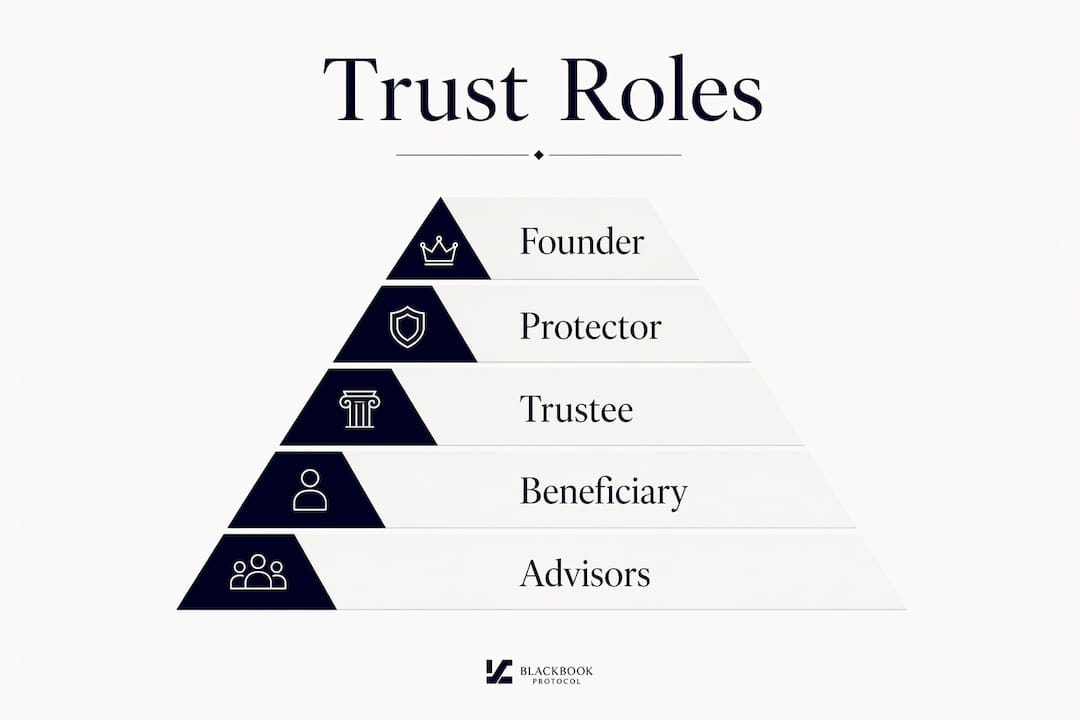
Key roles within a trust structure
Every trust involves three distinct roles, and understanding them is non-negotiable:
- Settlor. The founder who creates the trust and transfers assets into it.
- Trustee. The individual or institution with legal responsibility for managing trust assets according to the deed.
- Beneficiary. The person or persons who receive distributions from the trust.
- Protector. An optional but powerful fourth role that many founders overlook.
The Protector role deserves particular attention. Appointing a Protector allows founders to retain influence over the trust, including the power to veto distributions or replace trustees, without holding legal ownership. This is the compromise between control and legal safety that most founders need but few are told about. You can review a detailed breakdown of this approach in Blackbookprotocol’s guide on control retention for founders.
Pro Tip: Appoint a Protector who is neither a trustee nor a beneficiary. This preserves your influence over the trust without triggering legal liabilities or tax complications associated with direct ownership.
One of the most common and costly mistakes in trust planning is poor asset titling. A trust that holds no assets because the founder forgot to re-title property, bank accounts, or business interests into the trust’s name is legally sound but practically useless. Prenuptial agreements for adult children add a further layer of protection, since courts increasingly consider trust assets in divorce settlements.
| Legal tool | Primary function | Key limitation |
|---|---|---|
| Will | Directs asset distribution after death | Public, subject to probate, no lifetime protection |
| Irrevocable trust | Removes assets from taxable estate | Cannot be easily amended once established |
| Prenuptial agreement | Protects trust assets from divorce claims | Requires early, proactive discussion with heirs |
| Protector appointment | Retains founder influence without ownership | Must be carefully defined in the trust deed |
How do founders integrate financial planning and tax strategies?
Legal structures create the container. Financial planning determines what goes inside and how it grows. For founders, wealth preservation methods must account for tax efficiency, investment horizon, and philanthropic goals simultaneously.
The 2026 annual gift tax exclusion allows individuals to gift $19,000 per recipient each year, or $38,000 per couple, without reducing the lifetime exemption. This means a founder with three adult children can transfer $57,000 annually, completely outside the estate, without triggering any reporting obligation. Over a decade, that is $570,000 removed from a taxable estate through a simple, repeatable process.
The coordinated financial planning approach that works for founders follows a clear sequence:
- Map the taxable estate. Identify all assets, including business interests, property, and investment accounts, and calculate the current estate tax exposure against the 2026 thresholds.
- Maximise annual gifting. Use the $19,000 per recipient exclusion systematically each year to reduce the estate gradually without touching the lifetime exemption.
- Structure the investment portfolio for generational horizons. Multi-generational portfolios integrate growth, income, risk control, and philanthropy over long time horizons, not the three to five year cycles most fund managers optimise for. This distinction changes asset allocation materially.
- Incorporate charitable giving. Donor-advised funds and family foundations reduce taxable estates while creating a shared family purpose around philanthropy. This is both a tax strategy and a governance tool.
- Coordinate advisors. Tax, investment, and estate planning advisors who operate in silos produce plans that conflict. A founder whose tax adviser recommends one structure while the estate lawyer recommends another is paying for confusion. Appoint one lead adviser to coordinate the others.
The investment portfolio succession checklist from Blackbookprotocol provides a structured framework for aligning these five steps with your specific exit timeline and family circumstances.
What role does family governance play in sustaining generational wealth?
Family governance is the system of rules, processes, and structures that determine how a family makes decisions about shared wealth. Without it, even the most technically sound trust arrangement will fail. The evidence is direct: failures in generational wealth preservation stem from inadequate heir preparation, not from poor legal or investment arrangements.
A family governance framework typically includes:
- A family mission statement. A written articulation of the family’s values, wealth purpose, and long-term goals. This is not a motivational poster. It is a decision-making reference that trustees and heirs consult when conflicts arise.
- A family council. A formal body that meets regularly to discuss wealth-related decisions, hear concerns from heirs, and maintain alignment across generations. Separating this council from day-to-day financial management prevents relational disputes from contaminating governance decisions.
- A Family Constitution. A written document detailing decision-making processes, distribution triggers, and voting rights. This document carries the same practical weight as the trust deed itself.
- Defined heir roles. Clarity about who manages, who advises, and who simply benefits from the trust. Ambiguity here is the single most common source of family conflict after a founder’s death.
Pro Tip: Establish the family council before you need it. Founders who introduce governance structures only after a liquidity event face resistance from heirs who feel the rules are being imposed on them. Build the framework while you are still the operating authority.
Establishing family governance structures, including councils and values statements, significantly increases the probability of wealth continuity across generations. The mechanism is straightforward: when heirs understand the rules and have participated in shaping them, compliance and stewardship follow naturally.
How do communication and heir education contribute to wealth preservation?
Proactive communication is the least glamorous and most neglected component of any founders wealth management strategy. Legacy planning for founders requires a written post-exit strategy that aligns wealth with values, family roles, and lifestyle goals, not just legal vehicles. That alignment cannot happen without direct, early conversations with the people who will inherit.
The practical steps for building communication into your wealth preservation plan include:
- Introduce financial literacy concepts to children and heirs early, well before any inheritance discussion becomes relevant. Familiarity with compound interest, tax obligations, and investment risk is the baseline.
- Use a letter of wishes to communicate your intentions to trustees. This document is not legally binding, but it guides trustees on distribution priorities, values, and circumstances the trust deed cannot anticipate. Side letters of wishes help trustees align distributions with founder values in ways that a formal legal document cannot capture.
- Have direct conversations about inheritance expectations, responsibilities, and the risks of sudden wealth. Founders who avoid these conversations because they feel uncomfortable create far larger problems for their heirs.
- Encourage adult children to enter prenuptial agreements before marriage. Prenuptial agreements supplement trusts to protect family wealth during divorce proceedings, and courts are increasingly willing to consider trust assets in settlements.
- Revisit all communication documents and governance frameworks every three to five years, or after any major life event such as a business exit, marriage, or death in the family.
The founder legacy planning checklist from Blackbookprotocol covers each of these communication steps in sequence, with specific prompts for founders at different stages of exit planning.
Key takeaways
Founders protect generational wealth through an integrated system of irrevocable trusts, disciplined annual gifting, structured family governance, and proactive heir education, not through any single legal or financial instrument alone.
| Point | Details |
|---|---|
| Irrevocable trusts are non-negotiable | They remove assets from the taxable estate and protect against the 40% federal estate tax above 2026 thresholds. |
| Annual gifting compounds over time | Gifting $19,000 per recipient annually removes significant wealth from the estate without touching the lifetime exemption. |
| Governance prevents the 70% failure rate | Family councils, mission statements, and a Family Constitution address the governance gaps that cause most wealth transfers to fail. |
| Heir education is a structural requirement | Financial literacy and direct inheritance conversations prepare heirs to manage wealth rather than deplete it. |
| Advisors must be coordinated | Tax, estate, and investment advisers operating independently produce conflicting plans; one lead adviser must align all three. |
Why most founders get this wrong before they get it right
The founders I observe who lose the most ground after an exit are not the ones with bad lawyers or weak portfolios. They are the ones who treated wealth protection as a legal project rather than a governance project. They signed the trust documents, appointed the trustees, and then assumed the work was done.
The uncomfortable reality is that the legal structure is the easy part. Any competent solicitor can draft an irrevocable trust. What they cannot do for you is build the relational infrastructure that makes the trust work across three generations. That requires you to have difficult conversations with your children about money, values, and expectations. It requires you to sit in a room with your heirs and agree on a Family Constitution before anyone has died or sold anything.
I have also observed that founders consistently underestimate the divorce risk. A trust that took years to structure correctly can be partially unwound in a single contested divorce proceeding if the heir’s spouse has a good barrister and the prenuptial agreement was never discussed. The asset protection blueprint approach treats prenuptial agreements as a standard component of the wealth plan, not an optional add-on.
Start earlier than you think you need to. Revisit the plan every three years. And treat the governance work with the same seriousness you gave to building the business.
— Blackbook
Secure your legacy with the Blackbook Protocol
The frameworks covered in this article, from UK Trust Law structures and 95/5 equity splits to tax-efficient gifting and family governance blueprints, are documented in full within the Blackbook Protocol.

The Blackbook Protocol hardback provides a complete, step-by-step blueprint for founders who want to move from knowing the theory to implementing the structures. The audio and eBook edition includes practical templates you can take directly to your legal and financial advisers. Both editions are built specifically for founders and entrepreneurs who need a governance framework that works alongside their existing professional team, not instead of it.
FAQ
What is the most effective legal structure for protecting generational wealth?
An irrevocable trust is the primary legal vehicle for founders with significant estates. It removes assets from the taxable estate, provides protection against the 40% federal estate tax above the 2026 thresholds of $15 million per individual, and allows a Protector to retain influence without legal ownership liability.
How much can founders gift annually without affecting their lifetime exemption?
The 2026 annual gift tax exclusion is $19,000 per recipient for individuals, or $38,000 per couple. Gifts within this limit do not reduce the lifetime exemption and are a standard method for gradually reducing a taxable estate.
Why do most wealthy families fail to preserve wealth beyond the second generation?
Nearly 70% of wealthy families lose their wealth by the second generation due to governance failures and poor communication, not investment underperformance. The absence of family councils, clear distribution rules, and heir education are the primary causes.
What is a letter of wishes and why does it matter?
A letter of wishes is a non-binding document that communicates a founder’s intentions to trustees regarding distribution priorities and family values. It guides trustee decisions in circumstances the formal trust deed cannot anticipate, making it a practical complement to the legal structure.
Do prenuptial agreements really protect trust assets?
Prenuptial agreements supplement trust protections by establishing clear boundaries around family wealth before a marriage begins. Courts increasingly consider trust assets in divorce settlements, making prenuptial agreements for adult children a necessary component of any complete wealth preservation plan.
0 comentarios