

TL;DR:
- Securing founder shares before funding involves issuing equity at formation with enforceable vesting schedules and legal agreements. Mistakes such as issuing shares after a priced round or delaying IP assignment can lead to tax liabilities and governance issues, which are avoidable with early legal planning. Proper structuring ensures ownership stability, predictable dilution, and a stronger position for future investment rounds.
Securing founder shares before funding means issuing equity at or near company formation, with enforced vesting schedules and legal agreements in place to protect ownership and align co-founder commitment. The standard instruments for this process include restricted stock purchase agreements, founders’ agreements, and intellectual property assignment documents. Get these structures wrong, or leave them until after your first priced round, and you face taxable income events, governance disputes, and investor scepticism. This guide covers every step you need to take before external capital arrives.
What legal steps secure founder ownership before funding?
Founder shares are issued at company formation at a near-zero valuation. This timing is not arbitrary. Issuing shares after a priced round at near-zero value triggers immediate taxable compensation income equal to the spread between that low price and the company’s current fair market value. The financial exposure can be severe.
The core legal documents you need in place are:
- Restricted stock purchase agreement (RSPA): This is the primary instrument for issuing founder shares. It grants shares outright but subjects them to a company repurchase right over unvested portions. If a founder departs early, the company buys back unvested shares at the original low price.
- Intellectual property assignment agreement: IP must be assigned before or at incorporation. Failing to do this concurrently with share issuance complicates adding vesting retroactively and significantly raises legal costs.
- Founders’ agreement: This is the early-stage governance document that covers decision-making, roles, and equity splits before a formal shareholders’ agreement is needed.
- Shareholders’ agreement: Once the company has multiple founders and potentially early investors, this document formalises rights, obligations, and exit provisions.
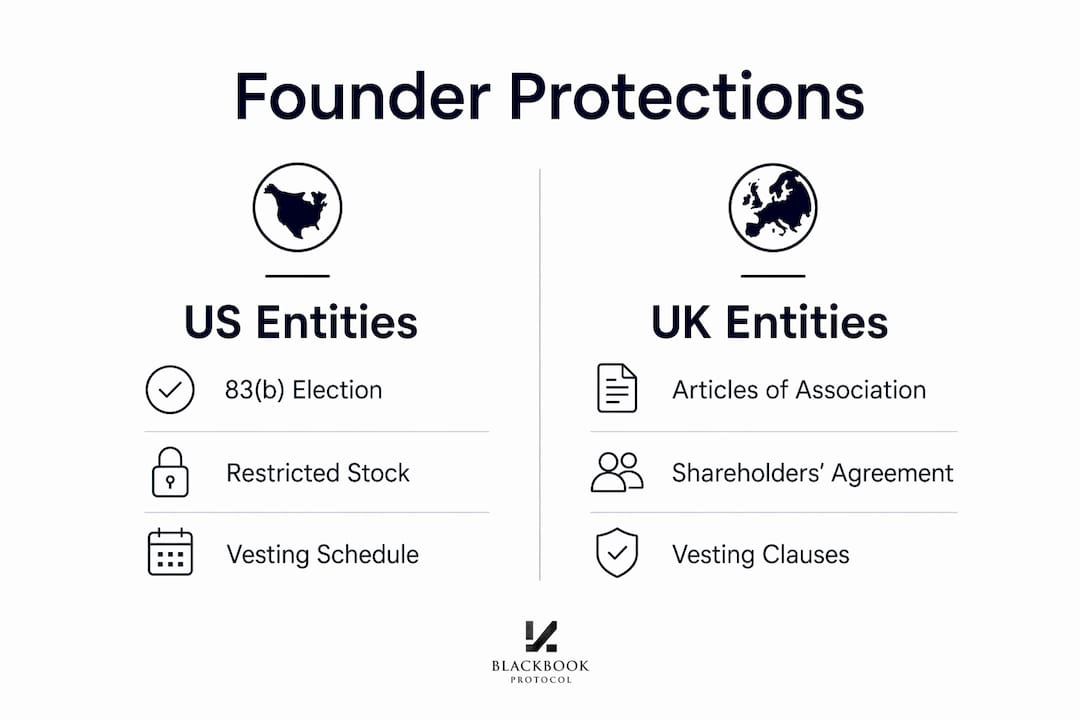
For US-incorporated entities, the 83(b) election is a critical tax filing. The 83(b) election must be filed within 30 days of restricted stock issuance to fix your tax basis at the current low value and avoid higher income tax liability on future vesting events. Filing requires sending a copy to the IRS, delivering another to the corporation, and retaining the mailing certificate as proof. No extensions apply.
Pro Tip: Engage a startup solicitor before you incorporate, not after. The cost of setting up these documents correctly from day one is a fraction of the cost of fixing them retroactively once investors are involved.

For UK-incorporated companies, the equivalent protections come through the articles of association, a shareholders’ agreement with drag-along and tag-along provisions, and an Enterprise Management Incentive scheme for later employee equity. The founder legacy planning checklist from Blackbookprotocol covers the UK-specific legal structure in detail.
How do founder vesting schedules work before funding?
Founder vesting is the mechanism by which a founder earns full ownership of their shares over time, rather than holding them outright from day one. It is one of the most misunderstood concepts in early-stage company formation.
The standard structure works as follows:
- Shares are issued in full at formation. The founder legally owns all their shares from the start. This is different from stock options, which are granted and exercised later.
- A repurchase right is attached. The company holds the right to buy back unvested shares at the original issue price if the founder leaves before the vesting period ends.
- A four-year schedule with a one-year cliff applies. Four-year vesting with a one-year cliff is the industry standard. No shares vest in the first twelve months. After the cliff, 25% vest immediately. The remaining 75% vest monthly over the following three years.
- The repurchase right lapses as shares vest. Once a tranche vests, the company loses its right to repurchase those shares. The founder owns them free and clear.
- Acceleration provisions can be negotiated. Single-trigger acceleration vests shares upon a change of control. Double-trigger acceleration requires both a change of control and termination without cause.
Investors expect vesting to be in place before they commit capital. A founder holding 40% of a company with no vesting is a governance risk. If that founder leaves six months after a Series A, they walk away with a 40% stake and no obligation to the business. No serious institutional investor will accept that structure.
Pro Tip: Set your vesting start date to your company formation date, not the date you sign the RSPA. This gives you credit for time already invested and avoids a situation where you are effectively unvested on day one of your first investor conversation.
Founder vesting also protects the remaining founders. If one co-founder exits early, the unvested shares return to the company rather than sitting with a disengaged party. This keeps the cap table clean and preserves the equity pool for future hires or investors.
What funding instruments affect your cap table before a priced round?
Pre-seed and seed fundraising in 2026 is dominated by a single instrument: the Simple Agreement for Future Equity, or SAFE. Understanding how SAFEs interact with your founder shares is non-negotiable before you raise a single pound or dollar.
| Feature | Post-Money SAFE | Pre-Money SAFE |
|---|---|---|
| Dilution calculation | Fixed on post-money cap table | Calculated on pre-money valuation |
| Founder dilution predictability | High. You know your ownership percentage immediately | Lower. Multiple SAFEs stack unpredictably |
| Investor preference | Standard since Y Combinator updated templates | Less common in new raises |
| Cap table complexity | Lower | Higher with multiple instruments |
| Conversion trigger | Next priced round, liquidity event, or dissolution | Same |
Post-money SAFEs are the predominant instrument for pre-seed and seed fundraising, with typical raises ranging from £400,000 to £2.5 million using Y Combinator standard templates. The post-money structure means each SAFE investor knows their ownership percentage at the time of signing. That predictability is the reason the format has become standard.
The critical implication for founders is dilution modelling. SAFEs allow founders to raise capital quickly while postponing share pricing, but you must model the dilution carefully to maintain your ownership objectives. Stack four or five SAFEs without modelling the conversion impact and you may arrive at your Series A with a smaller stake than you anticipated.
SAFE agreements convert into preferred stock at the next priced round, locking in investor ownership on a post-money basis. This conversion event is when your founder share percentage is formally recalculated. If your vesting schedule is not already in place, this is also the moment when retroactive share issuance becomes a tax problem.
Using standard legal templates like Y Combinator’s SAFEs reduces costs and delays compared to bespoke agreements. For most early-stage founders, the standard template is the right starting point.
What mistakes should founders avoid when protecting equity?
The most costly errors in pre-funding equity structuring are not complex. They are predictable, and they are avoidable.
- Issuing shares after a priced round. This is the single most expensive mistake. Founder shares issued at near-zero value after a priced financing round trigger taxable compensation income equal to the valuation gap. The tax bill can be substantial.
- Confusing founder shares with stock options. Founder shares must be issued outright at formation for clarity and tax efficiency. Stock options are employee incentives granted later. Using options as a substitute for founder equity creates formal and tax complications that are difficult to unwind.
- Delaying IP assignment. Intellectual property created before formal assignment belongs to the individual, not the company. Investors conducting due diligence will identify this gap immediately. Fixing it after the fact is expensive and sometimes impossible.
- Missing the 83(b) deadline. The 30-day window for filing the 83(b) election is absolute. Missing it exposes founders to income tax on the full value of shares as they vest, not just at the original issue price.
- Skipping vesting agreements between co-founders. Without vesting, a departing co-founder retains their full equity stake. This creates a governance dispute and a cap table problem that investors will flag during due diligence.
“Founder vesting isn’t just investor protection. It maintains team alignment and cap table integrity proactively.” — Borenius Tech Blog
Prudent founders seek legal counsel early to handle vesting, share issuance, and IP matters before they become costly retroactive fixes. The cost of a solicitor at formation is measurably lower than the cost of restructuring equity under investor scrutiny.
Key takeaways
Securing founder shares before funding requires issuing equity at formation, attaching vesting schedules via restricted stock purchase agreements, assigning IP concurrently, and modelling SAFE dilution before raising capital.
| Point | Details |
|---|---|
| Issue shares at formation | Founder shares issued after a priced round trigger taxable income. Act at incorporation. |
| Use restricted stock purchase agreements | RSPAs attach repurchase rights to unvested shares, protecting governance if a founder exits early. |
| Assign IP concurrently | IP assignment must happen at or before incorporation to avoid legal complications and investor red flags. |
| Implement four-year vesting with a one-year cliff | This is the investor-expected standard. Set the vesting start date to your formation date. |
| Model SAFE dilution before raising | Post-money SAFEs offer predictable dilution. Stack multiple instruments without modelling and your ownership stake shrinks unexpectedly. |
Why early structuring is the only sensible approach
The founders I see struggle most with funding rounds are not the ones who built inferior products. They are the ones who treated legal structuring as an administrative afterthought. By the time a Series A investor requests a clean cap table, the cost of fixing a poorly structured equity arrangement is not just financial. It delays the round, erodes investor confidence, and sometimes kills the deal entirely.
My view is direct: the window for getting this right is narrow. From the day you incorporate to the day you take your first external cheque, you have a brief period where share issuance is straightforward, valuations are low, and legal documents are inexpensive. That window closes fast. Once a priced round is on the table, every structural decision carries a tax or governance implication.
The 95/5 equity split model that Blackbookprotocol advocates is not just about protecting a majority stake. It is about building a structure that holds up under investor scrutiny, survives co-founder departures, and gives you the negotiating position you need at every subsequent round. Clean structures attract better terms. That is not opinion. It is what the data on cap table disputes and failed due diligence processes consistently shows.
Control retention strategies are most effective when implemented before any external party has a stake in the outcome. Once investors are involved, your options narrow. Act before funding, not after.
— Blackbook
Protect your founder shares with Blackbookprotocol
Knowing the steps is one thing. Having the correct documents and frameworks ready to implement is another.

Blackbookprotocol provides audio guides and legally vetted templates covering founder share issuance, vesting schedules, IP assignment, and corporate governance. These resources are built specifically for founders who want to move quickly without cutting legal corners. The templates cover the structures outlined in this guide, from restricted stock purchase agreements to SAFE dilution modelling frameworks. If you want a single resource that walks you through pre-funding equity protection from formation to first raise, the Blackbookprotocol protocol is the place to start.
FAQ
What is a restricted stock purchase agreement?
A restricted stock purchase agreement is the legal document used to issue founder shares subject to a company repurchase right over unvested portions. It is the standard instrument for enforcing founder vesting schedules.
When should founder shares be issued?
Founder shares must be issued at or shortly after company formation, when the company’s fair market value is near zero. Issuing shares after a priced funding round creates a taxable income event equal to the valuation gap.
What is the standard founder vesting schedule?
The standard is a four-year vesting schedule with a one-year cliff. No shares vest in the first twelve months, then 25% vest at the cliff, with the remainder vesting monthly over three years.
How do safes affect founder share ownership?
SAFEs delay share pricing but convert into preferred stock at the next priced round. Post-money SAFEs give founders predictable dilution figures. Founders must model the conversion impact before stacking multiple SAFE instruments.
What happens if you miss the 83(b) election deadline?
Missing the 30-day 83(b) filing deadline means you pay income tax on the full value of shares as they vest over time, rather than at the original low issue price. No extensions are granted, and the financial exposure can be significant.
0 Kommentare