

TL;DR:
- A letter of wishes is a non-legally binding document that guides trustees on discretionary estate decisions outside the will’s scope. Its effectiveness depends on clear, specific language, regular updates, and careful storage, ensuring it complements but does not override the will. Proper drafting and communication minimize disputes, making it a vital estate planning tool in the UK.
A letter of wishes is a non-legally binding document that guides your executors and trustees on personal preferences and estate decisions that fall outside the formal scope of your will. Unlike a will, it carries no legal force, yet it shapes how discretionary decisions are made after your death. For anyone engaged in UK estate planning, following letter of wishes best practices is the difference between a document that genuinely helps and one that causes confusion or conflict. This guide covers what to include, how to write it, where to store it, and the mistakes that undermine even well-intentioned letters.
What are the letter of wishes best practices UK planners should follow?
A letter of wishes is defined as a non-binding guidance document that requires no witnesses, solicitors, or special legal formalities to be valid in the UK. That simplicity is both its strength and its risk. Because there are no formal requirements, the quality of the document depends entirely on how carefully you draft it.

The primary function of a letter of wishes is to provide context for decisions rather than control them. Executors and trustees are legally bound to follow your will. The letter guides their discretion on matters the will cannot or does not address, such as who receives a particular piece of jewellery, how a discretionary trust should be managed, or what your funeral preferences are. A letter that is vague, contradictory, or written in mandatory language creates uncertainty rather than clarity.
The most effective letters are specific, plainly written, and reviewed regularly. They name individuals, describe items precisely, and explain the reasoning behind decisions. A letter that simply states “I hope my children will share my personal belongings fairly” gives executors almost nothing to work with. A letter that lists specific items and names specific recipients is genuinely useful.
What content should a letter of wishes include?
A well-drafted letter covers the full range of personal and discretionary matters that a will cannot address in detail. The following categories represent the core content areas:
- Personal possessions. Identify specific items of sentimental or financial value and name the intended recipient for each. This prevents disputes over items not formally bequeathed in the will.
- Funeral and burial preferences. State whether you prefer burial or cremation, any religious or cultural requirements, and preferences for the service itself. This is one of the most commonly used sections.
- Trust guidance. If you have set up a discretionary trust, explain how you intend the trustees to exercise their discretion. Name beneficiaries you would prioritise and describe circumstances where distributions should be made.
- Explanations for unusual decisions. If you have excluded someone who might expect to inherit, or divided your estate unequally, explain your reasoning. A clear explanation can help defend against claims under the Inheritance (Provision for Family and Dependants) Act 1975.
- Personal messages. Many people use the letter to leave words for loved ones, including explanations, apologies, or expressions of affection that feel out of place in a legal document.
- Digital assets. List online accounts, cryptocurrency holdings, and subscription services, along with guidance on how you wish them to be handled. Do not include passwords in the letter itself; reference a separate secure document instead.
Pro Tip: Keep the tone of your letter consistent throughout. Mixing warm personal messages with clinical instructions can confuse executors about which sections carry more weight.
A letter of wishes can include personal messages, funeral preferences, trust guidance, and an inventory of digital assets, filling gaps a will cannot address. That breadth makes it one of the most flexible tools in UK estate planning.
How to write a letter of wishes: step-by-step
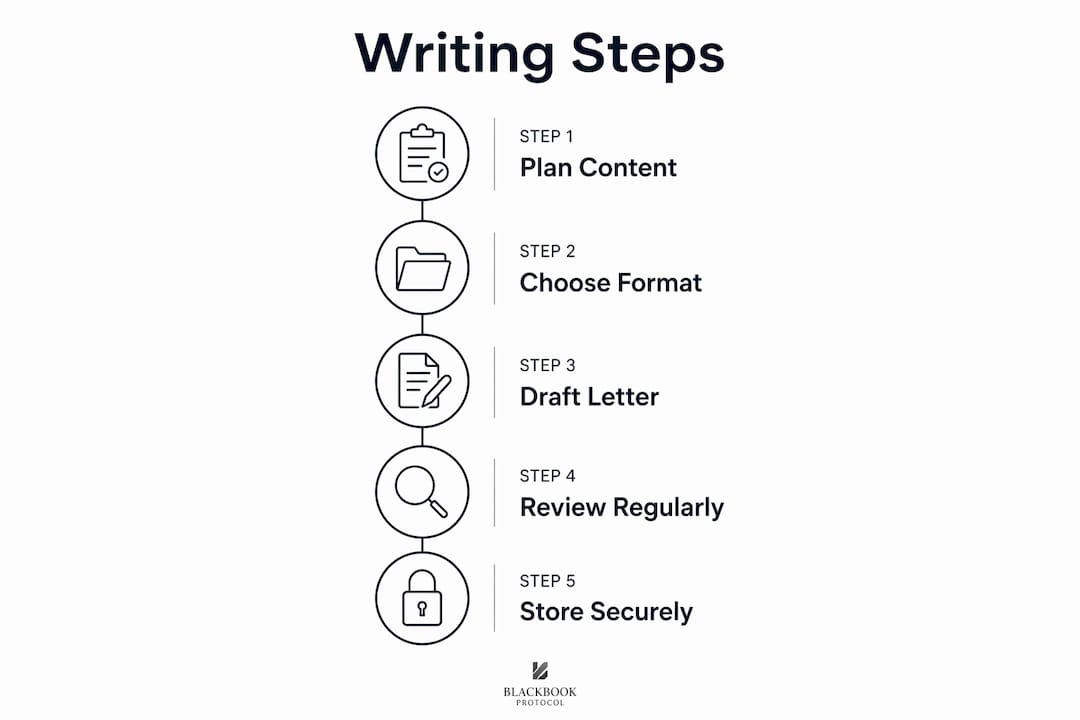
Writing an effective letter requires attention to language, structure, and presentation. Follow these steps to produce a document that executors and trustees can use with confidence.
- Use precatory language throughout. Phrases such as “I hope,” “I request,” and “I would like” signal that the letter is guidance, not instruction. Precatory language such as “I hope” or “I request” must replace mandatory phrases like “I direct” or “must” to preserve the document’s non-binding nature. Using mandatory language can confuse trustees and complicate legal interpretation.
- Include a date, your full name, and the names of your executors and trustees. This identifies the document clearly and connects it to your estate plan.
- Sign the letter. No witnesses are required, but your signature confirms authenticity and intent.
- Organise the letter into clear sections. Use headings for each topic area. Executors dealing with an estate under pressure will not read a wall of text.
- Write in plain English. Avoid legal jargon. The letter is a personal document, not a legal instrument.
- Keep it confidential but accessible. Store it securely, but make sure your executors know it exists and where to find it.
- Set a review schedule. Review your letter at least annually or after major life events such as marriage, divorce, or the birth of a child.
The table below summarises the practical options for creating your letter, including cost and format considerations.
| Method | Cost | Suitable for |
|---|---|---|
| Self-written letter | Free | Simple estates with clear wishes |
| Digital template | Approximately £15 | Those wanting structured guidance |
| Solicitor-assisted | Variable | Complex estates or trust arrangements |
Digital templates for structuring a letter of wishes are available in the UK market for approximately £15, while self-written letters cost nothing. The choice depends on the complexity of your estate and your confidence in drafting clearly.
Pro Tip: If you have a discretionary trust, consider asking your solicitor to review the trust guidance section of your letter. Trustees have legal duties, and your guidance should complement rather than conflict with the trust deed.
For a deeper understanding of how a letter of wishes fits within your broader estate documents, Blackbookprotocol’s guide on letters of wishes documents provides a clear structural overview.
Where and how should you store your letter of wishes?
Storage is one of the most overlooked aspects of this document. A letter that cannot be found, or is found too late, provides no benefit at all.
- Store the letter with your original will, but keep it physically separate. Stapling it to the will creates a risk that amendments to the letter could be interpreted as amendments to the will itself.
- Inform your executors about the letter’s existence and its location before you die. Communicating the existence of a letter of wishes to executors during your lifetime reduces the chances of estate disputes and confusion.
- Consider sharing the content with your executors while you are alive. This allows them to ask clarifying questions and reduces the risk of misinterpretation after your death.
- Do not store the letter in a location only you can access, such as a safe with a combination known only to you.
- Keep a note of the letter’s location alongside your will, in a document your executors can access immediately after your death.
Confidentiality is a legitimate concern, particularly if the letter contains sensitive explanations or personal messages. You are not obliged to share the contents with beneficiaries. However, storing the letter with the will but separately, and informing executors beforehand, reduces the risk of misunderstandings and aids administration. The balance between confidentiality and accessibility is one of the more nuanced judgements in estate planning.
Review triggers matter as much as review frequency. Marriage, divorce, the death of a named executor, significant changes to your assets, and the birth of grandchildren all warrant an immediate review. Blackbookprotocol’s resource on trust planning reviews sets out the key triggers and recommended timelines in detail.
Common mistakes in letters of wishes: what to avoid
The following errors appear repeatedly in letters of wishes that cause problems during estate administration. Each one is avoidable with careful drafting.
- Using mandatory language. Phrases like “I direct,” “must,” or “shall” can confuse trustees and complicate interpretation. Consistent use of precatory language is the single most important stylistic rule for maintaining the letter’s non-binding nature.
- Contradicting the will. The letter cannot override the will. If the two documents conflict, the will takes legal precedence. Contradictions create confusion and potential disputes.
- Failing to update after life events. A letter written before a divorce that still references an ex-spouse as a preferred beneficiary of a discretionary trust creates serious problems. Letters must be reviewed at least every 12 months or after any significant life change.
- Not telling executors the letter exists. A letter discovered weeks after probate has been granted, or never found at all, is worthless. Common mistakes include failing to communicate with executors, which causes confusion and disputes.
- Including inflammatory language. Explanations for excluding a family member are useful. Detailed criticisms of that person are not. Courts and executors may be required to read the letter, and hostile language can damage family relationships and complicate administration.
- Treating the letter as a substitute for legal documents. A letter of wishes cannot replace a will, a trust deed, or a lasting power of attorney. It supplements them.
“A letter of wishes does not override a will. Executors must follow wills legally but generally respect clear letters of wishes for discretionary decisions.” This distinction is the foundation of every effective letter.
Key takeaways
A letter of wishes is most effective when it uses precatory language, names specific individuals and assets, explains the reasoning behind decisions, and is reviewed regularly alongside the will.
| Point | Details |
|---|---|
| Use precatory language | Phrases like “I hope” and “I request” preserve the non-binding nature of the letter. |
| Cover all discretionary areas | Include trust guidance, personal possessions, funeral preferences, and digital assets. |
| Store and communicate clearly | Keep the letter with but separate from the will, and inform executors of its location. |
| Review after life events | Marriage, divorce, and births all require an immediate review of the letter’s contents. |
| Explain unusual decisions | Reasoning behind exclusions or unequal distributions reduces the risk of legal challenges. |
Why letters of wishes matter more than most people realise
From working through estate planning structures, the pattern is consistent. The letters of wishes that cause problems are almost never the ones that are too detailed. They are the ones that are too vague, too old, or never communicated to the people who need them.
The most common scenario is a letter written at the same time as a will, filed away, and never reviewed. Ten years later, the estate looks completely different. New grandchildren exist. Assets have changed. An executor named in the letter has died. The letter still refers to a family home that was sold years ago. At that point, the document does not guide anyone. It creates questions.
The second pattern is the letter that uses the wrong tone. Someone writes “I direct my trustees to distribute income to my daughter annually.” That sounds clear. It also sounds legally binding, which it is not, and it conflicts with the trustee’s discretionary powers under the trust deed. A solicitor then has to unpick whether the letter was intended to override the trust, which it cannot, or simply guide it, which it can.
The practical advice is straightforward. Write the letter at the same time as the will. Review it every year. Tell your executors it exists and where it is. Use “I hope” and “I request” throughout. Keep the explanations factual and calm. That combination produces a document that genuinely helps the people responsible for carrying out your wishes.
Protect your estate plan with Blackbookprotocol
Blackbookprotocol provides structured resources for UK individuals who want their estate planning documents to work together precisely. The Blackbook Protocol hardback includes expert blueprints covering UK trust law, asset protection frameworks, and document governance, giving you the tools to draft a letter of wishes that complements your will and trust arrangements correctly. For those who prefer a digital format, the ebook and templates bundle includes ready-to-use templates designed for UK estate planning. If your estate involves discretionary trusts, property structures, or complex asset arrangements, these resources provide the clarity that generic advice cannot.
FAQ
What is a letter of wishes in UK law?
A letter of wishes is a non-legally binding document that guides executors and trustees on personal preferences and discretionary decisions not covered by the will. It requires no witnesses or legal formalities to be valid in the UK.
Does a letter of wishes override a will?
No. A will takes legal precedence in all cases. Executors are legally bound to follow the will, but they are generally expected to respect a clear and current letter of wishes for discretionary matters.
How often should I update my letter of wishes?
Review your letter at least annually or immediately after major life events such as marriage, divorce, the birth of a child, or significant changes to your assets or executors.
Can I write a letter of wishes without a solicitor?
Yes. A letter of wishes requires no legal formalities and can be self-written at no cost. Digital templates are available for approximately £15 if you want a structured format to work from.
What language should I use in a letter of wishes?
Use precatory language throughout, including phrases such as “I hope,” “I request,” and “I would like.” Avoid mandatory phrases such as “I direct” or “must,” which can confuse trustees and undermine the document’s non-binding nature.
0 Kommentare