

TL;DR:
- Proper management and formal documentation of director loan accounts are essential to safeguarding personal assets from tax liabilities and insolvency risks. Establishing layered legal structures and insurance proactively during good financial health enhances protection against future claims. Timely repayment, accurate record-keeping, and strategic structuring prevent loans from becoming enforceable debts during insolvency or legal audits.
Director loan account asset protection is the practice of safeguarding your personal wealth from legal and tax liabilities that arise when money moves between you and your limited company. A Director’s Loan Account (DLA) records every transaction outside of salary, dividends, and expenses. When that balance turns overdrawn, you face a chain of consequences: a 33.75% s.455 Corporation Tax charge if the loan remains unpaid nine months and one day after the company’s year-end, benefit-in-kind exposure on loans exceeding £10,000, and in the worst case, personal liability enforced by a liquidator. The protection methods that work combine formal loan governance, dividend planning, and layered legal structures built before any liability arises.
What triggers director loan account risks?
The DLA becomes dangerous the moment it goes overdrawn without a repayment plan. Three specific triggers account for most director liability.
The s.455 tax charge is the most common penalty. If your overdrawn DLA exceeds nine months and one day past the company’s accounting year-end without repayment, HMRC levies a 33.75% Corporation Tax charge on the outstanding balance. That charge is refundable once you repay the loan, but the cash flow damage is immediate and significant.
Benefit-in-kind liability applies when a loan exceeds £10,000 at any point during the tax year and no interest is charged at HMRC’s official rate. The company must report the loan on a P11D form, and both the director and the company face additional tax and National Insurance costs. Keeping individual loan balances below £10,000 removes this obligation entirely.
HMRC’s anti-avoidance rules close the most obvious escape route. Repaying and reborrowing within 30 days of the year-end, known as bed and breakfasting, is disregarded by HMRC for s.455 purposes. The repayment is treated as if it never happened. Directors who rely on this tactic discover the charge still applies.
Writing off a loan creates a separate problem. HMRC treats the written-off amount as employment income, triggering income tax and National Insurance on the full sum. The company also loses the s.455 refund it would otherwise receive on repayment.
- Overdrawn balance past the nine-month deadline triggers s.455 at 33.75%
- Loans over £10,000 without interest at HMRC’s official rate generate benefit-in-kind charges
- Bed-and-breakfasting repayments within 30 days are disregarded by HMRC
- Written-off loans are reclassified as employment income, attracting income tax and National Insurance
How to manage director loans proactively
Proactive director loan management is the first line of defence against personal liability. Formal documentation and regular reconciliation are not optional extras. They are the foundation of every protection strategy that follows.
-
Monitor the DLA monthly. Review the balance at the end of every month, not just at year-end. Catching an overdrawn position early gives you time to act before the nine-month clock becomes a problem.
-
Use dividends to offset overdrawn balances. A properly declared dividend, backed by a board resolution and confirmed distributable reserves, can clear an overdrawn DLA without a cash repayment. The dividend must be legal. Paying a dividend when the company has insufficient reserves creates an unlawful distribution, which carries its own liability.
-
Document every transaction with board minutes. Board resolutions and formal loan agreements establish the legitimacy of every drawing and repayment. During an HMRC audit or insolvency investigation, undocumented drawings are treated as unauthorised loans. Formal minutes protect you.
-
Avoid informal drawings. Taking cash or paying personal expenses through the company account without recording them immediately creates reconstruction risk. Liquidators and HMRC both treat unrecorded drawings as loans, regardless of your intent.
-
Repay before the nine-month deadline. If you cannot repay in full, make a partial repayment to reduce the s.455 charge. Even reducing the overdrawn balance before the deadline lowers the tax cost.
Pro Tip: Structure any new borrowing so the balance stays below £10,000 at all times during the tax year. This removes the benefit-in-kind obligation entirely and simplifies your year-end position.
Directors frequently treat DLAs as a personal bank, not realising that informal borrowing exposes their personal finances to corporate risk and legal enforcement. Treating the DLA as a dynamic cash management tool, with monthly reconciliations and clear documentation, is the single most effective habit you can build.

What happens to director loans in insolvency?
Insolvency transforms a DLA from a tax inconvenience into a personal debt. An overdrawn DLA becomes a debt owed to the company the moment a liquidator is appointed. The liquidator has a statutory duty to recover that balance for creditors.
“Liquidators have statutory power and a duty to recover all overdrawn director loans as company assets in insolvency, often reclassifying informal drawings into enforceable debts, raising serious director risks.” — Antony Batty & Company
The personal exposure does not stop at repayment demands. Failure to repay can lead to lawsuits and additional claims including wrongful trading and misfeasance. Misfeasance covers situations where a director has misapplied company assets, and an undocumented overdrawn DLA is a straightforward example.
Poor record-keeping makes the position worse. Liquidators reconstruct the DLA when records are incomplete, treating every unrecorded drawing as a loan. The reconstructed balance is often higher than the director expected. That higher figure becomes the enforceable debt.
Unlawful dividends compound the problem. If dividends were paid when the company lacked sufficient distributable reserves, a liquidator can reverse them. The amounts paid out are reclassified as loans, adding to the overdrawn balance. Directors who relied on informal dividend declarations to manage their DLA find themselves facing a much larger personal liability than they anticipated.
What are the best layered asset protection strategies?
Managing the DLA correctly prevents most problems. Layered asset protection strategies address the risks that governance alone cannot eliminate. The core principle is that structures must be in place before liabilities arise. Post-claim transfers are routinely reversed by courts as fraudulent conveyances.
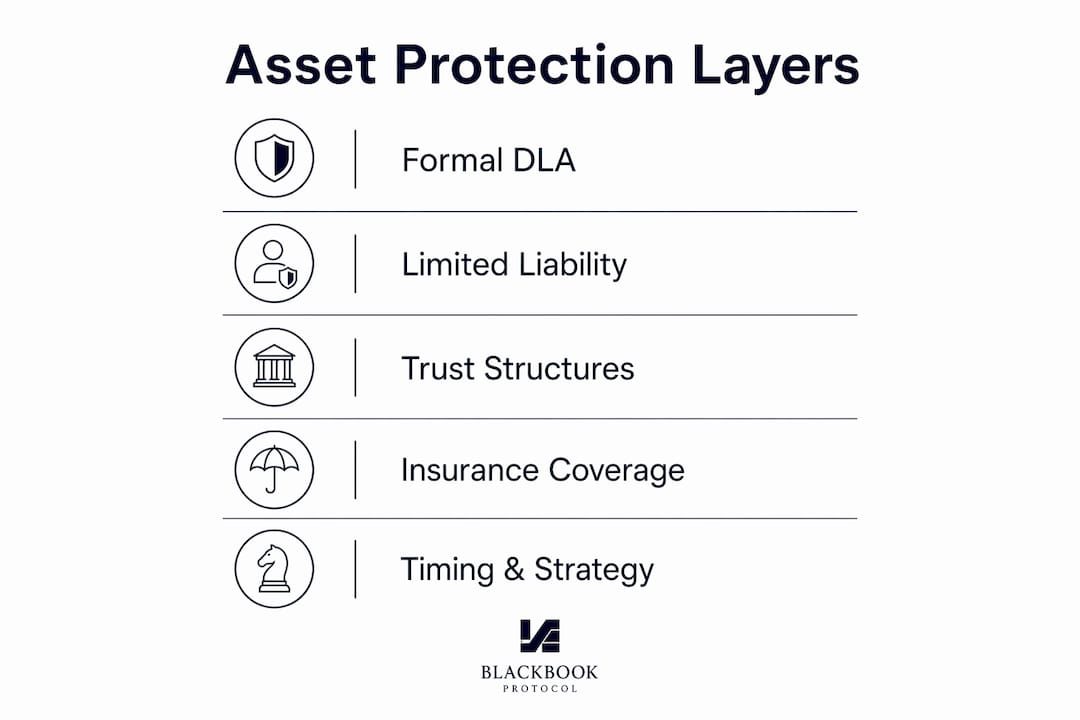
Limited liability companies provide a structural separation between personal and business assets. A well-maintained corporate structure limits creditor reach to company assets, provided the director has not personally guaranteed debts or breached their duties.
Trusts offer a deeper layer of protection. A purpose trust or a Domestic Asset Protection Trust (DAPT) can hold personal assets outside the reach of future creditors, provided the trust is established during a period of solvency. Offshore trusts provide additional separation but require careful compliance with UK tax reporting obligations. Share trust agreements can also form part of a layered structure, separating beneficial ownership from legal title.
Liability and umbrella insurance act as the first line of defence. Directors and Officers (D&O) insurance covers legal costs and claims arising from decisions made in your capacity as a director. It does not replace structural protection, but it absorbs the initial cost of any claim before it reaches your personal assets.
Pro Tip: Establish your protection structures during a period of financial health. Layered asset protection using entities, trusts, and insurance is most effective when built proactively. Waiting until a creditor claim is in progress makes most structures ineffective.
| Protection Method | Effectiveness | Complexity | Cost |
|---|---|---|---|
| Formal DLA documentation | High for tax and audit defence | Low | Minimal |
| Limited liability company structure | High for business liability separation | Medium | Low to medium |
| Domestic Asset Protection Trust | High for personal asset shielding | High | Medium to high |
| Directors and Officers insurance | Medium as first-line defence | Low | Annual premium |
| Offshore trust | High with full compliance | Very high | High |
A well-timed protection strategy combines multiple structures rather than relying on a single method. Each layer addresses a different category of risk, and together they create a position that is significantly harder for creditors to penetrate.
Key takeaways
Effective director loan account asset protection requires formal governance, timely repayment, and layered legal structures established before any liability arises.
| Point | Details |
|---|---|
| s.455 charge deadline | Repay overdrawn DLAs within nine months and one day of year-end to avoid the 33.75% Corporation Tax charge. |
| Document every transaction | Board minutes and formal loan agreements protect you during HMRC audits and insolvency investigations. |
| Insolvency changes everything | An overdrawn DLA becomes an enforceable personal debt the moment a liquidator is appointed. |
| Build structures early | Trusts, corporate structures, and insurance must be in place before creditor claims arise to be legally effective. |
| Dividends require reserves | Only use dividends to offset DLA balances when the company has confirmed distributable reserves and a board resolution. |
The governance gap most directors never close
Most directors I work with understand that an overdrawn DLA is a problem. Very few understand how quickly it becomes a personal one. The gap is not knowledge of the rules. It is the assumption that the rules apply to other people.
The DLA is not a flexible overdraft facility. It is a formal record of a legal relationship between you and your company. Treating it casually, taking drawings without recording them, skipping board minutes, relying on a year-end tidy-up, creates exactly the conditions that liquidators and HMRC are trained to exploit.
The directors who face the worst outcomes are not the ones who borrowed the most. They are the ones who borrowed informally, documented nothing, and assumed their accountant would sort it at year-end. By the time insolvency arrives, the reconstructed DLA bears no resemblance to what they thought they owed.
The protection framework that works is not complicated. Monthly monitoring, formal documentation, a clear repayment plan, and a layered structure built during solvency. The trust planning review and compliance work that directors defer for years costs a fraction of what a liquidator will recover from an unprotected personal estate.
Start the governance work now. The structures that protect you are only available before the problem arrives.
— Blackbook
Protect your assets with the blackbook protocol
The strategies in this article form the foundation of a protection plan. Implementing them correctly requires precise documentation, the right legal structures, and a clear understanding of UK trust law and corporate governance.

Blackbookprotocol has developed a complete resource for directors and business owners who want to move from awareness to action. The asset protection toolkit includes audio guides, a detailed eBook, and ready-to-use templates covering DLA governance, trust structures, and layered protection planning. For directors who prefer a physical reference, the Blackbook Protocol hardback covers asset protection and corporate governance in full. Both formats are built for directors who need practical tools, not theory.
FAQ
What is a director loan account?
A Director’s Loan Account is a record of all money a director borrows from or lends to their company outside of salary, dividends, and approved expenses. When the balance is overdrawn, the director owes money to the company.
When does the s.455 tax charge apply?
The s.455 charge of 33.75% applies when a director’s loan account remains overdrawn nine months and one day after the company’s accounting year-end. The charge is refundable once the loan is fully repaid.
Can a dividend clear an overdrawn director loan account?
Yes, a properly declared dividend backed by a board resolution and confirmed distributable reserves can offset an overdrawn DLA. The dividend must be lawful. Paying a dividend without sufficient reserves creates an unlawful distribution and additional liability.
What happens to an overdrawn DLA if the company goes into liquidation?
The overdrawn balance becomes an enforceable personal debt owed to the company. The liquidator has a statutory duty to pursue full repayment and can bring misfeasance or wrongful trading claims if the circumstances warrant it.
When should directors set up asset protection structures?
Asset protection structures, including trusts and corporate entities, must be established during a period of solvency before any creditor claims arise. Post-claim transfers are routinely reversed by courts as fraudulent conveyances.
0 Kommentare