

TL;DR:
- UK law mandates companies to identify and report individuals who ultimately control or own them, with strict deadlines and penalties for non-compliance. Beneficial owners are defined by shareholding, voting rights, influence, or control over trustees or companies, regardless of stake size, requiring detailed reporting and ongoing updates. Failure to comply poses criminal sanctions, fines, and restrictions, making beneficial ownership disclosure a vital governance responsibility.
Beneficial ownership disclosure is a mandatory legal obligation requiring UK companies and overseas entities to identify and report the individuals who ultimately own or control them. The framework operates primarily through two mechanisms: the Persons with Significant Control (PSC) regime, which applies to UK-incorporated companies, and the Register of Overseas Entities (ROE), which governs foreign entities owning UK land. Companies House administers both. Compliance is not optional. Failure to meet beneficial ownership disclosure requirements UK law imposes carries criminal sanctions, fines, and restrictions on property transactions.
What are the beneficial ownership disclosure requirements UK law sets out?
The PSC regime defines a beneficial owner as any individual who meets at least one of five statutory conditions. An individual qualifies as a PSC if they hold more than 25% of shares or voting rights, can appoint or remove a majority of directors, or exercise significant influence or control over the company. That threshold matters because it draws a clear legal line between passive investors and those with genuine control.
The five conditions in full are:
- Holding more than 25% of shares in the company
- Holding more than 25% of voting rights
- Holding the right to appoint or remove a majority of the board of directors
- Exercising significant influence or control over the company
- Exercising significant influence or control over a trust or firm that itself meets one of the first four conditions
The fourth and fifth conditions are the most frequently misunderstood. Significant influence or control does not require a shareholding at all. A person who controls board decisions through a shareholders’ agreement, or who holds veto rights over key corporate actions, may qualify as a PSC even with a 1% stake.
Pro Tip: Review all shareholder agreements, side letters, and governance documents when assessing PSC status. Formal share registers alone will not reveal shadow control arrangements.

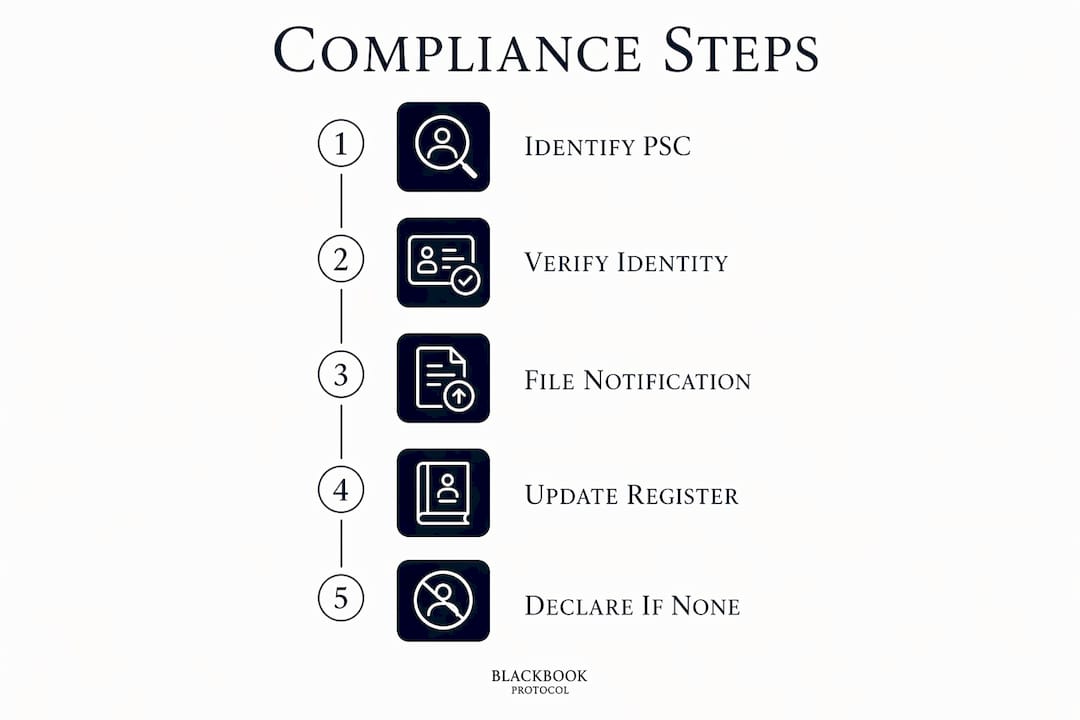
If no individual PSC can be identified, companies must file a declaration explaining why, rather than leaving the register blank. This prevents companies from simply claiming no beneficial owner exists without justification.
What information must companies disclose about their beneficial owners?
Once a PSC is identified, the company must collect and record a defined set of personal details. The disclosure obligations UK law specifies are precise and non-negotiable.
Required information for each PSC includes:
- Full legal name
- Date of birth (month and year are publicly visible; the day is protected)
- Nationality
- Country of usual residence
- Service address (publicly visible)
- Residential address (kept private on the register)
- Date the person became a PSC
- Nature of control, including the specific condition or conditions met
- Shareholding percentage band (for example, 25–50%, 50–75%, or 75–100%)
The distinction between public and private data matters for compliance officers. Residential addresses are protected from public disclosure but must still be collected and held accurately. Providing a service address as a residential address is a common error that can invalidate a filing.
For overseas entities owning UK land, the ROE requires broadly similar information. However, overseas entities must also disclose managing officers even where no individual PSC exists, or face restrictions on property transactions. This is a critical difference from the standard PSC regime.
How to fulfil beneficial ownership disclosure requirements: step-by-step compliance
Compliance with UK corporate ownership disclosure follows a clear sequence. Each step has a statutory basis and a defined deadline.
-
Review your share register and governance documents. Identify all shareholders holding more than 25% of shares or voting rights. Then review all shareholder agreements, articles of association, and board resolutions for evidence of significant influence or control beyond share percentage.
-
Send formal PSC notices. Companies must send written notices to individuals they believe may be PSCs, requesting confirmation of their status and personal details. Recipients have a legal duty to respond accurately.
-
Collect and verify PSC details. Gather all required personal information. Cross-reference identity documents against the details provided. PSC identity verification requirements introduced under recent reforms now require PSCs to verify themselves directly to Companies House, strengthening the integrity of ownership data.
-
Maintain your internal PSC register. Every company must keep an internal PSC register at its registered office or with its agent. This register is legally distinct from the Companies House filing and must be kept up to date independently.
-
File with Companies House. Companies must report PSC information to Companies House within 14 days of confirming it. Any subsequent changes must also be reported within 14 days of the company becoming aware of them. That 14-day window is strict.
-
Submit your annual confirmation statement. UK companies must confirm their PSC information annually via a confirmation statement. Overseas entities on the ROE must submit annual updates confirming accuracy of their beneficial ownership information. Failure to do so results in Land Registry restrictions and potential criminal penalties.
| Obligation | Deadline | Filing body |
|---|---|---|
| Initial PSC notification | Within 14 days of confirmation | Companies House |
| Change of PSC details | Within 14 days of awareness | Companies House |
| Annual confirmation statement | Once per year | Companies House |
| ROE annual update | Once per year | Companies House |
| Internal register update | Immediately on change | Company records |
Pro Tip: Set calendar reminders for the 14-day filing window the moment any ownership or control change is identified. Waiting until the next board meeting is a common cause of late filings.
What are the most common compliance risks in beneficial ownership reporting UK?
Most compliance failures in this area share a common root: treating beneficial ownership as a one-time administrative task rather than an ongoing obligation. The risks are specific and avoidable.
-
Underestimating significant influence. Relying on share percentage alone is a common compliance error. Governance reviews must assess veto rights, board appointment influence, and voting agreements. A person with a 10% stake and a veto over all major decisions almost certainly qualifies as a PSC.
-
Failing to update registers promptly. The 14-day deadline for reporting changes is frequently missed. A director who acquires additional shares, or a shareholder who gains new veto rights through a revised agreement, triggers an immediate update obligation.
-
Neglecting the internal PSC register. Companies often fail to maintain accurate internal PSC registers alongside their public filings. Discrepancies between the internal register and the Companies House record attract regulatory scrutiny.
-
Confusing PSC with Ultimate Beneficial Owner (UBO). The PSC regime focuses on individuals meeting specific statutory conditions. The UBO concept, used in anti-money laundering contexts, may capture a broader or different set of individuals. Compliance officers must understand which framework applies in each context.
-
Overlooking overseas entity obligations. Foreign entities owning UK land face annual update duties under the ROE. Many assume a one-time registration suffices. It does not.
Failure to comply with beneficial ownership disclosure is a criminal offence. Sanctions include fines, imprisonment, and corporate restrictions on the company’s ability to operate. Directors and PSCs themselves can face personal liability. The UK transparency regime aims to deter financial crime by removing anonymity from corporate ownership. Compliance officers should view these disclosures as risk mitigation, not administrative burden.
Key takeaways
UK beneficial ownership disclosure requires companies to identify, verify, and report PSCs to Companies House within 14 days, maintain accurate internal registers, and submit annual confirmations, with criminal penalties for non-compliance.
| Point | Details |
|---|---|
| PSC threshold | Any individual holding over 25% of shares, voting rights, or exercising significant control qualifies. |
| 14-day filing rule | Report all PSC confirmations and changes to Companies House within 14 days of awareness. |
| Internal register | Maintain a separate internal PSC register; it is a legal requirement distinct from public filings. |
| Overseas entities | ROE registrants must submit annual updates and disclose managing officers even without a PSC. |
| Criminal penalties | Non-compliance is a criminal offence carrying fines, imprisonment, and property transaction restrictions. |
Compliance is a governance function, not a filing exercise
The most persistent mistake I see in beneficial ownership compliance is treating the PSC register as a box to tick at incorporation and then forget. The legal obligation is continuous. Ownership structures change. Shareholders enter new agreements. Directors gain influence through informal arrangements that never appear in the articles of association.
The assessment of significant influence or control demands documented governance reviews, including veto rights and board appointment influence. This frequently triggers PSC registration even when a shareholding sits below 25%. That is the part most compliance officers miss until a regulator asks.
The ROE has added a further layer of complexity for businesses with overseas structures holding UK property. The regulatory landscape for overseas entities is tightening, with retrospective and ongoing maintenance expectations that many businesses have not yet built into their annual compliance calendars.
My practical advice is to integrate beneficial ownership reviews into your annual governance cycle, not just your confirmation statement process. Treat it the same way you treat board minutes and statutory accounts. A wealth advisory compliance checklist is a useful starting point for building that structure. The companies that get this right are the ones that treat transparency as a governance function, not a filing exercise.
— Blackbook
Blackbookprotocol resources for UK ownership compliance
Beneficial ownership compliance requires more than knowing the rules. It requires the right tools to apply them consistently across your corporate structure.

Blackbookprotocol provides practical resources built for UK business owners and compliance officers managing these obligations. The asset protection audio, eBook, and templates include structured guidance on PSC register maintenance, governance documentation, and corporate transparency obligations. For those who prefer a comprehensive reference, the Blackbookprotocol hardback covers UK trust law, asset protection, and corporate governance in depth. These are not generic compliance tools. They are built around the specific legal frameworks UK companies face in 2026.
FAQ
What is a Person with Significant Control (PSC)?
A PSC is any individual who holds more than 25% of shares or voting rights in a UK company, can appoint or remove a majority of directors, or exercises significant influence or control. Companies must identify and register all PSCs with Companies House.
How quickly must PSC changes be reported to Companies House?
Companies must report any confirmed PSC information or changes within 14 days of becoming aware of them. Missing this deadline is a criminal offence under UK company law.
Does the PSC regime apply to overseas entities owning UK land?
Overseas entities owning UK land must register on the Register of Overseas Entities and submit annual updates. They must also disclose managing officers even where no individual PSC exists, or face Land Registry restrictions.
What happens if a company has no identifiable PSC?
If no individual meets the PSC conditions, the company must file a formal declaration explaining why, rather than leaving the register blank. An empty register without justification is not a valid filing.
Can someone with less than 25% shareholding be a PSC?
Yes. A person who exercises significant influence or control through veto rights, board appointment powers, or voting agreements qualifies as a PSC regardless of their shareholding percentage. Governance documents must be reviewed, not just the share register.
0 Kommentare