

TL;DR:
- Legacy planning ensures founders secure their business and family interests through proper asset transfer and governance strategies. It prevents operational paralysis, minimizes inheritance tax consequences, and fosters clear family communication and decision-making frameworks. Early, coordinated planning reduces delays, legal conflicts, and costly probate expenses, safeguarding long-term business continuity.
Legacy planning is the process founders use to secure the future of their business and family by defining how assets, control, and responsibilities transfer after their death or incapacitation. Without it, courts decide who leads your company, HMRC collects penalties on delayed tax payments, and heirs inherit conflict alongside wealth. Understanding why founders need legacy planning is not a theoretical exercise. It is a practical requirement, particularly under the UK’s 2026 inheritance tax framework, where nil-rate bands remain fixed until 2031 and probate delays carry real financial consequences. A founder legacy planning checklist is a practical starting point for any entrepreneur who has not yet formalised their arrangements.
Why founders need legacy planning for business continuity
The most immediate risk of no legacy plan is operational paralysis. Without succession provisions, courts decide leadership after a founder’s death or incapacity, and no authorised person can act for weeks or months. That means payroll may stall, contracts cannot be signed, and vendor relationships go unmanaged.

The legal tools that prevent this are specific and well established. A buy-sell agreement defines who can acquire a founder’s shares and at what price, removing ambiguity at the worst possible moment. A lasting power of attorney grants a named individual authority to act on business matters if the founder becomes incapacitated. Succession provisions within shareholder agreements clarify leadership transitions before a crisis forces the question.
Here is how to structure business continuity protections in order of priority:
- Draft a lasting power of attorney covering both property and financial affairs, and register it with the Office of the Public Guardian before it is needed.
- Establish a buy-sell agreement with co-founders or shareholders, funded by life insurance to cover the purchase price.
- Embed succession provisions into your shareholder agreement, naming interim leadership and decision-making authority.
- Review governance documents annually as the business grows, because a provision written at Series A may be unworkable at Series C.
Probate processes freeze business-linked assets, so structuring assets to pass outside probate where possible reduces delays significantly. Trusts, jointly held assets, and nominated beneficiaries on pension and life policies all achieve this. The goal is to distinguish probate-affected assets from those that transfer immediately, so the business keeps moving while the estate is administered.
Pro Tip: Review your shareholder agreement and lasting power of attorney together, not separately. Gaps between the two documents are where operational authority falls through.
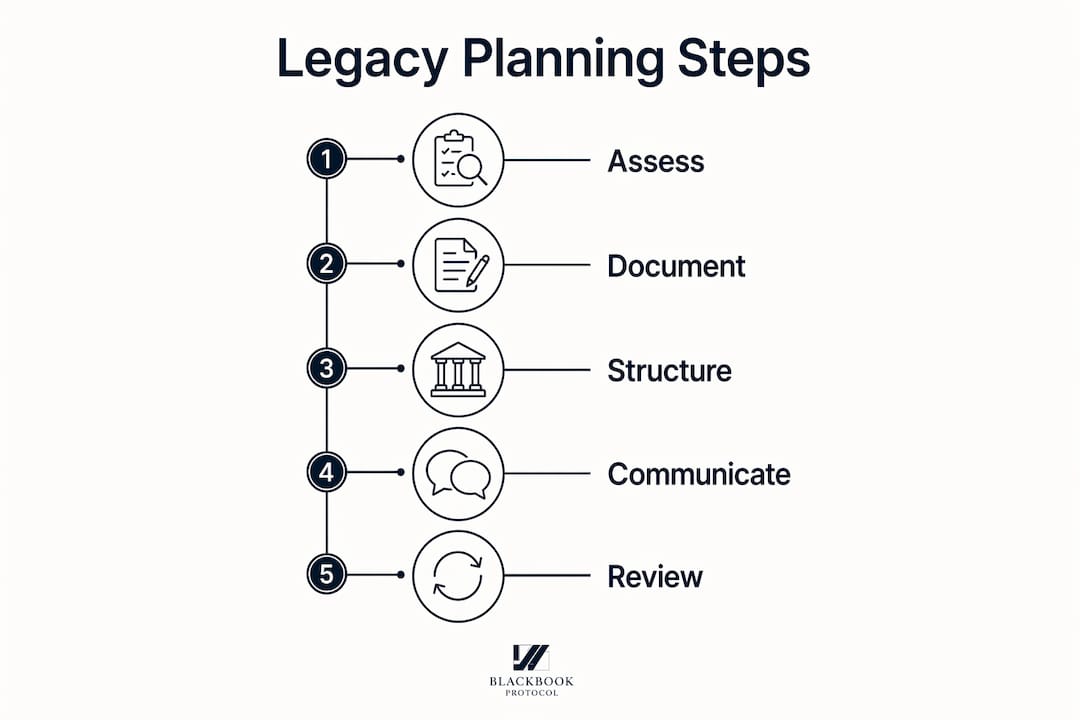
What are the key tax considerations for founders in 2026?
The UK inheritance tax framework in 2026 is fixed and unforgiving for founders who delay planning. The standard nil-rate band is £325,000 and the residence nil-rate band is £175,000, both frozen until 2031. The taper on the residence nil-rate band begins at estates valued above £2 million, which catches many founders whose business equity pushes them above that threshold.
| Threshold | Amount | Notes |
|---|---|---|
| Standard Nil-Rate Band | £325,000 | Fixed until 2031 |
| Residence Nil-Rate Band | £175,000 | Fixed until 2031; tapers above £2m |
| Combined maximum | £500,000 | Per individual, subject to conditions |
| Inheritance tax rate | 40% | Applied to value above thresholds |
| Probate delay interest | 7.75% | Applied to unpaid inheritance tax |
The interest rate on delayed inheritance tax payments is 7.75%. On a £250,000 tax bill, a one-year delay adds nearly £20,000 in interest charges alone. That figure makes the cost of procrastination concrete rather than abstract.
Trust-based planning remains a legitimate tool for founders, but recent HMRC trust reforms require precise timing and compliance to access reliefs and avoid periodic charges. A discretionary trust established without proper advice can trigger unexpected tax events. Founders using trusts should work with advisers who understand both the corporate governance implications and the personal tax position. For more detail on structuring, the trust planning review published by Blackbookprotocol covers UK-specific structures in depth.
Pro Tip: Do not treat Business Property Relief as guaranteed. HMRC scrutinises whether a business is genuinely trading versus holding investments, and the distinction matters enormously at 40% tax.
How does legacy planning address governance and family communication?
Legacy planning addresses governance, communication, and transition frameworks, not just asset distribution. Standard estate planning answers the question of who gets what. Legacy planning answers the harder question of what happens next. For founders, that distinction is the difference between a business that survives and one that fractures under the weight of unresolved expectations.
Governance frameworks define who holds authority, who has an advisory role, and who has no formal role at all. These distinctions matter enormously when a founder’s children have different levels of involvement in the business. A family council, a formal board structure, or a shareholder committee can each provide a mechanism for decisions to be made without personal conflict derailing the process.
The education and early involvement of heirs increases the likelihood that wealth is stewarded responsibly. Founders who involve successors gradually, through board observer roles, mentoring, or structured financial education, reduce the risk of conflict and poor decisions after transition. This is not sentiment. It is risk management.
Key elements of a governance and communication framework include:
- A family governance charter that sets out how decisions are made, how disputes are resolved, and what values guide the enterprise.
- Defined roles for heirs before the transition occurs, so expectations are set and tested while the founder is still present.
- A letters of wishes document that sits alongside the will and communicates the founder’s intentions to trustees without creating legally binding obligations. Blackbookprotocol’s guide on what a letters of wishes document is explains how this tool works in practice.
- Regular family meetings structured around the business, not just personal matters, to build shared understanding of strategy and financial position.
Legacy planning’s primary benefit lies in reducing emotional and financial friction for heirs. Clear frameworks do not eliminate disagreement, but they give families a process for resolving it without litigation.
What are the common pitfalls founders face in legacy planning?
Most founders do not fail at legacy planning through ignorance. They fail through delay, incomplete documentation, and a failure to coordinate across multiple plans. Only 31% of people have a will, and among founders, the complexity of business interests makes the absence of planning far more costly than it is for individuals with straightforward estates.
The most frequent errors follow a recognisable pattern:
- Ignoring digital assets. Cryptocurrency holdings, online business accounts, domain names, and cloud-based intellectual property all require specific planning. Without access credentials and legal authority, these assets can be lost entirely. RIAA Barker Gillette identifies digital asset administration as a growing source of probate delays and increased costs.
- Misaligned partner or spouse plans. Uncoordinated estate plans between business partners can produce contradictory outcomes. A buy-sell agreement that requires a partner’s estate to sell shares back to the business is worthless if the partner’s will directs those shares elsewhere. LG Arza Law identifies this as one of the most common and costly planning failures.
- Outdated documents. A succession plan written before a second round of funding, a divorce, or a new co-founder is not a plan. It is a liability. Plans must be reviewed after every material change to the business or family structure.
- Insufficient liquidity. Buy-sell triggers and inheritance tax bills both require cash at short notice. Founders who hold most of their wealth in illiquid business equity must plan specifically for liquidity, typically through life insurance or a sinking fund.
Timely coordination of legal, financial, and tax instruments is what separates a plan that works from a collection of documents that conflict. Founders should work with advisers who operate across legal, tax, and financial disciplines simultaneously, not sequentially.
Pro Tip: Ask your solicitor and your accountant to review each other’s work. Gaps between legal documents and tax structures are where estates lose the most money.
Legacy planning works best when starting with people and responsibility before numbers and deal structures. Founders who begin by clarifying roles and responsibilities unlock better outcomes than those who begin with tax calculations.
Key takeaways
Founders who plan their legacy protect both their business and their family from the costs of uncertainty, probate delays, and governance failure.
| Point | Details |
|---|---|
| Business continuity requires legal authority | Without a lasting power of attorney and succession provisions, no one can act for weeks after a founder’s death. |
| UK tax thresholds are frozen until 2031 | The £325,000 nil-rate band and £175,000 residence nil-rate band are fixed, making early planning more valuable. |
| Probate delays are expensive | Interest on unpaid inheritance tax runs at 7.75%, adding nearly £20,000 on a £250,000 bill after one year. |
| Governance matters as much as asset transfer | Defining roles, authority, and decision-making frameworks prevents conflict and protects business value. |
| Coordination across plans is non-negotiable | Misaligned wills, buy-sell agreements, and trust structures produce contradictory outcomes that courts must resolve. |
The founders who wait longest pay the most
Working with founders over many years, I have seen the same pattern repeat. The founder who built something genuinely valuable, who thought carefully about product, team, and capital, gave almost no thought to what happens when they are no longer present. Not because they did not care. Because the business always felt more urgent.
The cost of that delay is not abstract. It shows up as a six-month probate process during which a co-founder cannot access the company bank account. It shows up as a family dispute over shares that a buy-sell agreement would have resolved in a week. It shows up as a £40,000 inheritance tax interest bill that proper timing would have eliminated.
Legacy planning is not about control after death. It is about responsibility today. The founder who plans is not being morbid. They are being precise about the thing they built and the people who depend on it.
My consistent advice is to start with governance and people before you touch the paperwork. Decide who leads, who advises, and who steps back. Then build the legal and tax structures around those decisions. The documents are only as good as the clarity behind them.
Blackbookprotocol’s approach to this is grounded in the same sequence: define the structure, then protect it. The founders who follow that order spend less time in advisers’ offices and more time building.
— Blackbook
Build your legacy plan with Blackbookprotocol
Blackbookprotocol has developed a structured set of resources specifically for founders who need to move from intention to implementation. The Blackbook Protocol hardback covers UK Trust Law, 95/5 equity splits, and tax-efficient asset protection in a format designed for founders managing complex estates.

For founders who prefer a portable format, the audio ebook and templates provide the same frameworks alongside practical documents you can adapt immediately. These resources cover the alignment of wills, trusts, shareholder agreements, and succession frameworks in one coordinated system. If you are a founder who has been putting this off, the protocol gives you the structure to act.
FAQ
What is legacy planning for founders?
Legacy planning for founders is the process of defining how business assets, control, and responsibilities transfer after death or incapacity. It goes beyond a standard will to include governance frameworks, succession provisions, and tax planning.
How does legacy planning differ from estate planning?
Estate planning focuses on distributing assets. Legacy planning addresses governance, family communication, and business continuity, answering who leads and how decisions are made, not just who inherits what.
What happens to a business without a succession plan?
Without clear succession provisions, courts decide leadership after a founder’s death or incapacity. This causes governance gaps where no authorised person can act for weeks or months, risking payroll, contracts, and vendor relationships.
What are the UK inheritance tax thresholds in 2026?
The standard nil-rate band is £325,000 and the residence nil-rate band is £175,000, both fixed until 2031. Estates above £2 million see the residence nil-rate band taper, and inheritance tax applies at 40% above the combined threshold.
When should a founder start legacy planning?
Founders should start legacy planning at the point of incorporating a business or taking on co-founders, not at retirement. Material changes to the business or family structure require an immediate plan review.
0 commenti