

TL;DR:
- A contract deemed null and void has no legal effect from the start and cannot be enforced or breached.
- Distinguishing between void and voidable contracts is crucial, as only the latter allows for rescission and damages.
Most people assume a signed contract is either valid or broken. The reality is more precise, and the gap between those two assumptions can cost you significantly. A contract null and void is not a broken contract. It is a contract that never legally existed. Understanding that distinction matters whether you are an individual disputing a personal agreement or a business facing a contractual challenge that could affect assets, obligations, or recovery rights. This guide covers what makes a contract legally void, how it differs from a voidable contract, what remedies are available, and the practical steps you can take to protect your position.
Table of Contents
- Key takeaways
- What a contract null and void actually means
- Factors making a contract void
- Void versus voidable contracts
- Legal implications and remedies
- How to declare a contract void and protect yourself
- My view on contract nullity in practice
- Protect your assets with the right knowledge
- FAQ
Key takeaways
| Point | Details |
|---|---|
| Void means never existed | A null and void contract has no legal effect from the outset, as though it was never formed. |
| Voidable is different | A voidable contract remains valid until one party chooses to rescind it through legal action. |
| Restitution is the primary remedy | You cannot sue for breach on a void contract; the focus shifts to recovering money or property exchanged. |
| Timing matters for recovery | Statutes of limitations apply to restitution claims, so delays can bar recovery entirely. |
| Illegal contracts carry extra risk | Courts may refuse to assist either party where the contract involves illegal activity. |
What a contract null and void actually means
The phrase “null and void” is used often but understood rarely. In legal terms, a void contract has no legal effect from the moment it is created. Neither party can enforce it, and neither can sue for breach. It is treated as if it never existed.
The Latin term for this is void ab initio, meaning void from the beginning. This is not a technicality. It has real consequences for what you can claim, how you can claim it, and whether a court will assist you at all.
A void contract offers no contractual obligations or rights for either party. This is fundamentally different from a contract that has ended or been terminated. Termination ends an existing contract. Nullity means no contract ever came into existence. Confusing these two concepts leads to serious legal errors, particularly when deciding which type of claim to pursue.
Here are the core characteristics of a null and void contract:
- It cannot be enforced by either party in court.
- No legal obligations arise from it, regardless of what was signed.
- It cannot be fixed, ratified, or made valid through continued performance.
- Any money or property exchanged must be returned through restitution, not damages.
- It is treated as a legal nullity from day one.
Pro Tip: If you are unsure whether a contract is void or simply unenforceable, the distinction matters significantly for your legal strategy. An unenforceable contract may still create some rights or obligations; a void contract does not.
Consider a straightforward example. A person with a diagnosed severe mental illness signs a contract to sell their home during a period of incapacity. That contract is void from the outset. No court will enforce the sale. The buyer cannot claim breach if the seller refuses to proceed, because there was never a valid agreement to breach.
Factors making a contract void
Knowing the common causes of void contracts helps you identify problems before they escalate. The defects that create nullity are not minor procedural issues. They go to the very heart of whether a valid agreement was ever formed.
Illegality
A contract whose purpose or subject matter is illegal is void from the start. This applies to agreements to commit crimes, contracts that violate statutory prohibitions, and arrangements that contravene public policy. A contract to supply unlicensed financial services, for instance, may be void under financial regulation legislation.
Missing essential elements
Every valid contract requires offer, acceptance, consideration, and a genuine meeting of minds. When any of these is absent, the contract fails at formation. The most common examples include:
- No consideration. One party promises something without receiving anything in return. A promise to make a gift, with no reciprocal obligation, is not a contract.
- No genuine agreement. The parties were not actually agreeing to the same terms. This is sometimes called a fundamental mistake, where each party understood the contract to mean something entirely different.
- Lack of legal capacity. Minors, individuals with severe mental incapacity, and in some contexts companies acting outside their constitutional powers cannot form valid contracts.
- Lack of authority. An agent who signs a contract without authority to do so may render the agreement void against the principal.
Fundamental mistake
A fundamental mistake goes beyond a simple misunderstanding. It occurs when the mistake is so significant that no real agreement was ever reached. If two parties contract for the sale of goods that, unknown to both, no longer exist, the contract is void. There is nothing to sell and nothing to buy.
It is worth distinguishing these void-creating defects from the factors that produce a voidable contract. Misrepresentation, duress, and undue influence typically render contracts voidable rather than void from the start. A contract signed under duress still exists legally until the aggrieved party takes steps to rescind it. That is a critical difference when planning your legal response.
Void versus voidable contracts
The confusion between void and voidable contracts is one of the most common and costly misunderstandings in contract law. They sound similar. The legal consequences are entirely different.
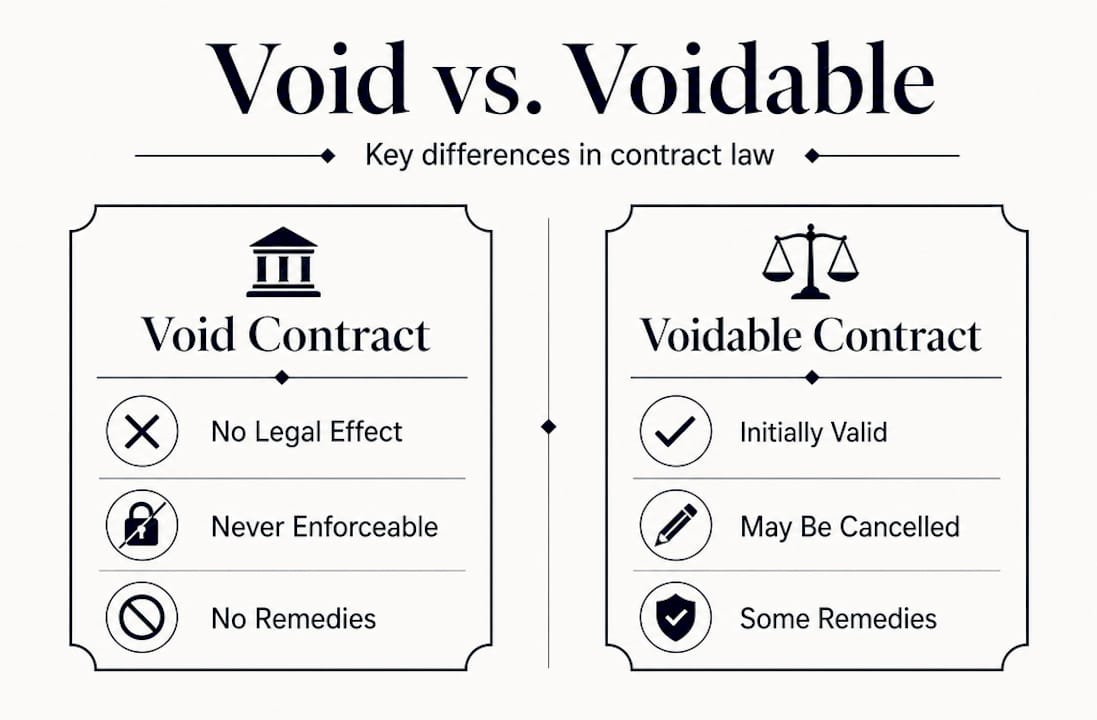
A void contract has no legal existence from the outset. A voidable contract is valid and enforceable until one party exercises their right to rescind it. The aggrieved party in a voidable contract has a choice. They can affirm the contract and continue with it, or they can rescind it and seek remedies. That choice does not exist with a void contract, because there is nothing to affirm.
The distinction between void and unenforceable contracts also affects the availability of remedies and the timing of legal action. Some contracts are valid but unenforceable due to procedural defects, such as failing to put a contract in writing when statute requires it. These are not void. They occupy a separate legal category with their own remedies and limitations.
The table below sets out the key differences clearly:
| Feature | Void contract | Voidable contract |
|---|---|---|
| Legal existence | None from the outset | Valid until rescinded |
| Enforceability | Cannot be enforced by either party | Enforceable unless rescinded |
| Can be ratified | No | Yes, by the innocent party |
| Primary remedy | Restitution | Rescission and/or damages |
| Typical causes | Illegality, fundamental mistake, incapacity | Misrepresentation, duress, undue influence |
| Effect of inaction | Remains void regardless | Contract may be affirmed by delay |
Pro Tip: If you have been induced into a contract by misrepresentation, act quickly. Delay can amount to affirmation of the contract, which eliminates your right to rescind it. With a void contract, time pressure is less acute, but it still applies to restitution claims.
The practical impact of this distinction is significant. If you are pursuing a voidable contract claim, you may be entitled to damages for losses suffered. If the contract is void, damages for breach are unavailable. Your claim must be framed differently, and the evidence you need to gather changes accordingly.
Legal implications and remedies
When a contract is declared null and void, the primary legal consequence is that breach of contract claims are unavailable. You cannot sue for losses arising from non-performance of a contract that never existed. This catches many individuals and businesses off guard, particularly those who have already paid money or transferred property under the void agreement.
The main remedy is restitution. Restitution operates on the principle of unjust enrichment. If one party has received money, goods, or a benefit under a void contract, they must return it. Courts will not enforce the contract terms, but they will order the return of what was exchanged.
Several important limitations apply:
- Illegal contracts carry additional risk. Courts may refuse to assist either party under the in pari delicto doctrine, which bars recovery where both parties are equally at fault in an illegal arrangement. If you knowingly entered an illegal contract, you may not recover what you paid.
- Evidence is critical. Payment records, invoices, and proof of property transfer are essential to a restitution claim. Without documentation, recovery becomes difficult regardless of the merits.
- Time limits apply. Statutes of limitations begin running when you discover the contract is void or when the defect arises. Delays can bar recovery entirely, even where the contract was void from inception.
Continuing to perform a contract you believe to be void is one of the most damaging mistakes a party can make. It does not validate the contract, but it can complicate your restitution claim and may be interpreted as an attempt to affirm the agreement.
The risk of acting as though a void contract is valid is real. Businesses that continue delivering services or making payments under a void arrangement often find their recovery position weakened when they eventually seek legal advice.
How to declare a contract void and protect yourself
Identifying and challenging a void contract requires a methodical approach. Here is a practical sequence to follow:
- Assess the contract carefully. Review the agreement for the factors making a contract void: illegality, missing essential elements, fundamental mistake, or lack of capacity. If any of these are present, the contract may be a legal contract invalid from the outset.
- Stop performance immediately. Do not continue delivering services, making payments, or transferring property under a contract you believe to be void. Continuing to perform does not cure the defect, but it does complicate your position.
- Preserve all evidence. Gather payment records, correspondence, invoices, and any documentation relating to the agreement. This evidence is the foundation of any restitution claim.
- Avoid making admissions. Do not write to the other party acknowledging the contract as valid. Keep communications factual and avoid language that could be read as affirming the agreement.
- Seek legal advice promptly. The distinction between void and voidable contracts, and the available remedies, depends on specific facts and applicable law. A solicitor can assess your position accurately and identify the correct legal strategy.
- Consider negotiation. In some cases, particularly where the other party is aware of the defect, a negotiated settlement is faster and less costly than litigation. Understanding why parties settle disputes rather than litigating can inform your approach to resolution.
- Act within time limits. Restitution claims are time-sensitive. Do not assume that because the contract was void from the start, you have unlimited time to pursue recovery.
Pro Tip: When reviewing an employment agreement or any contract for services, check that the contract type is appropriate and that all parties had the legal capacity and authority to sign. Many disputes over common employment contracts arise from defects that could have been identified before signing.
My view on contract nullity in practice
I have seen individuals and businesses lose significant money not because their legal position was weak, but because they misunderstood what kind of problem they were dealing with. The void versus voidable distinction is not academic. It determines whether you can claim damages or only restitution, whether time is running against you, and whether a court will help you at all.
The most common mistake I observe is people treating a void contract as though it were a terminated one. They write letters claiming breach. They calculate loss of profit. They spend months building the wrong case. When the legal reality is finally clarified, they have often lost time, money, and in some cases their right to recover entirely.
What I have found consistently is that early legal advice changes outcomes. Not because solicitors have magic solutions, but because framing the claim correctly from the start determines which evidence you gather, which arguments you make, and which court process you follow. A restitution claim built on strong documentary evidence from day one is far more effective than one assembled retrospectively.
Contracts are not just formalities. They are legal relationships with specific rules about formation, validity, and consequence. Treating them with that level of care, before signing and when disputes arise, is the most practical thing any individual or business can do.
— Blackbook
Protect your assets with the right knowledge
Understanding when a contract is null and void is one part of a broader picture of asset protection and financial governance. If you are dealing with contractual disputes, business structures, or questions about how to protect what you have built, the right framework makes all the difference.

Blackbookprotocol provides expert blueprints for UK Trust Law, corporate governance, and tax-efficient asset protection. The Blackbook Protocol guide covers the legal structures and strategies that individuals and businesses use to protect assets and manage risk, including the contractual and governance frameworks that prevent costly disputes from arising in the first place. For a detailed reference you can return to, the Blackbook Protocol Kindle eBook is available now. If you prefer a physical reference, the hardback edition covers the same ground in full.
FAQ
What does it mean for a contract to be null and void?
A null and void contract has no legal effect from the moment it is created. It is treated as though it never existed, meaning neither party can enforce it or sue for breach.
What is the difference between a void and a voidable contract?
A void contract has no legal existence from the outset. A voidable contract is valid and enforceable until the aggrieved party chooses to rescind it, typically due to misrepresentation, duress, or undue influence.
What remedies are available when a contract is declared void?
The primary remedy is restitution, which requires the return of money, goods, or benefits exchanged. Breach of contract damages are not available because no valid contract ever existed.
Can a void contract be made valid through continued performance?
No. A void contract cannot be ratified or cured by continued performance or agreement. It remains invalid from inception regardless of what either party does afterwards.
How long do you have to make a restitution claim on a void contract?
Statutes of limitations apply to restitution claims and begin running when you discover the contract is void. Delays can bar recovery entirely, so prompt legal advice is advisable.
Recommended
- Blackbook Protocol Hardback | Asset Protection & Corporate Governance – BLACKBOOK PROTOCOL
- BLACKBOOK PROTOCOL Kindle eBook | Asset Protection & Corporate Governance
- Blackbook Protocol | UK Trust Law & Asset Protection Guide 2026 – BLACKBOOK PROTOCOL
- Blackbook Protocol | UK Trust & Asset Protection Guide – BLACKBOOK PROTOCOL
0 commenti