

TL;DR:
- An employee benefit trust is a discretionary trust created by an employer to hold assets separately for employees, managed by independent trustees. It allows businesses to pre-fund benefits, hold shares, and maintain flexibility while protecting assets from company creditors. Proper trustee independence and legal compliance are essential to retain the trust’s tax advantages and operational effectiveness.
An employee benefit trust (EBT) is a discretionary trust established by an employer to hold assets separately for the benefit of its employees, managed by independent trustees under a formal trust deed. The trust assets form a separate fund, distinct from the employer’s operational funds, with trustees holding legal title and accountable for managing those assets according to the trust terms. EBTs typically hold company shares or cash, which trustees can allocate to employees under discretionary schemes rather than granting automatic entitlement. For UK business owners, understanding how an employee benefit trust works is the first step towards building a more tax-efficient and competitive compensation structure.
What is an employee benefit trust and how is it structured?
An employee benefit trust is a legal arrangement where a company transfers assets into a trust, placing them outside direct company ownership and under the control of appointed trustees. The trust operates as a separate legal entity, governed by a trust deed that sets out the rules for how assets are held, managed, and distributed. Trustees carry a duty to act in the interests of the beneficiaries, which are typically the employees and sometimes their dependants.

The key structural feature of an EBT is the separation of assets. Once transferred into the trust, those assets no longer belong to the company. This separation protects the assets from company creditors and creates a secure pool from which employee benefits can be funded over time.
EBTs are classified as discretionary trusts. This means trustees decide who receives benefits, when, and in what amount, within the boundaries set by the trust deed. Employees do not hold an automatic legal right to any specific portion of the trust fund. This discretionary status is central to how the trust achieves its tax and operational advantages.
How is an employee benefit trust established and operated?
Establishing an EBT follows a clear sequence of legal and administrative steps. Each stage must be completed correctly to ensure the trust is valid and operates within UK law.
- Draft the trust deed. The trust deed is the founding document. It defines the beneficiaries, the trustees’ powers, the rules for distributing benefits, and the duration of the trust. A solicitor should draft this document to reflect the company’s specific incentive objectives.
- Appoint trustees. The company appoints one or more trustees. These can be individuals, a corporate trustee, or a professional trustee company. Trustee independence from the employer is critical and must be built into the appointment process.
- Fund the trust initially. The trust is settled with an initial contribution, often a nominal sum such as £100, to establish its legal validity. This nominal funding confirms the trust exists as a legal entity before larger asset transfers follow.
- Transfer further assets. The company then contributes shares, cash, or other assets into the trust fund. These contributions fund the employee benefit schemes the trust is designed to support.
- Operate according to the trust deed. Trustees manage and distribute assets in line with the deed’s terms. They exercise independent judgement when allocating benefits, without simply following employer instructions.
Pro Tip: Use a professional trustee company rather than appointing internal directors as trustees. Professional trustees are better placed to demonstrate the independence that HMRC expects, and they reduce the risk of the trust being challenged on the grounds that trustees merely acted as the employer’s agents.
Trustees hold regular meetings, keep formal records of decisions, and document the reasoning behind benefit allocations. This paper trail is not optional. It is the evidence that demonstrates genuine independent operation of the trust.
What are the key benefits of employee benefit trusts for businesses?
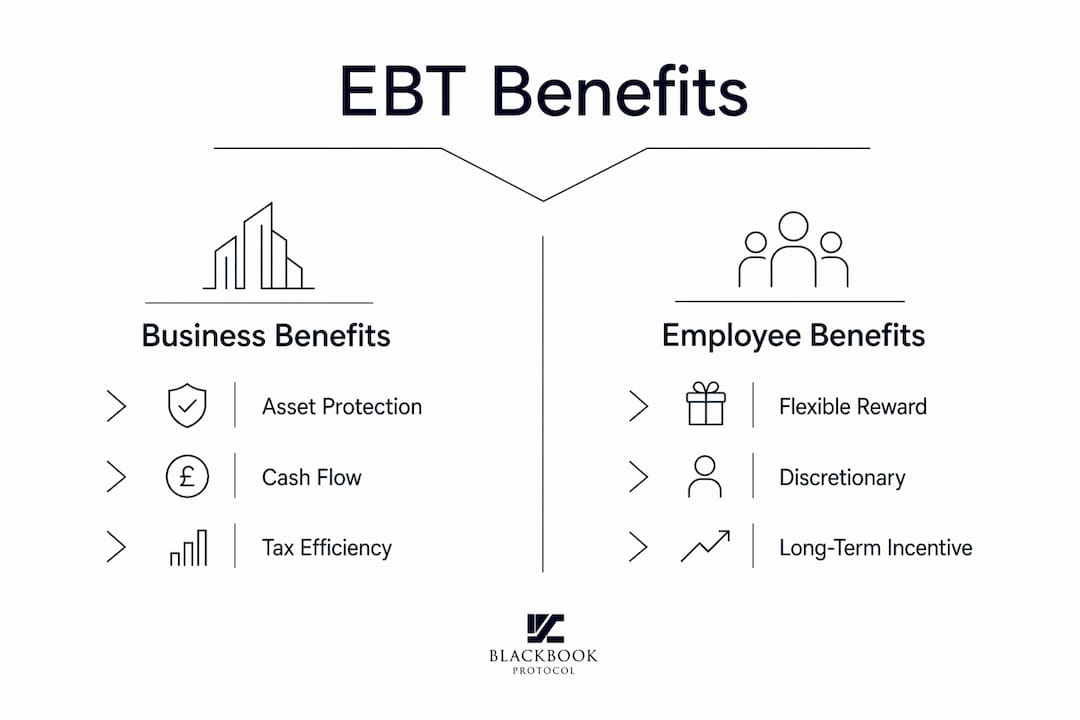
EBTs serve several practical purposes for UK businesses beyond simple tax planning. Understanding the full range of benefits helps business owners decide whether this structure fits their compensation strategy.
- Pre-funding employee benefits. EBTs help businesses pre-fund employee benefits and smooth company cash flow. Rather than paying out large sums at irregular intervals, the company contributes to the trust steadily, creating a managed liability.
- Share incentive schemes. EBTs are widely used to hold company shares for allocation to employees through approved or unapproved share schemes. The trust buys or receives shares and holds them until trustees decide to allocate them to specific employees.
- Discretionary reward flexibility. Because benefits are not automatic rights, the company retains flexibility in how and when employees receive rewards. This is particularly useful for performance-linked incentive schemes where outcomes are uncertain at the time of funding.
- Asset protection from company risk. Assets held in the trust are legally separate from the company. If the company faces financial difficulty, trust assets are not available to company creditors, providing a degree of security for the intended employee benefits.
- Profit-sharing arrangements. EBTs can act as a vehicle for profit-sharing, allowing the company to allocate a portion of profits into the trust and distribute them to employees at a later date according to scheme rules.
The separation of assets also has a practical cash flow benefit. A company can contribute to the trust in a profitable year and distribute benefits in a later year, smoothing the timing mismatch between earning profits and rewarding staff.
What legal and tax considerations must business owners know?
The tax treatment of EBTs is governed by UK legislation and HMRC guidance. Getting this wrong carries significant financial and legal consequences.
- Capital gains tax. Trust fund gains are subject to capital gains tax under UK law. Trustees must account for CGT when the trust disposes of assets, including when shares are transferred to employees.
- Employment income tax. When employees receive benefits from the trust, those benefits are taxable as employment income. National Insurance contributions also apply in most cases. The company, as employer, is typically responsible for operating PAYE on these payments.
- Trustee independence. Trustees must act independently and in accordance with the trust deed to preserve the legal and tax advantages of the EBT. HMRC scrutinises arrangements where trustees appear to act solely on employer instructions.
- Trust registration. EBTs must be registered with HMRC’s Trust Registration Service (TRS). Failure to register is a compliance breach and can attract penalties.
- Avoiding automatic entitlement. UK tax law requires EBT deeds to be structured so employees do not gain automatic legal entitlement to trust assets. Preserving discretionary status is what maintains the beneficial tax treatment.
| Consideration | Requirement | Consequence of non-compliance |
|---|---|---|
| Trust Registration Service | Register with HMRC TRS | Financial penalties |
| Capital gains tax | Report and pay CGT on trust disposals | Tax arrears and interest |
| Employment income tax | Operate PAYE on employee benefits | PAYE liability and penalties |
| Trustee independence | Trustees must act on their own judgement | Trust may be disregarded by HMRC |
| Trust deed structure | No automatic employee entitlement | Loss of discretionary tax status |
Pro Tip: Review your trust deed drafting checklist before finalising any EBT structure. A poorly drafted deed is the most common reason EBTs fail to deliver their intended tax treatment.
How do employee benefit trusts compare with other incentive structures?
EBTs differ from direct share awards) and profit-sharing plans primarily through asset segregation and trustee discretion in distributions. Each structure has distinct advantages depending on the company’s size, objectives, and appetite for administrative complexity.
| Feature | Employee benefit trust | Direct share award | Profit-sharing plan |
|---|---|---|---|
| Asset ownership | Held by trustees, separate from company | Transferred directly to employee | Paid directly from company funds |
| Employee entitlement | Discretionary, no automatic right | Immediate on award | Defined by scheme rules |
| Tax efficiency | Potential CGT and income tax planning | Income tax on award value | Income tax and NIC on payment |
| Administrative complexity | High, requires trustees and deed | Low to medium | Medium |
| Asset protection | Yes, assets ring-fenced in trust | No | No |
| Flexibility of distribution | High, trustees exercise discretion | Low | Medium |
Direct share awards are simpler to administer but offer no asset protection and give employees immediate taxable entitlement. Profit-sharing plans are straightforward but lack the flexibility and asset segregation that an EBT provides. Professional trustees and tailored deeds) help maintain the discretionary trust status that makes EBTs operationally and tax-advantageously distinct.
EBTs suit companies that want to hold shares or cash for future allocation, need flexibility in timing distributions, and are prepared to invest in proper legal and administrative infrastructure. They are not the right choice for businesses seeking a low-cost, low-complexity reward mechanism.
Key takeaways
An employee benefit trust is the most flexible and asset-protective structure available to UK business owners for delivering employee compensation outside direct company ownership.
| Point | Details |
|---|---|
| Core definition | An EBT is a discretionary trust holding assets separately from the employer for employee benefit. |
| Establishment steps | A valid EBT requires a trust deed, appointed trustees, nominal funding, and further asset contributions. |
| Tax obligations | Trust gains attract CGT and employee benefits are taxable as employment income under PAYE. |
| Trustee independence | Trustees must act on their own judgement, not employer instruction, to preserve tax advantages. |
| Comparison advantage | EBTs offer asset segregation and distribution flexibility that direct awards and profit-sharing plans do not. |
Why trustee independence is the detail most business owners underestimate
The effectiveness of an EBT depends entirely on trustees genuinely exercising independent judgement within the trust’s framework. This is not a formality. HMRC has successfully challenged EBT arrangements where trustees functioned as little more than a rubber stamp for employer decisions. When that happens, the tax advantages disappear and the company faces back-taxes, interest, and penalties.
My strong advice is to appoint a professional trustee company from the outset. Internal appointments, such as company directors acting as trustees, create an inherent conflict of interest that is difficult to manage in practice. A professional trustee brings documented independence, experience in trust administration, and a clear audit trail of decision-making that stands up to regulatory scrutiny.
The regulatory environment around EBTs has tightened considerably. HMRC pays close attention to arrangements that appear to give employees a pre-determined entitlement dressed up as discretion. The trust deed must be drafted to reflect genuine discretion, and trustees must operate it that way. Reviewing your UK trust law compliance checklist annually is not excessive caution. It is basic governance.
EBTs are genuinely powerful tools when structured and operated correctly. The businesses that benefit most are those that treat the trust as a real legal entity with its own governance requirements, not as an administrative convenience.
— Blackbook
Blackbookprotocol resources for EBT structuring
Setting up an employee benefit trust without the right legal and governance foundations is a costly mistake. Blackbookprotocol has developed a suite of resources specifically for UK business owners who want to build tax-efficient, compliant trust structures from the ground up.

The Blackbookprotocol asset protection toolkit includes audio guides, eBook content, and ready-to-use templates covering trust deed frameworks, trustee governance protocols, and HMRC compliance steps. These resources are built around UK trust law and are designed for business owners who want practical, structured guidance rather than generic legal advice. Whether you are establishing your first EBT or reviewing an existing structure, the toolkit gives you the blueprint to do it correctly.
FAQ
What is the definition of an employee benefit trust?
An employee benefit trust is a discretionary trust established by an employer to hold assets, such as shares or cash, for the benefit of its employees. Trustees manage the assets independently under a formal trust deed, and employees do not hold automatic entitlement to the trust fund.
How does an employee benefit trust work in the UK?
The employer transfers assets into the trust, which is governed by a deed and managed by independent trustees. Trustees allocate benefits to employees at their discretion, in line with the trust deed and any associated incentive scheme rules.
What are the tax implications of an employee benefit trust?
Trust fund gains are subject to capital gains tax, and benefits received by employees are taxable as employment income with National Insurance contributions applying. The company must operate PAYE on employee benefit payments from the trust.
Do employees have automatic rights to assets in an employee benefit trust?
No. EBTs are structured as discretionary trusts specifically to avoid giving employees automatic legal entitlement to trust assets. This discretionary status is what preserves the trust’s beneficial tax treatment under UK law.
When should a business consider setting up an employee benefit trust?
A business should consider an EBT when it wants to hold shares or cash for future employee allocation, needs flexibility in timing reward distributions, and is prepared to invest in proper trustee governance and legal administration.
0 commenti