

TL;DR:
- A purpose trust in the UK is a legal structure established to accomplish a specific objective rather than benefit identifiable individuals. Most non-charitable purpose trusts are void under English law because they lack an enforceable beneficiary or enforcer, relying instead on statutory frameworks offshore. Proper drafting, appointment of an enforcer, and compliance with registration and reporting obligations are essential to ensure validity and avoid legal pitfalls.
A purpose trust in the UK is a legal structure created to fulfil a specific objective rather than to benefit identifiable human beneficiaries. This makes it fundamentally different from the conventional trust you encounter in estate planning, where named individuals or a defined class of people hold enforceable rights. Understanding the distinction matters because UK trust law, shaped by centuries of case precedent, treats these two structures very differently. Most non-charitable purpose trusts are void under English law. Knowing why, and knowing the narrow exceptions, is what separates a well-structured arrangement from one that collapses under legal scrutiny.
What is a purpose trust UK and why does it matter?
A purpose trust, formally defined under English law, is a trust where the property is held to advance a stated purpose rather than for the benefit of persons. The purpose trust definition places it in direct tension with the beneficiary principle, the foundational rule that every valid trust must have a beneficiary capable of enforcing it. Without that enforcer, English courts have no mechanism to hold a trustee accountable.

The landmark case Morice v Bishop of Durham (1804) established this principle. The court held that there must be somebody in whose favour the court can decree performance. A trust for abstract purposes, with no person able to compel the trustee to act, fails that test entirely. This is not a technicality. It is the structural logic of UK trust law.
Charitable trusts are the primary statutory exception. The Charities Act 2011 gives the Charity Commission supervisory authority, effectively substituting institutional oversight for individual beneficiaries. That oversight is what makes charitable purpose trusts valid where non-charitable ones are not.
Pro Tip: If you are structuring a trust around a specific goal rather than named beneficiaries, take legal advice before execution. A trust that appears purposive but lacks a valid enforcer or charitable status will be declared void, and the assets may revert to the settlor’s estate.
Why are most non-charitable purpose trusts void in UK law?
The beneficiary principle renders the vast majority of non-charitable purpose trusts unenforceable under English law. The courts require a definite object, meaning a person or class of persons with legal standing to bring the trustee to account. Without that, the trust has no mechanism for enforcement.
Several legal constraints compound this position:
- The beneficiary principle. Established in Morice v Bishop of Durham, it requires an identifiable beneficiary with locus standi to enforce the trust.
- The rule against inalienability. Property cannot be tied up indefinitely. Non-charitable purpose trusts must comply with the Perpetuities and Accumulations Act 2009, which caps the perpetuity period.
- IRC v Broadway Cottages Trust (1955). This case confirmed that a trust for purposes without ascertainable beneficiaries fails for uncertainty of objects.
- Anomalous exceptions. Trusts for the maintenance of graves, the care of specific animals, and the upkeep of tombs have historically been upheld by courts as narrow, anomalous exceptions.
The Re Denley case (1969) offers the most practically useful exception. The court upheld a trust for the use of a sports ground by company employees because those employees were ascertainable individuals with locus standi to enforce. The purpose was indirect, but the beneficiaries were real. Professor David Hayton has argued that this logic extends further: explicitly appointing an enforcer or person with standing effectively allows non-charitable purpose trusts to function within English law, even where no traditional beneficiary exists.
Pro Tip: The Re Denley approach is the most reliable route for UK-based purpose trusts. Draft the trust so that an identifiable class of individuals benefits indirectly and retains the right to enforce. This satisfies the beneficiary principle without requiring full charitable status.
How do offshore jurisdictions enable non-charitable purpose trusts?
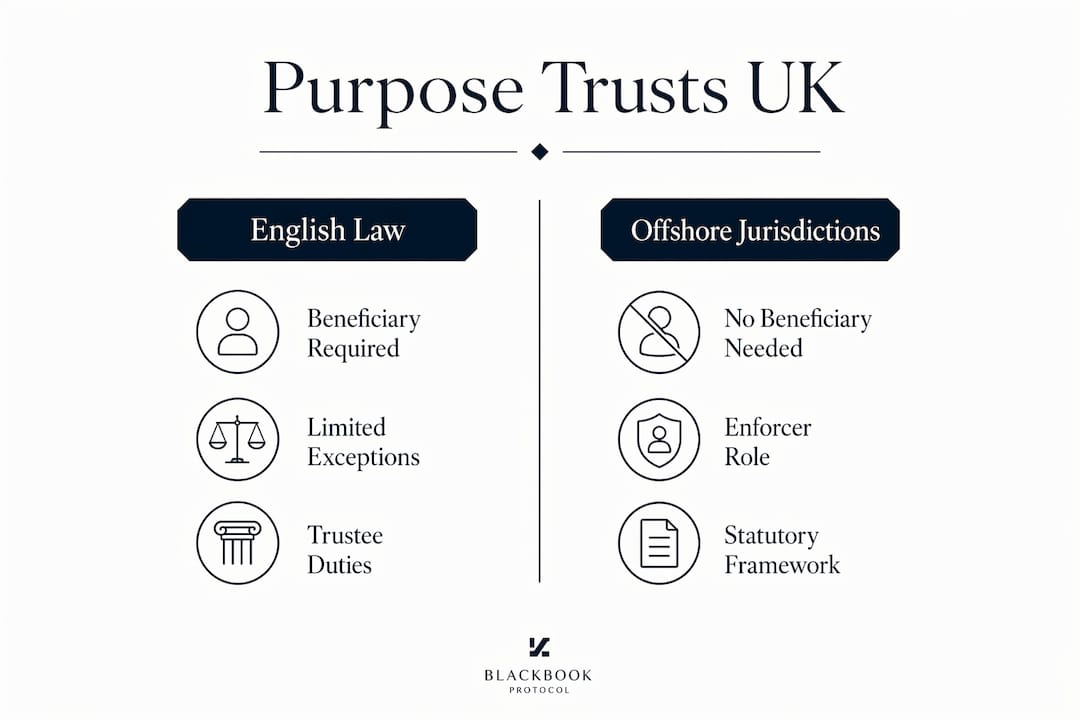
Offshore jurisdictions have resolved the beneficiary principle problem through statute. The Bahamas, Bermuda, the British Virgin Islands, and the Cayman Islands each have dedicated legislation permitting non-charitable purpose trusts without requiring identifiable human beneficiaries.
The mechanism is the enforcer. Each offshore framework requires the appointment of an enforcer, a person or institution with the legal duty and right to hold the trustee accountable for advancing the trust’s stated purpose. This replaces the beneficiary as the enforcement mechanism, satisfying the structural logic that English law requires but cannot achieve without a beneficiary.
| Feature | English law purpose trust | Offshore purpose trust |
|---|---|---|
| Beneficiary required | Yes, or trust is void | No, enforcer substitutes |
| Perpetuity period | Perpetuities and Accumulations Act 2009 | Jurisdiction-specific statutory limit |
| Enforcer role | No statutory framework | Mandatory appointment required |
| Trustee qualification | No residency requirement | Professionally qualified, resident trustee often required |
| Charitable status | Required for validity without beneficiary | Not required |
Offshore legal frameworks commonly require one or more professionally qualified trustees resident in the jurisdiction and impose limited trust duration to comply with local perpetuity rules. The Cayman Islands STAR Trust, for example, allows trusts of unlimited duration for any lawful purpose, provided an enforcer is appointed.
The risk for UK individuals and businesses is importing these structures without accounting for UK tax and perpetuity rules. An offshore purpose trust holding UK assets or managed by UK-resident trustees may be subject to HMRC scrutiny, UK inheritance tax, and TRS registration requirements regardless of where it was established.
Pro Tip: If you are using an offshore purpose trust to hold UK land or business interests, obtain specialist UK tax advice before execution. The jurisdiction of formation does not determine UK tax treatment. Substance and control matter.
What are the UK trust registration and compliance obligations?
All express trusts, including purpose trusts, must register with HMRC’s Trust Registration Service. This obligation applies regardless of whether the trust generates a UK tax liability. The TRS requirement was expanded significantly following the Fifth Anti-Money Laundering Directive, and the scope now captures most trusts with any UK connection.
Key compliance obligations include:
- Registration deadline. Trusts must register within 90 days of creation or within 90 days of any material change to the trust’s details.
- Financial penalties. Penalties can reach £5,000 per violation, with escalating fines for continued non-compliance.
- Land registration. Trusts holding UK land must comply with Registers of Control of Interest filings alongside TRS obligations.
- Automatic exchange of information. Since 2025, UK trust trustees face AEOI reporting requirements, requiring accurate data filing with penalties starting at £1,000.
- Ongoing updates. Any change to trustees, beneficiaries, or trust assets must be reported within the 90-day window.
The trust compliance checklist published by Blackbookprotocol covers these obligations in detail for 2026. Offshore trusts with UK connections are not exempt. A trust formed in the Cayman Islands that holds UK property or has UK-resident trustees falls within TRS scope and must register accordingly.
The practical implication is significant. Purpose trusts, which often lack named beneficiaries and may have complex governance structures, require careful record-keeping to satisfy HMRC. Trustees who assume that a non-standard structure exempts them from registration are mistaken.
In what practical scenarios are purpose trusts used?
Purpose trusts are emerging as strategic governance tools rather than purely wealth distribution vehicles. The applications are specific and often sophisticated.
- Family business governance. A purpose trust can hold voting shares in a family company, with the stated purpose being the preservation of the business’s founding principles. This prevents any single beneficiary from forcing a sale or altering the governance structure.
- Intellectual property management. Holding IP in a purpose trust allows a business to separate ownership from commercial exploitation, with the trust’s purpose defined as protecting and licensing the asset on specified terms.
- Securitisation structures. In finance, purpose trusts are used as special purpose vehicles to hold assets in structured finance transactions, isolating risk without creating beneficial ownership in any individual.
- Philanthropic structures. Where a donor wants to fund a specific project without establishing a charity, a purpose trust with a defined enforcer can achieve a similar result, provided it meets the legal requirements discussed above.
- Estate planning for complex assets. Where an estate includes assets that cannot easily be divided among beneficiaries, a purpose trust can hold and manage those assets according to defined rules while the estate is administered.
The limitations are real. Purpose trusts carry higher legal complexity than conventional trusts, require specialist drafting, and face ongoing compliance burdens. The absence of a beneficiary also means there is no natural party to challenge trustee misconduct, making the enforcer role critical. For wealth management applications, the structure works best when the purpose is clearly defined, the enforcer is independent, and the trustees are professionally qualified.
Key takeaways
Purpose trusts in the UK are valid only where they satisfy the beneficiary principle, qualify as charitable, or operate under an offshore statutory framework with a properly appointed enforcer.
| Point | Details |
|---|---|
| Purpose trust definition | A trust created to fulfil a specific objective rather than benefit identifiable individuals. |
| Beneficiary principle | English law voids non-charitable purpose trusts without an enforceable beneficiary or appointed enforcer. |
| Offshore alternatives | Jurisdictions like the BVI and Cayman Islands permit purpose trusts via statutory enforcer frameworks. |
| TRS registration | All express trusts must register with HMRC within 90 days of creation, with penalties up to £5,000. |
| Practical uses | Governance of family businesses, IP management, and securitisation are the most common applications. |
The case for taking purpose trusts seriously in 2026
Purpose trusts occupy an unusual position in UK trust law. They are simultaneously constrained by centuries of precedent and increasingly relevant to modern wealth planning. What I find most striking, having worked through the compliance frameworks and case law, is how often settlors and their advisers underestimate the structural precision required.
The Re Denley exception is genuinely useful, but it is not a workaround. It requires careful drafting, a clearly ascertainable class of individuals, and a trust deed that explicitly preserves their right to enforce. Treating it as a shortcut to avoid charitable registration almost always produces a defective structure.
The offshore route is legitimate but carries its own risks for UK-connected assets. The enforcer mechanism works well in the Cayman Islands or BVI because the statutory framework supports it. Transplanting that structure into a UK context without accounting for HMRC’s reach, the Perpetuities and Accumulations Act 2009, and TRS obligations is a common and costly error.
The compliance burden is also increasing, not decreasing. The AEOI requirements introduced in 2025 add another layer of reporting for trustees who may already be managing complex governance structures. UK trust compliance is rapidly evolving, and the administrative burden on trustees is growing year on year. Professional guidance is not optional at this level of complexity. It is the difference between a structure that holds and one that does not.
— Blackbook
Protect your trust structure with Blackbookprotocol
Purpose trusts require precise drafting, proactive compliance, and a clear understanding of UK trust law. Blackbookprotocol provides the frameworks to get this right.

The Blackbook Protocol hardback guide covers asset protection, trust governance, and UK compliance in detail, including purpose trust structures, TRS registration, and 95/5 equity split strategies. For immediate access to templates and audio guidance, the audio ebook and templates package gives you the practical tools to structure and register a trust correctly from day one. Both resources are built for UK individuals and businesses who need more than generic legal advice.
FAQ
What is a purpose trust under UK law?
A purpose trust is a trust created to fulfil a specific objective rather than to benefit identifiable individuals. Under English law, most non-charitable purpose trusts are void because they fail the beneficiary principle established in Morice v Bishop of Durham.
Can you set up a non-charitable purpose trust in the UK?
A non-charitable purpose trust can be structured in the UK if it appoints an identifiable person with locus standi to enforce it, following the Re Denley principle. Without that, the trust is void under English law.
Do purpose trusts need to register with HMRC?
All express trusts, including purpose trusts, must register with HMRC’s Trust Registration Service within 90 days of creation. Failure to register carries penalties up to £5,000 per violation.
How does an offshore purpose trust differ from a UK trust?
Offshore purpose trusts in jurisdictions such as the BVI or Cayman Islands operate under statutory frameworks that permit trusts without beneficiaries, provided a qualified enforcer is appointed. English law has no equivalent statutory framework for non-charitable purpose trusts.
What is the role of an enforcer in a purpose trust?
An enforcer is a person or institution appointed to hold the trustee accountable for advancing the trust’s stated purpose. In offshore jurisdictions, the enforcer is a mandatory appointment that substitutes for the beneficiary as the enforcement mechanism.
0 commenti