

TL;DR:
- A private trust company is a corporate entity that acts as trustee exclusively for one family’s trusts, providing a tailored governance structure. It offers families control over board decisions, asset management, and succession, especially for complex or illiquid assets. Active governance and proper legal structuring are essential for maximizing its benefits and protecting family wealth across generations.
A private trust company (PTC) is a standalone corporate entity incorporated solely to act as trustee for a family’s trusts, offering a middle ground between individual trustees and commercial trust companies. Unlike a high-street bank acting as trustee, a PTC exists exclusively for one family group, giving that family direct control over governance, investment decisions, and succession planning. The private trust company definition matters because the structure you choose as trustee shapes every major decision about your wealth for generations. This guide explains how PTCs are formed, what advantages they deliver, and how they operate in practice.
What is a private trust company and how is it structured?
A PTC is a standalone legal corporate entity formed under company law, not a trust in itself. It holds the trustee role for one or more family trusts, meaning the company, rather than an individual or a bank, signs off on distributions, investments, and governance decisions. This distinction matters because a corporate trustee carries perpetual legal existence. Individual trustees die; companies do not.

Ownership of the PTC is the detail most families get wrong. The PTC’s ownership is often held by a non-charitable purpose trust to ensure no individual beneficiary owns it directly, preserving estate and gift tax efficiencies and legal insulation. That structure means no single family member can claim the PTC as a personal asset, which protects it from divorce proceedings, creditor claims, and inheritance disputes.
Jurisdictional choice shapes the regulatory burden significantly. Jurisdictions like Cayman and Jersey exempt PTCs from complex licensing requirements as long as they serve a defined family group and do not offer public fiduciary services. That exemption removes the compliance overhead that commercial trust companies carry, making PTCs far simpler to operate for a single family.
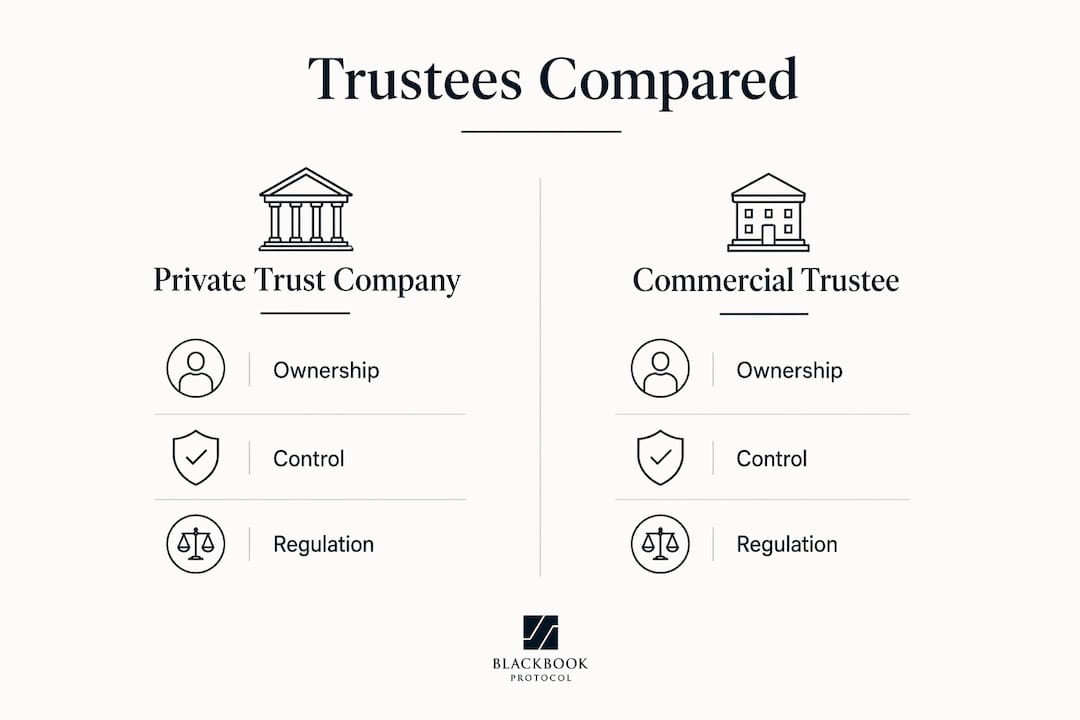
| Feature | Private trust company | Commercial trustee |
|---|---|---|
| Ownership | Family or purpose trust | Publicly regulated institution |
| Licensing | Exempt in qualifying jurisdictions | Full regulatory licence required |
| Board composition | Family members plus advisors | Professional staff only |
| Asset flexibility | Illiquid and complex assets | Standardised, liquid portfolios |
| Privacy | High, no public disclosure | Lower, subject to regulatory reporting |
What are the benefits of private trust companies?
PTCs allow families to retain full control of board seats, providing institutional governance for multi-generational succession and specialised asset management beyond commercial bank capabilities. That control is the defining advantage. A commercial trustee answers to its own risk committee; a PTC board answers to the family’s values and long-term objectives.
The benefits of private trust companies extend well beyond control:
- Privacy. A PTC operates without the public disclosure obligations that apply to regulated commercial trustees. Family wealth, asset composition, and distribution decisions remain confidential.
- Complex asset management. PTCs are especially suited to manage concentrated or illiquid assets, such as private businesses or real estate, which commercial trustees often avoid or charge heavily for managing.
- Custom governance. The PTC’s board and committee structure can be tailored to the family’s specific needs, including specialist investment committees and distribution panels.
- Succession and leadership development. PTCs play a vital role in formalising family leadership, facilitating wealth education, and supporting smooth generational succession.
- Continuity. As a corporate entity, the PTC survives the death or incapacity of any individual family member, removing the disruption that individual trustee succession causes.
Pro Tip: Place rising-generation family members on the PTC board as observers before giving them full voting rights. This builds governance literacy without exposing the trust to inexperienced fiduciary decisions.
The PTC is gaining popularity because it merges the best traits of corporate fiduciaries and family trustees, providing customised governance combined with family intimacy. That hybrid quality is what separates it from every other trustee structure available.
How do private trust companies work in practice?
The operational mechanics of a PTC divide into two layers: governance and administration. Governance sits with the board, which typically includes senior family members and independent professional directors. Administration covers the day-to-day compliance, tax filing, and accounting work.
Family members serving on the PTC’s board often delegate administrative tasks such as compliance and tax filing to third-party professionals, freeing the family to focus on strategic wealth matters. This delegation is not optional for most families. Fiduciary liability for errors in tax reporting or regulatory compliance is real, and professional service providers carry the appropriate indemnity cover.
Effective governance follows a structured committee model:
- Investment committee. Reviews and approves asset allocation, manager selection, and portfolio rebalancing within the trust.
- Distribution committee. Evaluates beneficiary requests against trust deed criteria and family policy, preventing ad hoc or emotionally driven decisions.
- Audit committee. Oversees financial reporting, compliance monitoring, and third-party service provider performance.
- Governance committee. Manages board appointments, succession of directors, and updates to the PTC’s constitutional documents.
Successful PTC governance requires active fiduciary commitment from family board members and structured committees to avoid catastrophic governance failures seen in less engaged setups. Honorary board roles are the single most common cause of PTC failure. A family member who attends meetings but does not engage with the agenda creates personal liability without adding any governance value.
Pro Tip: Treat every board meeting as a formal fiduciary event. Circulate papers at least five working days in advance, record minutes, and document every material decision with the reasoning behind it. This paper trail is your defence against future disputes.
PTCs also differ from individual trustees in how they interact with investment managers. A corporate trustee can enter long-term investment management agreements, negotiate institutional fee rates, and maintain continuity of mandate across trustee changes. An individual trustee cannot reliably do any of those things.
When should you establish a private trust company?
PTCs deliver the most value in specific circumstances. Families owning private businesses, concentrated shareholdings, or illiquid real estate portfolios are the clearest candidates. Commercial trustees routinely decline to hold controlling stakes in private companies because of the liability and management complexity involved. A PTC has no such constraint.
Business succession planning is another strong use case. When a founder wants to transfer a business into trust while retaining operational influence through the PTC board, the structure provides a legally sound mechanism for doing so. The trust owns the shares; the PTC acts as trustee; the family controls the PTC board. That chain preserves both asset protection and operational continuity.
Jurisdictional suitability requires careful analysis. Not every jurisdiction offers the regulatory exemptions that make PTCs cost-effective. Cayman, Jersey, and several US states with dedicated family trust company statutes are the most established options. UK families often use an offshore PTC to hold assets internationally while maintaining UK-resident beneficiaries.
| Situation | PTC suitable? | Reason |
|---|---|---|
| Family owns a private business | Yes | Commercial trustees avoid controlling stakes |
| Liquid portfolio, no business interests | Unlikely | Cost of PTC exceeds benefit over commercial trustee |
| Multi-generational succession required | Yes | Corporate continuity and governance structure |
| Single beneficiary, simple assets | No | Overhead not justified |
| Complex international asset base | Yes | Custom governance and jurisdictional flexibility |
Governance pitfalls are predictable and avoidable. Passive family board roles, absent committee structures, and failure to document decisions are the three most common failures. Families that treat the PTC as a legal formality rather than an active governance body create the very risks they sought to avoid. Complementing the PTC with professional advisors, including a trust counsel, a family office administrator, and an independent director, removes the most serious operational risks.
Privacy is a genuine and underappreciated benefit. A PTC does not appear on public registers in the same way a regulated trust company does. Beneficiary identities, asset values, and distribution histories remain within the family’s control. For families with significant public profiles or business interests, that confidentiality has direct commercial value.
Key takeaways
A private trust company is the most effective structure for families who need institutional governance, family control, and the flexibility to manage complex or illiquid assets across generations.
| Point | Details |
|---|---|
| Core definition | A PTC is a corporate entity that acts as trustee exclusively for one family’s trusts. |
| Ownership structure | Ownership via a non-charitable purpose trust prevents direct beneficiary ownership and protects tax efficiency. |
| Regulatory exemption | Qualifying jurisdictions exempt PTCs from commercial licensing, reducing compliance burden. |
| Governance discipline | Active committees covering investment, distribution, and audit are non-negotiable for effective PTCs. |
| Best-fit scenarios | PTCs suit families with private businesses, illiquid assets, or complex multi-generational succession needs. |
Why governance is the real test of a private trust company
Most commentary on PTCs focuses on structure and tax. The real test is governance. I have seen families spend considerable sums incorporating a PTC in a well-regarded jurisdiction, only to treat board meetings as a formality and delegate every decision to a single professional director. That approach defeats the purpose entirely.
The advantages of private trusts are only realised when the family engages actively with the fiduciary role. PTCs primarily provide governance infrastructure rather than tax avoidance. Their value lies in managing complex family assets that commercial trustees reject. Families who approach a PTC expecting a tax solution will be disappointed. Families who approach it as a governance tool will find it transformative.
The misconception I encounter most often is that a PTC automatically insulates family members from fiduciary liability. It does not. Board members carry personal liability for decisions made negligently or in breach of the trust deed. The PTC structure reduces certain risks, but it does not eliminate the obligation to act as a competent, informed fiduciary. That obligation requires time, education, and professional support.
The families who use PTCs most effectively treat the board as a genuine leadership body, not an administrative convenience. They invest in governance training for rising-generation members, appoint independent directors with relevant expertise, and review the PTC’s constitutional documents regularly. That discipline is what makes a PTC worth the cost.
— Blackbook
Blackbookprotocol: governance tools for private trust companies
Families and business owners who have decided a PTC is the right structure need more than a legal framework. They need practical governance tools, clear documentation standards, and a working understanding of UK trust law and asset protection principles.

Blackbookprotocol provides exactly that. The asset protection audio, eBook, and templates cover UK trust law, 95/5 equity splits, and tax-efficient asset protection in a format designed for founders and families, not just lawyers. The hardback edition goes deeper into corporate governance principles directly applicable to PTC board management. Whether you are establishing a PTC or reviewing an existing structure, Blackbookprotocol gives you the blueprint to do it properly.
FAQ
What is the private trust company definition in simple terms?
A private trust company is a corporate entity formed solely to act as trustee for one family’s trusts. It gives the family institutional governance and direct control over trustee decisions.
Can I create a private trust company in the UK?
UK families typically establish PTCs in offshore jurisdictions such as Cayman or Jersey, which offer regulatory exemptions for family-only trust companies. A UK-incorporated PTC would require a full trust company licence under the Financial Services and Markets Act 2000.
How does a private trust company differ from an LLC?
A PTC acts as trustee and carries fiduciary duties to beneficiaries. An LLC is a trading or holding vehicle with no inherent fiduciary obligations. The two structures serve different legal purposes and are not interchangeable in estate planning.
What assets are best held through a private trust company?
PTCs are best suited to illiquid or complex assets such as private company shares, real estate portfolios, and concentrated family business interests that commercial trustees routinely decline to manage.
What governance structures do private trust companies use?
Effective PTCs operate through formal committees covering investment, distribution, audit, and governance. Each committee meets on a defined schedule, records minutes, and reports to the full board, mirroring the discipline of professional trust companies.
0 commenti