

Most wealthy individuals treat their trust as a finished product. You set it up, sign the deed, and assume the work is done. That assumption is one of the most costly mistakes in estate planning. A trust planning review is a structured, adviser-led examination of your existing trust arrangements to confirm they still reflect your intentions, your current asset base, and the requirements of UK law. Without periodic reviews, even the most carefully drafted trust can quietly drift out of alignment with your wishes, your family circumstances, and the tax rules that govern how your wealth passes to the next generation.
Table of Contents
- What is a trust planning review and why it matters
- How often should you review your trust: timing and triggers
- Common issues uncovered during trust planning reviews
- What happens during a trust planning review: the two-track approach
- How a trust planning review protects your legacy and optimises tax efficiency
- Why trust reviews are the most overlooked step in preserving wealth
- How Blackbook Protocol supports your trust planning review journey
- Frequently asked questions
Key Takeaways
| Point | Details |
|---|---|
| Trust reviews are essential | Regular trust planning reviews ensure your trust remains aligned with your wishes and current UK law. |
| Review every 3-5 years | Perform a trust review every three to five years and after major life or financial changes. |
| Check both law and funding | Effective reviews cover both legal terms and whether assets are properly held and administered. |
| Prevent probate exposure | Incomplete or outdated trusts can trigger probate, so reviews help safeguard your estate. |
| Reviewing gives peace of mind | Even if no changes are needed, reviews confirm your plan still protects your legacy effectively. |
What is a trust planning review and why it matters
A trust planning review is an adviser-led check-up of your existing trust structures and the wider estate plan around them. Its purpose is to confirm that the trust still matches your current wishes, the intentions recorded in the trust deed and letter of wishes, and current UK legal and tax requirements. That definition sounds straightforward, but the scope of what it covers is considerable.
A thorough review examines the following:
- Trust provisions and deed language: Are the distribution powers, trustee discretions, and protective clauses still appropriate for your family and asset base?
- Trustee and beneficiary arrangements: Are the right people named? Are any trustees deceased, incapacitated, or no longer suitable?
- Asset funding and titling: Are all intended assets actually held within the trust, or have some been acquired since the trust was created and never transferred in?
- Alignment with current UK tax rules: Does the trust structure still deliver the inheritance tax, capital gains tax, and income tax outcomes it was designed to achieve?
- Letter of wishes: Does it reflect your current intentions, or was it written a decade ago when your family circumstances were entirely different?
Understanding trust planning at this level means recognising that a trust is a living legal arrangement. It responds to changes in law, in your family, and in your financial position. A review is the mechanism that keeps it responsive.
How often should you review your trust: timing and triggers
Knowing what a review covers is only part of the picture. Knowing when to conduct one is equally important. Advisers recommend a periodic review cadence of approximately every three to five years, even when you believe nothing has changed, with additional reviews triggered immediately after major life or financial events.
The three-to-five year baseline matters because legal and tax environments shift gradually. HMRC updates its guidance, Finance Acts introduce new rules, and trust case law evolves. None of these changes announce themselves to you personally. A scheduled review catches the drift before it becomes a problem.
Beyond the regular cadence, the following events should trigger an immediate review:
- Marriage or civil partnership (yours or a key beneficiary’s), which can affect inheritance expectations and tax planning.
- Divorce or separation, which may require removing a former spouse from trustee or beneficiary roles.
- Birth or adoption of a child or grandchild, creating new potential beneficiaries not contemplated in the original deed.
- Death of a trustee or beneficiary, which may leave the trust without a required number of trustees or alter the distribution landscape.
- Significant change in asset values or composition, such as selling a business, inheriting property, or acquiring new investments.
- Material changes in UK tax legislation, particularly those affecting inheritance tax thresholds, trust taxation, or reporting requirements.
- Relocation of trustees or beneficiaries abroad, which can trigger unexpected tax consequences under UK rules.
Pro Tip: Do not wait for a trigger event to prompt action. Set a fixed review date in your calendar every three years and treat it as a non-negotiable appointment with your solicitor or trust adviser. Passive estates rarely remain protected ones.
Common issues uncovered during trust planning reviews
The trust review process consistently surfaces the same categories of problem, regardless of how well the original deed was drafted. Knowing what to expect helps you approach the process with the right questions.
The most frequent issues include:
- Incomplete trust funding: Even one asset left outside the trust can undermine the trust’s intended effect, including potentially triggering probate for that asset. Property purchased after the trust was established, new bank accounts, or investment portfolios opened independently are common culprits.
- Outdated beneficiary designations: A beneficiary named in the original deed may have predeceased you, had a change in circumstances, or you may simply have changed your mind about the appropriate share of your estate they should receive.
- Inappropriate trustees: A trusted friend appointed as trustee fifteen years ago may now be elderly, living abroad, or estranged from the family. Trustees who are no longer suitable can create administration problems or, in serious cases, legal disputes.
- Failure to account for legislative change: UK trust taxation has changed materially over the past two decades. Trusts established before significant Finance Act amendments may carry provisions that are now inefficient or even non-compliant.
- Absent or stale letters of wishes: These documents guide trustee discretion. An outdated letter can lead trustees to make distributions that no longer reflect your intentions.
“A trust that was perfectly constructed at inception can become a liability through neglect. The deed is only as effective as the administration that surrounds it.”
This is not a theoretical concern. HMRC scrutiny of trust arrangements has increased, and the consequences of non-compliance, including penalties and unexpected tax charges, fall on trustees personally.
What happens during a trust planning review: the two-track approach
Practitioners treat a trust planning review as a two-track exercise. The first track is the legal and tax design check. The second is the operational audit. Both are essential, and neglecting either one leaves your trust exposed.
| Track | Focus areas | Common findings |
|---|---|---|
| Legal and tax design | Deed language, trustee powers, distribution strategies, inheritance tax efficiency, compliance with current legislation | Outdated provisions, tax inefficiencies, missing protective clauses |
| Operational audit | Asset titles and funding, documentary trail, trustee meeting records, compliance filings, consistency of transactions | Unfunded assets, missing records, unreported changes, mis-titled property |
The operational audit is frequently where problems are found. Many advisers report that trust failures arise not from flaws in the original deed but from poor ongoing administration. Assets never transferred in. Trustee decisions never formally recorded. Annual tax returns filed inconsistently or not at all.

Pro Tip: Ask your adviser to provide a written summary of both tracks after each review. A documented audit trail demonstrates to HMRC and to any future beneficiaries that the trust has been actively and properly managed throughout its life.
How a trust planning review protects your legacy and optimises tax efficiency
The benefits of trust planning reviews extend well beyond administrative tidiness. For wealthy UK individuals, the financial and personal stakes are significant.
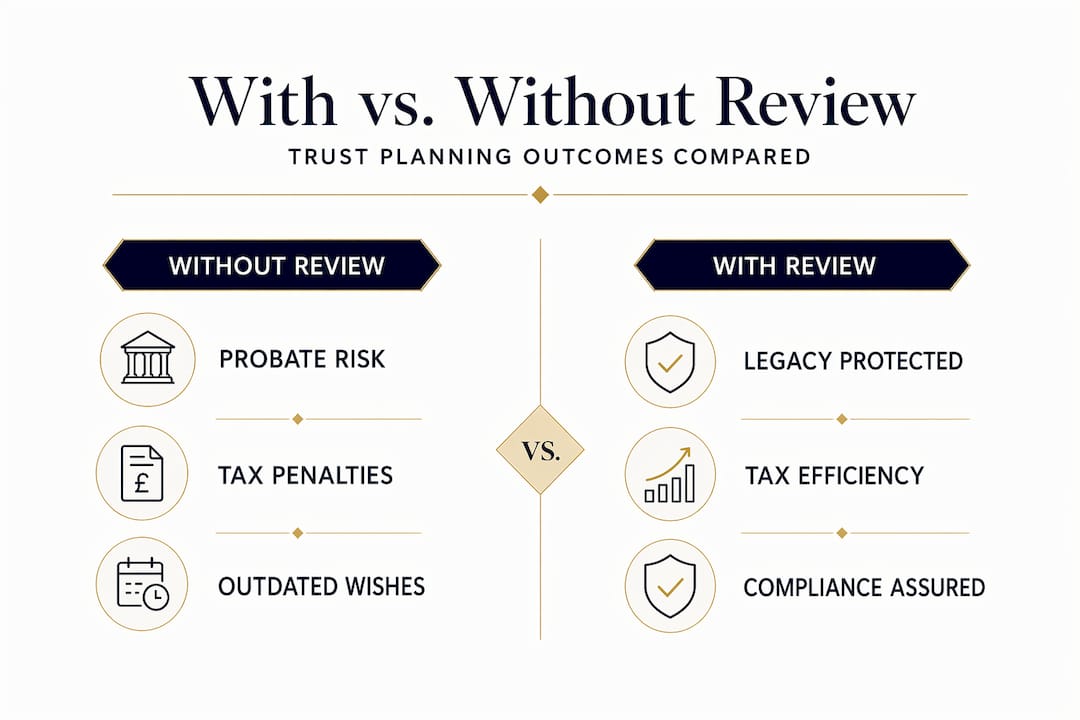
Regular reviews help ensure your estate plan remains legally valid, keeps asset distribution aligned with your wishes, minimises potential beneficiary disputes, and takes advantage of changes in tax laws and estate planning strategies. In practical terms, this translates to the following outcomes:
- Reduced probate risk: Assets properly held within a trust pass outside of probate, saving time and cost. A review confirms your asset funding remains complete.
- Inheritance tax efficiency: UK inheritance tax applies at 40% above the nil-rate band. Trust structures can reduce this exposure materially, but only if they remain correctly structured under current rules. Reviews identify opportunities to use available reliefs, including business property relief and agricultural property relief, where applicable.
- Prevention of family disputes: Clear, current trustee roles and an up-to-date letter of wishes leave far less room for disagreement among beneficiaries. Disputes over estate distributions are costly and damaging to family relationships.
- Alignment with evolving family circumstances: A trust designed for a family of three children may need adjustment when one child predeceases you, when grandchildren arrive, or when family dynamics shift significantly.
| Benefit | Without regular review | With regular review |
|---|---|---|
| Probate exposure | High, if assets are unfunded | Minimised |
| Inheritance tax position | May be inefficient or non-compliant | Aligned with current reliefs and thresholds |
| Trustee suitability | Potentially outdated | Confirmed and appropriate |
| Beneficiary clarity | Risk of dispute | Clearly documented |
| Legal compliance | Uncertain | Verified |
Trust and estate planning reviews are not a luxury for the ultra-wealthy. They are a baseline requirement for anyone who has taken the time to establish a trust and expects it to perform.
Why trust reviews are the most overlooked step in preserving wealth
There is a persistent belief among even experienced wealth holders that creating a trust is the hard part. Once the deed is signed and the solicitor’s invoice is paid, the thinking goes, the structure will simply do its job. This belief is understandable. It is also wrong, and the consequences of holding it can be severe.
Advisers consistently emphasise that trust planning is not a set-and-forget exercise. The review re-confirms that your plan aligns with your assets, your family circumstances, and the law at the moment that matters most. The moment, in other words, when the trust is actually called upon to function.
The trusts that fail are rarely the ones with poorly drafted deeds. They are the ones where a property was never transferred in. Where a trustee died and was never replaced. Where a beneficiary’s circumstances changed entirely and no one updated the letter of wishes. These are operational failures, not legal ones, and they are entirely preventable.
There is also a subtler point worth making. Tax law in the UK does not stand still. The interaction between trusts, inheritance tax, capital gains tax, and income tax is complex and changes with each Finance Act. A trust that was tax-efficient in 2015 may carry structural inefficiencies today. A review is the only way to know.
The discipline of regular reviews also changes how you relate to your estate plan. Instead of treating it as a document filed away and forgotten, you engage with it as a living component of your financial life. That engagement, in itself, tends to produce better outcomes. Trustees who know the plan is reviewed regularly tend to administer more carefully. Beneficiaries who see an active, maintained trust have fewer grounds for dispute.
If you have a trust in place and cannot recall when it was last reviewed, that is your answer. The time is now.
How Blackbook Protocol supports your trust planning review journey
Understanding what a trust planning review involves is the first step. Knowing how to act on that understanding is where most people need structured guidance. The Blackbook Protocol provides exactly that: detailed, UK-specific blueprints covering trust law, 95/5 equity splits, and tax-efficient asset protection strategies designed for individuals serious about preserving their wealth.

Whether you prefer to work through the material in print or on screen, the protocol is available as a hardback edition and as a Kindle eBook. Both formats deliver the same depth of guidance on maintaining effective trust structures, understanding your legal obligations as a settlor, and ensuring your arrangements remain compliant and efficient under current UK law. For anyone committed to a trust planning review that actually protects their legacy, this is the logical next step.
Frequently asked questions
What exactly is a trust planning review?
It is a professional check-up of your trust to ensure it aligns with your current wishes, is legally compliant, and your assets are properly included. A trust planning review confirms your trust still matches your intentions and current legal requirements so it functions as intended.
How often should I review my trust?
Generally, every three to five years is recommended, with additional reviews triggered by major life changes. Advisers recommend this cadence after major life or financial events such as marriage, death of a trustee, or significant changes in asset values.
What risks come from not reviewing a trust regularly?
Risks include assets not being properly held in trust, outdated beneficiary designations, increased probate exposure, and ineffective tax planning. Failure to review trusts can lead to incomplete funding, unintended beneficiaries, family conflicts, and tax consequences.
Does a review always mean I need to make changes?
Not necessarily. Sometimes the review confirms your trust remains entirely suitable, providing confidence in your estate plan. Reviewing your trust does not always mean changes are needed; often it reaffirms that your plan still reflects your wishes.
How does a trust review help with tax efficiency?
It identifies structural updates needed to benefit from current tax laws and strategies that reduce inheritance tax liabilities. Regular trust reviews take advantage of changes in tax legislation and estate planning strategies to optimise tax outcomes for your estate.
0 commenti