

TL;DR:
- A trust deed drafting checklist ensures all legal, governance, and tax requirements are met before execution.
- Using the checklist as a quality control tool helps prevent common omissions and legal defects.
A trust deed drafting checklist is a structured tool that confirms every legal requirement, governance clause, and tax provision is addressed before a trust deed is executed. Without one, settlors and trustees risk creating a document that is legally defective, open to dispute, or unfit for its intended purpose. The checklist covers the three core parties: the settlor (who creates the trust), the trustee (who manages it), and the beneficiaries (who benefit from it). Getting each element right from the outset is the difference between a trust that protects assets for generations and one that collapses under legal scrutiny.
1. What are the foundational legal requirements for a valid trust deed?
A trust deed is legally valid only when five core conditions are met: the settlor has legal capacity, there is clear intention to create a trust, beneficiaries are identifiable, trustees have defined duties, and no single person acts as both sole trustee and sole beneficiary. These five core legal requirements form the bedrock of any trust deed drafting checklist. Miss one, and the entire structure is at risk of being void.
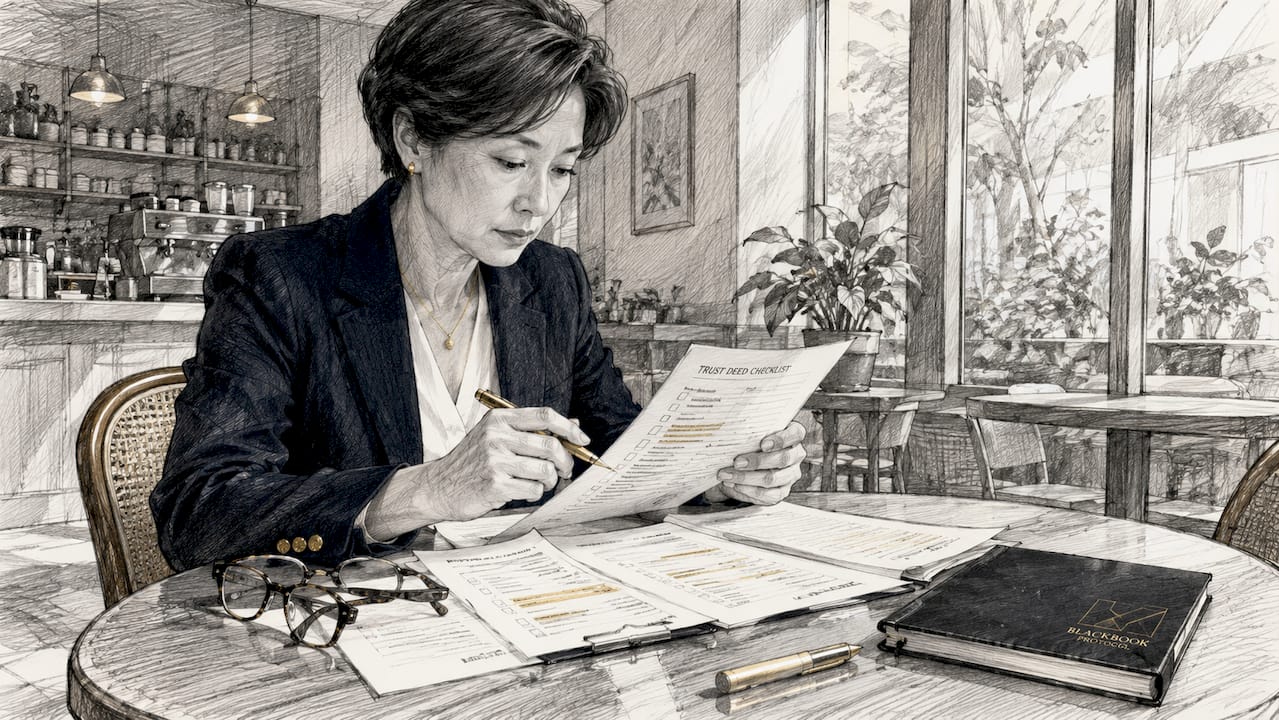
English common law adds the three certainties: certainty of intention (the settlor clearly intends to create a trust), certainty of subject matter (the trust property is identifiable), and certainty of objects (the beneficiaries or purposes are ascertainable). All three must be present. A deed that says “I wish my family to benefit” without naming or defining the class of beneficiaries fails the certainty of objects test.
Execution formalities are equally non-negotiable. A trust deed must be executed as a deed: signed, witnessed, and delivered, with trustees formally accepting their appointment. The drafting process typically takes 4–12 weeks depending on complexity. That timeline should be built into your checklist from day one.
Pro Tip: Confirm the settlor’s mental capacity in writing before drafting begins. A capacity assessment, particularly for older settlors, protects the trust from future challenge.
2. Settlor capacity and clear intention
Settlor capacity means the person creating the trust must be of legal age and sound mind at the point of execution. This is not a formality. Courts have set aside trusts where capacity was later questioned, leaving beneficiaries without protection and families in costly litigation.
Clear intention goes beyond stating “I create a trust.” The deed must demonstrate, through its language and structure, that the settlor intends to impose binding obligations on the trustee. Precatory language such as “I hope” or “I wish” does not create a trust. The deed must use imperative terms.
A trust planning review conducted before drafting begins helps confirm both capacity and intention are properly documented. This step is frequently skipped and frequently regretted.
3. Beneficiary identification and ascertainability
Beneficiaries need not be named at the point of trust creation, but they must be ascertainable. A discretionary trust can name a class such as “the children and grandchildren of the settlor” provided that class can be determined with certainty at the relevant time.
Purpose trusts, which benefit a defined purpose rather than named individuals, require specific legal structures to be valid in the UK. The legal standards for purpose trusts differ from those governing fixed or discretionary trusts. Your checklist must confirm which trust type applies and whether the beneficiary definition matches that structure.
Vague beneficiary definitions are one of the most common causes of trust disputes. The checklist item here is simple: can you draw up a complete list of current beneficiaries, or apply a clear test to determine membership of the class? If not, the definition needs rewriting.
4. Key clauses to include in your trust deed preparation guide
A well-drafted trust deed contains specific, verifiable clauses. The following are the minimum requirements for any trust deed checklist for estate planning:
- Recitals and definitions: Set out the background, parties, and defined terms to aid legal interpretation.
- Trust property schedule: Identify all assets transferred into the trust, including property, shares, cash, and digital assets.
- Trustee powers: Define investment powers, borrowing powers, delegation rights, and any restrictions.
- Trustee succession: Specify how trustees are appointed, removed, and replaced.
- Beneficiary definitions and distribution conditions: State who benefits, when, and on what terms.
- Protector provisions: Where a protector is appointed, define their powers and limitations clearly.
- Governing law clause: Confirm which jurisdiction’s law governs the trust.
- Annual accounting obligations: Require trustees to prepare accounts and file tax returns.
- Amendment and revocation powers: State whether and how the deed can be varied.
Effective trust agreements include clear recitals, defined trustee powers, beneficiary definitions, tax provisions, and annual accounting clauses. Each of these is a distinct checklist item, not a combined entry.
Pro Tip: Include a digital assets clause even if no digital assets exist at the point of creation. Cryptocurrency, online accounts, and intellectual property rights are increasingly significant components of estates.
5. Common trust deed mistakes to avoid
Generic trust deed templates frequently omit critical clauses, which leads to disputes and costly court intervention. This is the single greatest risk in trust deed preparation. A template sourced online may be valid in one jurisdiction but defective in another, or simply out of date with current tax legislation.
The most frequent errors include:
- Vague trustee powers: A deed that grants trustees “general investment powers” without specifying scope leaves them exposed to personal liability.
- Missing tax provisions: Inheritance tax, capital gains tax, and income tax treatment must all be addressed. Omitting these creates unexpected liabilities.
- No dispute resolution mechanism: Without a defined process, disagreements between trustees and beneficiaries go straight to court.
- Failure to update after legislative changes: Trust law and tax rules change. A deed drafted in 2015 may not reflect current HMRC requirements.
- Incorrect execution: A deed signed without a witness, or not delivered, is not legally effective regardless of its content.
“Bespoke documents tailored to family circumstances reduce legal disputes far more effectively than any off-the-shelf template.” This principle underpins every element of a sound drafting process.
Specialist trust lawyers with STEP membership are the recommended standard for trust deed drafting. STEP (the Society of Trust and Estate Practitioners) members hold recognised qualifications in trust and estate law and are bound by professional conduct rules. Using a generalist solicitor for a complex family trust is a false economy.
6. How to prepare effectively before drafting begins
Preparation before the first draft is written reduces both cost and revision cycles. The most effective preparatory tool is a family charter: a non-legally binding document that sets out the settlor’s values, objectives, and wishes for the trust. A family charter reduces legal fees by giving lawyers a precise brief, which cuts the number of revision rounds required.
The preparation phase should follow these steps:
- Write a detailed briefing document. Cover the purpose of the trust, the assets to be settled, the intended beneficiaries, and any specific distribution wishes.
- Appoint trustees before drafting. Trustees should be identified and willing to act before the deed is drafted, not after.
- Engage a tax adviser. Inheritance tax planning, capital gains tax holdover relief, and income tax treatment all affect the deed’s structure.
- Confirm the governing jurisdiction. For UK trusts, confirm whether English, Scottish, or another law applies.
- Review existing wills and estate plans. The trust deed must align with the settlor’s wider estate planning documents.
Pro Tip: Send your briefing document to both your trust lawyer and your tax adviser simultaneously. Misalignment between legal structure and tax strategy is a common and expensive error.
7. How to use the checklist in practice
The trust deed drafting checklist is most effective when used at three distinct stages: before drafting, during review, and at execution. Using it only at the end is the equivalent of proofreading a contract after it has been signed.
The drafting process involves 2–4 review rounds to refine governance, tax strategy, and settlor objectives. Each round should be checked against the full checklist, not just the sections that were amended. Errors introduced in revision are as damaging as those present in the first draft.
At execution, confirm the following before signing:
- All parties have reviewed and approved the final draft.
- The deed is executed as a deed: signed, witnessed, and delivered.
- Trustees have formally accepted their appointment in writing.
- Trust assets are transferred into the trust immediately after execution.
- Registration with HMRC’s Trust Registration Service is completed where required. The Trust Registration Service requirements changed significantly in recent years and now apply to most UK express trusts.
Post-execution, schedule a review of the deed every three to five years, or whenever there is a significant change in family circumstances, tax legislation, or trust assets.
Key takeaways
A complete trust deed drafting checklist is the most reliable way to create a legally valid, tax-efficient, and dispute-resistant trust under UK law.
| Point | Details |
|---|---|
| Legal validity requires five conditions | Settlor capacity, clear intention, ascertainable beneficiaries, trustee duties, and no sole trustee/beneficiary overlap. |
| Execution formalities are non-negotiable | The deed must be signed, witnessed, and delivered, with trustees formally accepting appointment. |
| Bespoke drafting outperforms templates | Generic templates frequently omit critical clauses and create costly disputes. |
| Preparation reduces cost and errors | A family charter and detailed briefing document cut revision rounds and align legal and tax strategy. |
| Post-execution review is required | Review the deed every 3–5 years or after major changes in law, assets, or family circumstances. |
Why I treat the checklist as the trust itself
Most practitioners treat the checklist as a supporting document. I treat it as the primary one. The deed is the legal output. The checklist is the quality control system that determines whether that output is fit for purpose.
The errors I see most often are not exotic or obscure. They are the same omissions repeated across different clients: no digital assets clause, no dispute resolution mechanism, trustee powers that are either too narrow or too broad, and tax provisions that were accurate in the year of drafting but have since been overtaken by legislative change. A checklist that is reviewed and updated annually catches all of these.
The other pattern I notice is the gap between legal and tax advice. Solicitors draft the deed. Tax advisers plan the structure. When these two professionals do not communicate directly, the result is a deed that is legally sound but tax-inefficient, or vice versa. The checklist forces that conversation by making both sets of requirements visible in one document.
UK trust law compliance changes regularly. The checklist must change with it. A static document is not a checklist. It is a historical record.
— Blackbook
Blackbookprotocol resources for trust deed preparation
Blackbookprotocol has developed a suite of resources specifically for individuals and professionals working through the trust deed preparation process.
The asset protection audio, e-book, and templates package covers UK trust law structures, 95/5 equity splits, and tax-efficient asset protection frameworks. These resources complement a trust deed drafting checklist by providing the governance context that lawyers and settlors need before drafting begins. The Blackbookprotocol hardback provides a comprehensive reference on asset protection and trust governance methodologies, suitable for both first-time settlors and experienced trustees managing complex family structures.
FAQ
What is a trust deed drafting checklist?
A trust deed drafting checklist is a structured list of legal, governance, and tax requirements that must be verified before a trust deed is executed. It covers settlor capacity, beneficiary identification, trustee powers, execution formalities, and post-creation compliance obligations.
How long does it take to draft a trust deed?
Drafting a trust deed takes 4–12 weeks depending on the complexity of the trust structure, the number of assets involved, and the number of review rounds required.
Do beneficiaries need to be named in the trust deed?
Beneficiaries do not need to be named at the point of creation, but they must be ascertainable. A defined class such as “the children of the settlor” satisfies the legal requirement provided the class can be determined with certainty.
What qualifications should a trust deed lawyer have?
A trust deed lawyer should hold active STEP membership and have specific practical experience in trust and estate law. Generalist solicitors without trust law specialisation carry a higher risk of drafting errors.
When should a trust deed be reviewed after creation?
A trust deed should be reviewed every 3–5 years, or immediately following a significant change in tax legislation, family circumstances, or the composition of trust assets.
0 commenti