

TL;DR:
- Trustees must actively supervise investment decisions despite delegation, maintaining oversight responsibility under UK law. The governance model chosen influences how frequently trustees and managers meet, the level of oversight, and documentation required. Effective collaboration involves clear agreements, substantive meetings, and reports that invite challenge rather than passively report results.
Investment managers interact with trustees through a defined governance relationship in which trustees retain fiduciary oversight while delegating day-to-day portfolio management. This distinction is not merely procedural. Under UK trust law, delegation does not remove a trustee’s oversight responsibility. The Pensions Regulator’s General Code and frameworks from STEP and Rathbones all reinforce the same principle: trustees must actively supervise, challenge, and document investment decisions rather than passively receive reports. For fund managers, understanding this dynamic is the foundation of every productive trustee relationship.
How investment managers interact with trustees: governance models explained
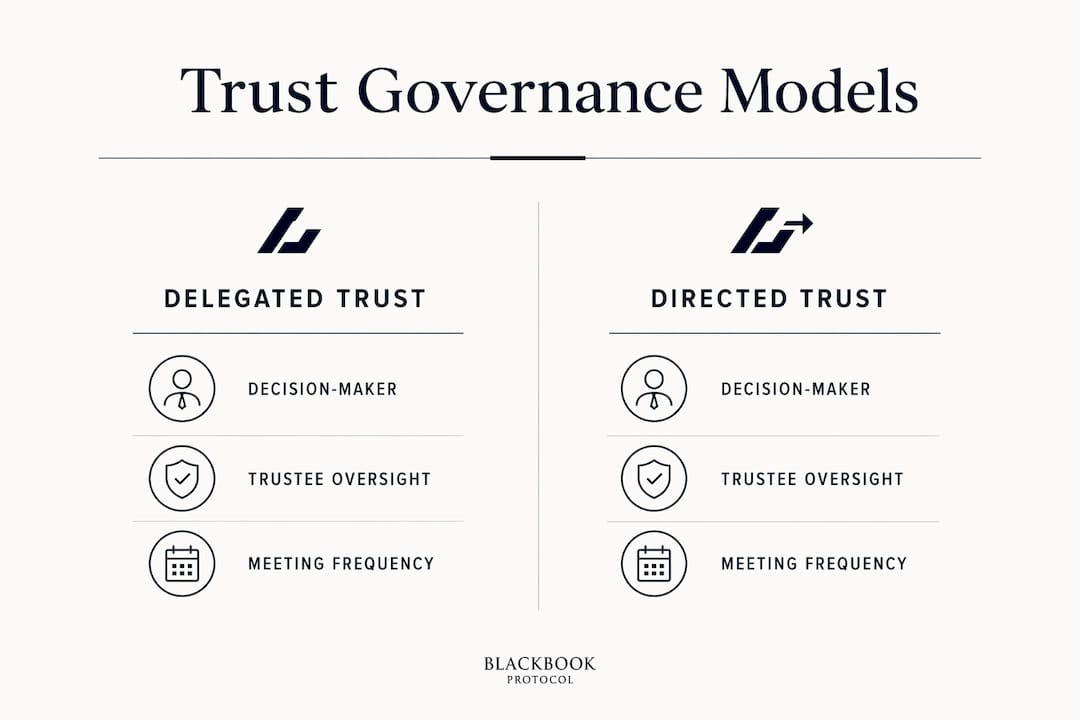
The governance model embedded in a trust document determines how investment managers and trustees divide responsibility. Two primary structures exist in UK practice: the delegated trust and the directed trust.
In a delegated trust, the trustee appoints an investment manager and grants discretionary authority over portfolio decisions. Critically, fiduciary risk is shared between both parties. The trustee cannot simply hand over assets and disengage. Active supervision remains a legal obligation, and failure to provide it exposes trustees to personal liability.
In a directed trust, an investment adviser assumes primary fiduciary responsibility for investment decisions. The trustee’s role shifts towards administration and compliance. This reduces the trustee’s direct exposure to investment risk but does not eliminate their duty to monitor whether the adviser is performing within the agreed mandate.
The choice of model directly shapes how often trustees and managers meet, what questions get asked, and how much documentation is required. A delegated structure demands more frequent, substantive engagement. A directed structure still requires periodic review, but the nature of scrutiny differs.
| Feature | Delegated trust | Directed trust |
|---|---|---|
| Primary investment decision-maker | Investment manager (discretionary) | Investment adviser |
| Trustee fiduciary exposure | Shared with manager | Reduced; primarily administrative |
| Required oversight level | High; active supervision | Moderate; periodic review |
| Meeting frequency | Typically more frequent | Can be less frequent |
| Documentation burden | Extensive; decisions and rationale | Focused on mandate compliance |
Understanding which model applies is the first task for any investment manager entering a trustee relationship. The trust structure itself sets the rules of engagement.
How should trustee meetings with investment managers be structured?
Meeting structure is where governance either works or fails. Trustee meetings should occur at least annually, with agendas and supporting materials distributed 5–7 days in advance. That lead time allows trustees to review performance data, prepare substantive questions, and arrive ready to challenge rather than simply listen.

The agenda itself matters as much as the frequency. Templated agendas are a governance failure waiting to happen. When every meeting follows the same script, discussions become mechanical report reviews rather than genuine strategic conversations. The Pensions Regulator and Dalriada Trustees both identify templated governance as a primary driver of poor oversight outcomes.
Effective meetings cover four areas: performance against benchmarks, risk profile alignment, fee transparency, and forward-looking strategy. Trustees should lead the discussion. Investment managers should present, but trustees should set the direction and ask the hard questions.
Documentation is non-negotiable. Minutes must record not just decisions but the reasoning behind them, the alternatives considered, and the market context at the time. Comprehensive meeting minutes serve as the primary defence in regulatory audits and, where disputes arise, in litigation.
- Circulate agenda and performance reports 5–7 days before the meeting
- Include fee analysis and benchmark comparison as standing agenda items
- Rotate agenda topics to prevent repetitive, formulaic discussions
- Assign a named trustee to lead each agenda item
- Record alternatives considered and reasons for decisions taken
Pro Tip: Embed a performance watch-list into every meeting pack. Flag any holding that has underperformed its benchmark for two consecutive quarters. This forces a substantive conversation rather than a cursory sign-off.
What questions should trustees ask investment managers?
Trustees fulfil their fiduciary duty through the quality of the questions they ask. Rathbones outlines a five-question framework that forms the basis for documented, defensible reviews. Investment managers who understand this framework can prepare more useful presentations and anticipate the scrutiny they will face.
The five areas trustees should probe at every substantive review are:
- Strategy alignment. Does the current portfolio reflect the trust’s stated objectives and risk appetite? If the mandate has drifted, why, and what is the plan to correct it?
- Risk profile. Has the risk level of the portfolio changed since the last review? Are trustees aware of any new concentrations or exposures?
- ESG and ethical compliance. Does the portfolio comply with any ethical or ESG guidelines set out in the investment policy statement? Can the manager demonstrate this with specific holdings data?
- Performance reporting. Is performance reported net of fees and against an appropriate benchmark? Are trustees able to distinguish between market-driven returns and manager skill?
- Role clarity. Are the boundaries between trustee decisions and manager discretion clearly understood by both parties? Has anything occurred that should have been escalated to trustees but was not?
These questions prevent the templated governance trap by forcing managers to justify decisions rather than simply report outcomes. For investment managers, preparing clear answers to all five areas before every meeting is the mark of a professional relationship.
How can investment managers support trustee compliance?
Approximately two-thirds of pension scheme trustees fail to provide effective ongoing oversight of their investment managers, relying on routine reporting rather than genuine scrutiny. That figure reflects a systemic problem. Investment managers who understand their role in solving it become far more valuable to the trustees they serve.
The most direct contribution an investment manager can make is producing reports that invite challenge rather than discourage it. A report that presents only positive outcomes, buries fees, or omits benchmark comparisons does not serve trustees well. It creates the illusion of oversight without the substance.
Bespoke investment guidelines incorporating ESG criteria and ethical parameters give both parties a shared reference point. Generic agreements leave too much open to interpretation. When a trustee asks whether a holding is appropriate, the answer should be traceable to a written policy, not a verbal understanding.
Investment managers should also support independent external reviews of their own performance. Fiduciary managers who welcome external scrutiny signal confidence in their process. Those who resist it raise legitimate governance questions.
| Common pitfall | Best practice alternative |
|---|---|
| Passive report approval without challenge | Structured review against written investment policy |
| Generic investment agreements | Bespoke guidelines with ESG and ethical parameters |
| Minutes recording only decisions | Minutes recording decisions, alternatives, and rationale |
| No independent performance review | Periodic external review commissioned by trustees |
| Retrospective monitoring only | Forward-looking strategy discussion at every meeting |
Pro Tip: Offer trustees a one-page governance summary at each meeting. List the three most significant decisions taken since the last review, the rationale for each, and any items that were escalated. This single document transforms a passive meeting into a documented oversight record.
What practical steps improve collaboration between trustees and managers?
Clear agreements on decision boundaries are the single most effective improvement any trustee and manager pairing can make. Explicit written agreements that define which decisions require trustee approval and which fall within manager discretion remove the ambiguity that causes governance failures.
Communication should not be limited to formal meetings. Interim updates, whether written or via a brief call, keep trustees informed between reviews and reduce the risk of surprises at the next meeting. A trustee who learns of a significant portfolio change only at the annual review has not been properly supported.
Technology and governance tools can help track decisions, flag performance thresholds, and maintain audit trails between meetings. The wealth management tools available in 2026 include platforms designed specifically for trustee governance documentation, reducing the administrative burden on both parties.
- Draft a written decision matrix specifying manager discretion limits and trustee approval thresholds
- Schedule at least one interim update between formal meetings, even if brief
- Use bespoke investment guidelines rather than standard-form agreements
- Maintain a shared decision log accessible to both trustees and managers
- Set clear escalation paths for strategy changes, market events, or compliance concerns
Pro Tip: Agree an escalation protocol in writing at the start of the relationship. Define what triggers an out-of-cycle trustee notification, such as a drawdown exceeding a set percentage or a change in the manager’s key personnel. This prevents ambiguity when it matters most.
Key takeaways
Effective trustee and investment manager collaboration requires clear governance structures, substantive meeting preparation, and documentation that records reasoning, not just decisions.
| Point | Details |
|---|---|
| Governance model determines oversight | Delegated trusts require active trustee supervision; directed trusts shift primary fiduciary risk to the adviser. |
| Meeting preparation drives quality | Agendas and materials distributed 5–7 days in advance produce substantive review rather than passive approval. |
| Five-question framework prevents drift | Trustees should probe strategy, risk, ESG, performance, and role clarity at every formal review. |
| Minutes must record reasoning | Documenting alternatives considered and rationale provides the audit trail that satisfies regulatory scrutiny. |
| Bespoke guidelines outperform generic ones | Written investment policies incorporating ESG criteria give both parties a clear, shared reference point. |
The governance gap no one talks about
The most persistent problem in trustee and manager relationships is not technical incompetence. It is the comfort of routine. Trustees who receive well-formatted reports, nod through the agenda, and sign the minutes have technically met. They have not governed.
I have observed this pattern repeatedly across UK trust structures. The meeting happens. The report is presented. The minutes are filed. And yet no one has asked whether the portfolio still reflects what the trust was set up to achieve. No one has questioned whether the fees are proportionate to the outcomes delivered. No one has challenged a single assumption.
The regulatory push from The Pensions Regulator and bodies like Dalriada Trustees is not bureaucratic box-ticking. It reflects a genuine recognition that passive oversight is a liability, not a defence. Trustees who cannot demonstrate that they actively challenged their investment manager are exposed, regardless of how well the portfolio has performed.
For investment managers, the opportunity here is significant. The manager who helps trustees ask better questions, who produces reports that invite scrutiny rather than deflect it, and who proactively flags concerns before they become problems is not just a service provider. That manager becomes a governance partner. That relationship is far harder to replace than one built on performance alone.
The trust review process for high-net-worth clients illustrates this clearly. The trustees who achieve the best long-term outcomes are those who treat every meeting as a leadership exercise, not an administrative obligation.
— Blackbook
Blackbookprotocol resources for trustee governance
Investment managers who want to build genuinely effective trustee relationships need more than good intentions. They need structured frameworks, documented protocols, and templates that hold up under regulatory scrutiny.

Blackbookprotocol provides practical resources built specifically for this purpose. The asset protection audio, eBook, and templates cover meeting protocols, investment policy statement drafting, and audit trail documentation in formats designed for immediate use. For investment professionals seeking a comprehensive reference, the Blackbookprotocol hardback delivers in-depth guidance on UK trust law, governance best practices, and the fiduciary frameworks that underpin every trustee and manager interaction. These are working tools, not theoretical overviews.
FAQ
What is the main duty of trustees when working with investment managers?
Trustees must actively supervise investment managers and cannot delegate away their fiduciary responsibility. Delegation transfers day-to-day management, not oversight accountability.
How often should trustees meet with their investment managers?
Trustees should meet with investment managers at least annually, with agendas and materials circulated 5–7 days in advance to allow meaningful preparation and scrutiny.
What should trustee meeting minutes include?
Minutes must record the decisions taken, the alternatives considered, the rationale applied, and the market context at the time. A bare record of decisions is insufficient for regulatory purposes.
What is the difference between a delegated and a directed trust?
In a delegated trust, the investment manager holds discretionary authority and fiduciary risk is shared with the trustee. In a directed trust, an investment adviser assumes primary fiduciary responsibility for investment decisions.
How can investment managers help trustees avoid governance failures?
Investment managers support good governance by producing clear, fee-transparent reports, drafting bespoke investment guidelines, welcoming independent reviews, and helping trustees move from retrospective monitoring to forward-looking strategic oversight.
0 commenti