

TL;DR:
- The BlackBook Protocol is a distributed custody system utilizing a 3-of-5 threshold scheme to generate single-use private keys for cross-chain asset management. It enhances security by preventing key exposure, ensuring shared control, and linking each key to specific withdrawal parameters for robust legacy planning. Its layered cryptographic safeguards support multi-asset portfolios while operating within legal frameworks, reducing centralized failure risks.
The BlackBook Protocol is a distributed threshold-cryptography custody system that uses multi-party computation to generate one-time private keys for cross-chain treasury management. No single participant ever holds a complete private key. Instead, five distributed nodes each hold a fragment, and any three of those fragments are sufficient to reconstruct a key for a single, specific withdrawal. This architecture sits at the intersection of cryptographic security and practical asset custody, making it directly relevant to anyone building a financial security or legacy planning strategy on blockchain infrastructure.

How the blackbook protocol’s distributed key generation works
The 3-of-5 threshold scheme is the structural foundation of the BlackBook Protocol. Five distributed key generation nodes, known as DKG nodes, each hold a share of a private key component. No single node ever sees the complete key. This design means that even if two nodes are compromised, an attacker still cannot reconstruct the private key. Security arises from requiring multiple nodes to collaborate without exposing secret keys to any individual participant.
Reconstruction uses Lagrange interpolation over the secp256k1 elliptic curve, the same curve used by Bitcoin and Ethereum. When a valid claim is submitted, three or more nodes contribute their shares, and the interpolation process reconstructs the key locally. The reconstructed key is then used once and discarded. This one-time-use property is not optional behaviour. It is enforced at the protocol level.
The secp256k1 curve choice is deliberate. It provides compatibility with the widest range of blockchain networks, which directly supports the protocol’s cross-chain treasury management function. For anyone planning financial security across multiple asset classes and chains, this compatibility is a practical advantage rather than a theoretical one.
Pro Tip: Threshold schemes do not simply split a key into pieces. They use polynomial mathematics so that any subset of the required size can reconstruct the secret, but any smaller subset reveals nothing at all. This is fundamentally different from splitting a password into parts.
Key security advantages of the threshold scheme include:
- No single node holds a complete private key at any point
- Compromise of fewer than three nodes yields zero information about the full key
- Key reconstruction happens locally, not on a centralised server
- Each reconstructed key is tied to a specific withdrawal request and cannot be reused
What is the step-by-step workflow of the BlackBook Protocol?
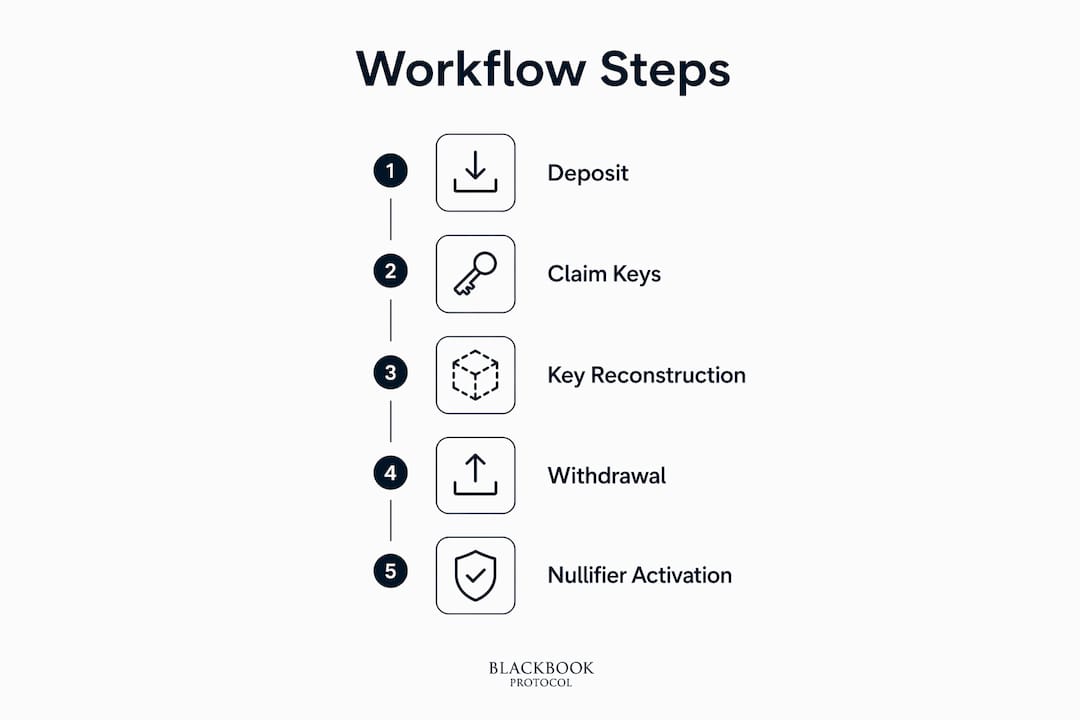
The BlackBook Protocol workflow follows three distinct phases: deposit, claim, and withdrawal. Each phase has specific technical requirements, and errors in any phase will cause the entire cycle to fail. Understanding the sequence is the most practical aspect of the blackbook protocol guide for anyone integrating it into a custody arrangement.
The sequential protocol steps are as follows:
- Deposit to the cross-chain treasury. The agent submits a deposit transaction on the source chain, including token approval. The transaction hash from this deposit becomes the reference identifier for all subsequent steps.
- Call claim_keys. The agent calls the claim_keys function, passing the deposit transaction hash alongside the withdrawal parameters. The MCP server coordinates this request across the five DKG nodes.
- MCP server signs proof messages. The MCP server generates signed proof messages that authenticate the agent’s identity. Each DKG node independently verifies the deposit and the proof before returning its key share.
- Nodes return key shares. Each participating node returns its share of the private key. The agent’s local environment collects the shares from at least three nodes.
- Local reconstruction of the one-time key. The agent’s local system applies Lagrange interpolation to the collected shares, reconstructing the one-time ECDSA key tied to the merkle root of the withdrawal request.
- Submit the withdrawal transaction. The reconstructed key signs the withdrawal transaction. The protocol validates the signature on-chain, confirms the nullifier has not been spent, and releases the funds to the designated address.
- Nullifier marked as spent. The on-chain nullifier is updated to reflect the key as used. Any attempt to reuse the same key or replay the transaction is rejected at the contract level.
The cross-chain deposit mechanism means that a deposit on one blockchain network can generate withdrawal keys for a completely different network, provided the token mappings and denomination registrations are correctly configured. This is the feature that makes the protocol genuinely useful for multi-asset treasury management rather than single-chain custody only.
Pro Tip: Agent wallet identity must remain consistent across the entire claim-and-withdraw cycle. A mismatch between the agent proof and the withdrawal request parameters will cause the claim to fail even when the DKG network is fully operational. Treat wallet identity as a fixed input, not a variable.
Repeated withdrawals are not handled by reusing a key. Each withdrawal is a distinct claim-and-withdraw cycle. The agent guidance resources embedded in the protocol repository cover denomination rules, error handling, and step-by-step workflows for exactly this reason.
How does the BlackBook Protocol protect against security threats?
The BlackBook Protocol’s security model addresses three categories of risk: key compromise, replay attacks, and single points of failure. Each is handled by a distinct mechanism rather than a single catch-all defence.
| Security property | Implementation |
|---|---|
| No single point of failure | 3-of-5 threshold scheme distributes key shares across five independent DKG nodes |
| Replay attack prevention | On-chain nullifier marks each reconstructed key as spent after one use |
| Local key storage protection | AES-256-GCM with PBKDF2 encrypts agent wallet storage |
| Deposit verification | Each DKG node independently verifies the deposit before returning a key share |
| Idempotency of claims | Repeated claim calls with the same parameters return the same result without creating duplicate keys |
| Timestamp validation | Protocol enforces time-bound validity on proof messages to prevent delayed replay |
The on-chain nullifier deserves particular attention. Once a reconstructed key is used to sign a withdrawal, the nullifier associated with that key is permanently marked as spent on the blockchain. This is not a database record that can be altered or deleted. It is an immutable on-chain state change. The UTXO model underlying this approach means that each withdrawal consumes a specific output, and that output cannot be spent twice.
Agent wallets must sign every keyshare claim request using ECDSA or Ed25519 signatures. This authentication layer means that even if an attacker intercepts a claim request in transit, they cannot submit it from a different wallet without the authentication failing. The combination of threshold key generation, on-chain nullifiers, and wallet-level authentication creates a layered security model where each layer addresses a different attack vector.
The deposit verification by nodes step is also worth noting for its idempotency property. If a claim_keys call is submitted twice with identical parameters, the nodes return the same shares rather than generating new ones. This prevents accidental duplication and makes the system tolerant of network retries without creating security vulnerabilities.
How does the BlackBook Protocol apply to financial security and legacy planning?
Distinguishing blockchain-based threshold key custody from legal or tax asset protection frameworks is essential when planning financial security solutions. The BlackBook Protocol handles the cryptographic layer of asset custody. It does not replace UK trust law structures, 95/5 equity splits, or tax-efficient holding arrangements. It operates alongside them, securing the digital asset layer while legal frameworks govern ownership and succession.
Practical benefits and considerations for financial security and legacy planning include:
- Cross-chain treasury management. Assets held across Bitcoin, Ethereum, and other networks can be managed through a single custody architecture, reducing the operational complexity of multi-asset portfolios.
- One-time key usage limits exposure. Because each key is used once and then invalidated, the window of vulnerability for any given withdrawal is extremely narrow. There is no persistent private key that can be extracted from a compromised device over time.
- Legacy planning through controlled access. The threshold scheme means that access to assets can be distributed across trustees, executors, or family members without any single person holding full control. This maps directly onto the governance structures used in UK trust law compliance.
- Merkle root linkage enforces withdrawal specificity. Each one-time key is tied to a specific merkle root, which encodes the exact withdrawal parameters. This prevents a key from being redirected to a different address or amount, even if intercepted.
- Inheritance cycles require distinct claim rounds. Because repeated withdrawals are treated as separate cycles, estate distributions can be structured as sequential, auditable events rather than a single bulk transfer.
The protocol’s cross-chain capability is particularly relevant for estates that include digital assets across multiple networks. A beneficiary receiving assets from a Bitcoin holding and an Ethereum holding does not need separate custody arrangements for each. The same threshold architecture governs both, provided the denomination registrations are correctly configured at setup.
For advisers working with clients on business wealth preservation, the BlackBook Protocol provides a technical custody layer that complements rather than competes with legal structures. The two operate at different levels of the asset protection stack.
Key takeaways
The BlackBook Protocol secures digital asset custody through a 3-of-5 threshold scheme where no single node holds a complete private key, and every reconstructed key is used once and permanently invalidated on-chain.
| Point | Details |
|---|---|
| Threshold key generation | Five DKG nodes hold shares; any three reconstruct the key without exposing it to any single party. |
| One-time key enforcement | On-chain nullifiers permanently mark each key as spent after a single withdrawal. |
| Sequential workflow | Deposit, claim_keys, and withdrawal are distinct phases; each withdrawal requires a fresh claim cycle. |
| Layered security model | AES-256-GCM local storage, ECDSA authentication, and deposit verification combine to address multiple attack vectors. |
| Legacy planning application | Threshold distribution maps onto trust governance structures, enabling controlled multi-party access to digital estates. |
Why threshold cryptography changes the custody conversation
Most custody failures I have observed do not stem from weak encryption. They stem from centralisation. A single private key stored on a hardware wallet is only as secure as the physical security of that device and the discipline of its owner. The BlackBook Protocol removes that single point of failure at the architectural level, not through better password hygiene.
What I find genuinely significant about this approach is the merkle root linkage. Tying a reconstructed key to specific withdrawal parameters means that key theft, even if it occurred, would yield a key that can only move a specific amount to a specific address. That is a fundamentally different risk profile from a persistent private key that grants open-ended access to a wallet.
The common pitfall I see is treating the protocol as a complete asset protection solution rather than a custody layer. It secures the cryptographic control of digital assets. It does not structure ownership, manage tax liability, or create the legal frameworks that govern succession. Practitioners who conflate the two end up with strong cryptographic custody sitting inside a legally fragile structure. The protocol is most powerful when it operates within a properly constructed legal architecture, not as a substitute for one.
The naming confusion with BlackRoad OS’s unrelated BlackBox Protocol for mesh networking is worth flagging. They share a name and nothing else. Anyone researching threshold cryptography custody should verify they are working with the InterNullOrg implementation, not the edge networking system.
— Blackbook
Explore the Blackbookprotocol resources
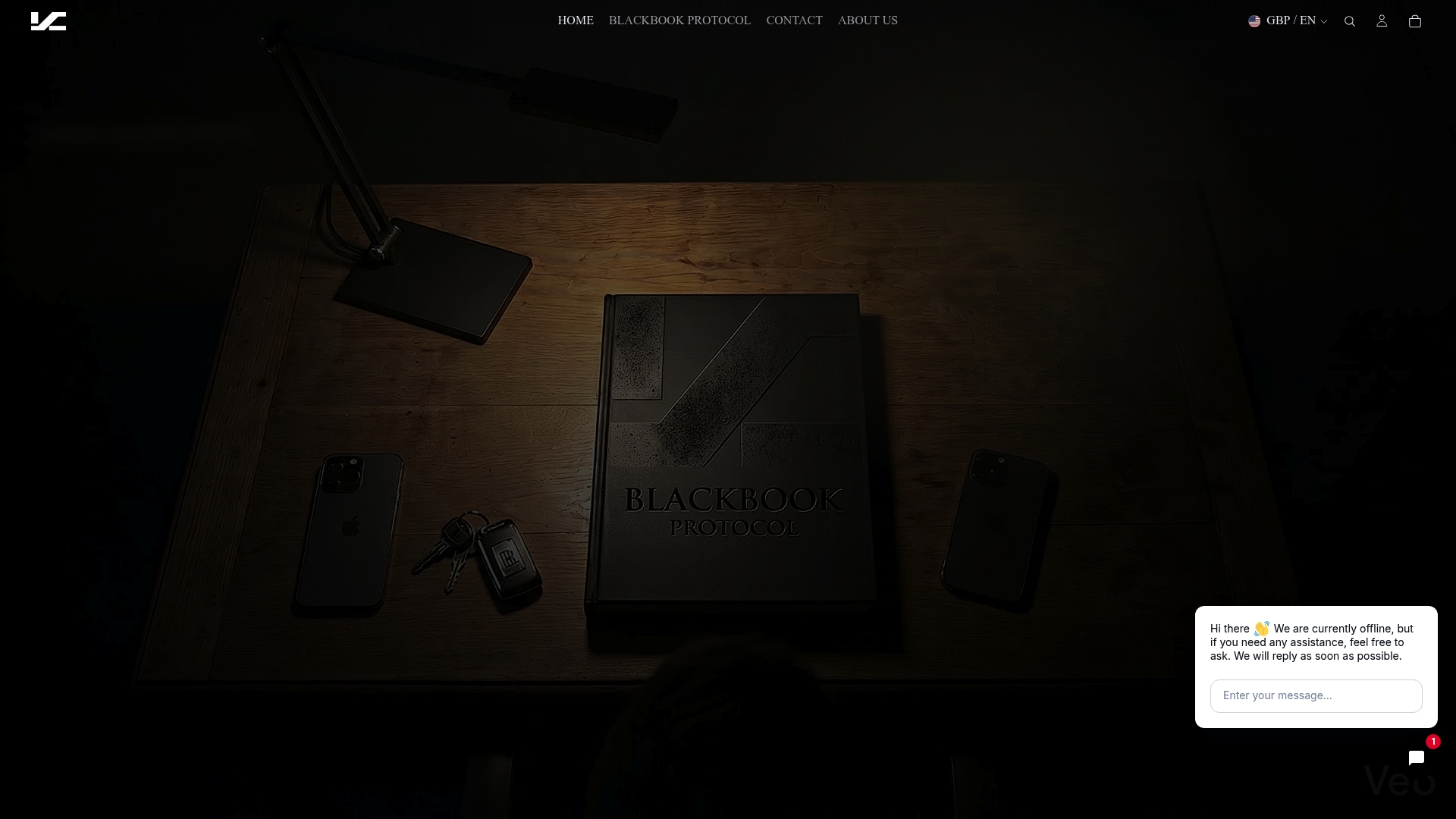
Blackbookprotocol provides structured resources for individuals and advisers who want to move beyond understanding the protocol and begin applying it within a complete asset protection framework. The Blackbook Protocol Hardback covers UK trust law structures, 95/5 equity splits, and tax-efficient asset protection in detail, with the cryptographic custody layer placed in its correct legal context. For those who prefer flexible digital access, the Kindle edition and the audio ebook with templates provide the same blueprint in formats suited to different working styles. Each resource is designed to translate technical and legal concepts into implementable steps for financial sovereignty.
FAQ
What is the BlackBook Protocol?
The BlackBook Protocol is a distributed threshold-cryptography custody system that uses five DKG nodes and a 3-of-5 threshold scheme to generate one-time private keys for cross-chain asset withdrawals. No single participant ever reconstructs or holds the full private key outside of a specific, authenticated withdrawal cycle.
How does the claim_keys process work?
An agent calls claim_keys with the deposit transaction hash and withdrawal parameters. The MCP server coordinates signed proof messages, each DKG node independently verifies the deposit, and at least three nodes return key shares that are used to locally reconstruct a one-time ECDSA key via Lagrange interpolation.
Can the same private key be used more than once?
No. Each reconstructed key is tied to a specific merkle root and withdrawal request. An on-chain nullifier permanently marks the key as spent after its first use, making reuse or replay technically impossible at the contract level.
How does the BlackBook Protocol support legacy planning?
The threshold scheme allows key shares to be distributed across trustees, executors, or beneficiaries, meaning no single person holds unilateral access to digital assets. Each inheritance distribution is structured as a distinct claim-and-withdraw cycle, creating an auditable sequence of transfers aligned with trust governance structures.
Is the BlackBook Protocol the same as BlackRoad OS’s BlackBox Protocol?
No. The BlackRoad OS BlackBox Protocol refers to a multi-network mesh routing system for edge networking and has no connection to the threshold-cryptography custody system described here. The InterNullOrg implementation is the relevant system for digital asset custody and financial security applications.
Recommended
- How blackbook protocol applies to wealth management – BLACKBOOK PROTOCOL
- Blackbook Protocol Hardback | Asset Protection & Corporate Governance – BLACKBOOK PROTOCOL
- Asset Protection & Corporate Governance Blueprint | BLACKBOOK PROTOCOL
- BLACKBOOK PROTOCOL Kindle eBook | Asset Protection & Corporate Governance
0 commenti