

TL;DR:
- Blackbook Protocol's trust layer architecture separates assets into distinct legal entities to protect wealth from legal claims. This multi-tiered system reduces exposure by isolating risks and requires formal, arm's length agreements governing inter-entity transactions. Maintaining governance and updating strategies ensures the structure remains resilient as risks and client circumstances evolve.
Blackbookprotocol's trust layer architecture is defined as a multi-tiered legal framework that partitions assets, liabilities, and operational risks into distinct legal entities, each serving a specific protective function. Understanding how Blackbook Protocol structures trust layers matters because a single undifferentiated structure exposes all assets to every legal claim simultaneously. The framework separates identity, intellectual property, operating activity, and capital into defensible containers linked by formal, arm's length agreements. Legal and finance professionals who grasp this architecture can design wealth management strategies that are both legally sound and genuinely resilient.
How Blackbookprotocol structures trust layers: the core architecture
Blackbookprotocol's trust layer system is built on a principle that separating assets and liabilities into specialised legal entities is the only reliable way to prevent undocumented risk accumulation. That separation is not cosmetic. Each layer holds a distinct category of value or exposure, and formal agreements govern how those layers interact.
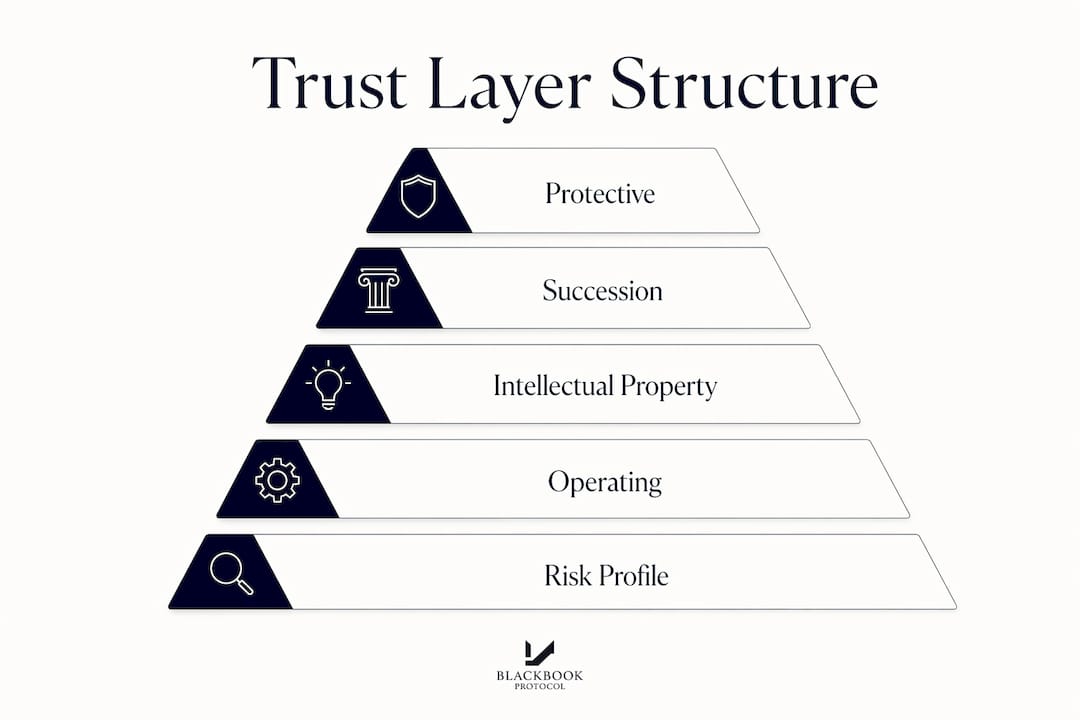
The architecture typically comprises three primary trust layers working in sequence.
- Protective trust layer. This layer holds personal and family wealth, shielding it from business creditors and legal claims arising from operational activity. Protective trusts integrate with wills and family property trusts to preserve assets across generations.
- Business succession trust layer. This layer governs the transfer of enterprise value, ensuring continuity of ownership without triggering unnecessary tax events or probate exposure.
- IP and operational holding layer. Intellectual property, brand assets, and AI-related tools sit in a separate holding entity. Operating companies licence these assets under formal agreements, keeping high-value IP away from front-line operational risk.
Sitting alongside these trust layers are two structural models that Blackbookprotocol uses to explain how the layers relate to one another. The Engine and Vault Model treats the operating company as the engine generating income and the trust structure as the vault preserving it. The 95/5 trust-equity split allocates 95% of beneficial interest to the trust and 5% to the operating director, reducing personal exposure while maintaining operational control.
| Layer | Primary function | Risk profile |
|---|---|---|
| Protective trust | Holds personal and family wealth | Low: insulated from business claims |
| Business succession trust | Governs enterprise transfer | Medium: managed through formal succession terms |
| IP and operational holding | Holds intellectual property and licences | Low: separated from operating liabilities |
| Operating company | Generates revenue and absorbs trading risk | High: front-line exposure to creditors and claims |

Pro Tip: Where IP is a material strategic asset, founders may consider holding it separately from the trading company and licensing it to the operating business. Whether that structure is appropriate depends on the commercial, tax, legal and financing circumstances.
How does trust layering mitigate risk and protect assets?
A single undifferentiated operating company becomes what practitioners call a legal junk drawer, absorbing every category of risk without distinction. Layering solves this by isolating each risk type within a container that cannot contaminate the others.
The risk categories that trust layering directly addresses include:
- Creditor claims. Operational debt and supplier disputes remain confined to the operating entity. Personal and trust-held assets sit beyond the reach of those claims.
- Litigation exposure. A lawsuit against the operating company cannot pierce the protective trust layer without a separate legal action, which raises the cost and complexity of any claim.
- IP vulnerability. Brand value and proprietary systems held in a separate IP entity are not at risk when the operating company faces financial difficulty.
- Succession risk. Without a business succession trust, enterprise value can be lost to probate, family disputes, or forced sale on the death of a principal.
- AI and technology liability. As AI agents become operational assets, separating AI-related tools into distinct entities reduces exposure from AI-generated errors or regulatory action.
The mechanism that makes this isolation work is the arm's length agreement. Each inter-entity relationship must reflect genuine economic reality: a licence fee, a management charge, or a loan at market rate. Without those agreements, courts and HMRC can disregard the structure entirely.
Pro Tip: Document every transaction between entities as if the parties were unconnected strangers. Informal arrangements between related entities are the most common reason layered structures fail under scrutiny.
What legal frameworks underpin Blackbookprotocol trust layers?
UK trust law provides the statutory and common law foundation for the Blackbookprotocol trust framework. Trustees carry fiduciary duties requiring them to act in the best interests of beneficiaries, maintain accurate records, and avoid conflicts of interest. Those duties are not optional formalities. They are the legal basis on which the entire layered structure rests.
The key legal principles that support trust layer implementation are:
- Fiduciary integrity. Trustees must act independently of the settlor's day-to-day instructions once the trust is established. Blurring this boundary undermines the trust's legal standing.
- Transparency and documentation. Formal documentation and alignment with economic reality strengthen fiduciary integrity and reduce the risk of disputes or HMRC challenge.
- Beneficiary rights. Beneficiaries hold enforceable rights to information and proper administration. A well-drafted trust deed defines those rights clearly.
- Tax compliance. Layered structures must comply with the UK's Inheritance Tax Act 1984, the Taxation of Chargeable Gains Act 1992, and relevant HMRC guidance on trust taxation. Structures designed purely to avoid tax without commercial substance are vulnerable to challenge under the General Anti-Abuse Rule.
- Inheritance planning integration. Trust layers connect directly to estate planning. A protective trust that integrates with a will ensures that assets pass to intended beneficiaries without unnecessary probate exposure.
Blackbookprotocol's approach differs from a simple limited company or sole trader model because it treats the legal structure as a coordinated system rather than a single container. A sole trader owns everything personally. A single limited company separates personal and corporate liability but leaves all corporate assets in one exposed entity. Layered trusts create multiple lines of defence, each governed by its own legal instrument.
How can professionals implement Blackbookprotocol trust layers in practice?
Practical trust layer implementation begins with a thorough asset and risk audit. Before designing any structure, you need a clear picture of what the client owns, what they owe, and what they are trying to protect.
The questions that drive the design process are direct:
- What categories of asset does the client hold: property, IP, business equity, cash, or pension?
- Which assets face the highest legal or creditor exposure?
- What are the client's succession intentions, and over what time horizon?
- Does the client operate through a trading entity, and if so, does that entity currently hold any assets that should sit in a protected layer?
- Are there existing trusts, wills, or shareholder agreements that the new structure must integrate with?
Once those questions are answered, the implementation follows a structured sequence.
- Draft the trust deed. The deed defines the trust type, trustee powers, beneficiary class, and distribution rules. Precision here prevents disputes later.
- Establish the holding and IP entities. Incorporate the appropriate holding company or IP trust and transfer relevant assets under formal, documented agreements.
- Execute inter-entity agreements. Licence agreements, management service agreements, and loan agreements must reflect arm's length terms and be signed before any transactions occur.
- Register with HMRC. Trusts with tax consequences must be registered on the Trust Registration Service. Failure to register carries financial penalties.
- Establish governance protocols. Trustee meetings, minutes, and annual reviews are not administrative niceties. They are the evidence that the structure operates as a genuine legal arrangement rather than a paper exercise.
- Integrate with the client's will and lasting power of attorney. The trust layers only deliver full protection when the estate planning documents align with the entity structure.
A practical example illustrates the outcome. A professional services firm with £2m in brand value, £500,000 in property, and a trading company generating £300,000 per year in revenue can separate those three asset categories into an IP trust, a family property trust, and an operating company respectively. A creditor claim against the operating company cannot reach the IP trust or the property trust. The Blackbookprotocol asset protection resources provide the templates and frameworks to structure that separation correctly.
Pro Tip: Review the inter-entity agreements annually. Commercial terms that made sense at inception may no longer reflect market rates, which creates HMRC risk and weakens the arm's length argument.
Key takeaways
Blackbookprotocol's trust layer architecture works because it separates every category of asset and risk into a distinct legal entity, governed by formal agreements that reflect genuine economic reality.
| Point | Details |
|---|---|
| Multi-tiered separation | Divide assets into protective, succession, IP, and operating layers to isolate each risk category. |
| Arm's length agreements | Every inter-entity transaction must be documented at market terms to withstand legal and HMRC scrutiny. |
| Fiduciary compliance | Trustees must act independently and maintain full records to preserve the legal standing of each layer. |
| Succession integration | Trust layers only deliver full protection when aligned with wills and lasting powers of attorney. |
| Living system governance | Annual reviews of agreements and trustee minutes keep the structure legally defensible as risks evolve. |
Why the static structure mindset is the biggest mistake I see
The most common error I observe among legal and finance professionals is treating a layered trust structure as a one-time filing exercise. They establish the entities, sign the deeds, and then leave the structure untouched for years. That approach defeats the purpose entirely.
A living system approach to asset protection means the structure adapts as the client's risk profile changes. A new AI tool deployed in the operating company is a new liability. A change in HMRC guidance on trust taxation requires a review of distribution policies. A new business partner changes the succession calculus. None of those events are exceptional. They are the normal rhythm of a professional's working life.
The professionals who get this right treat governance as part of the service. They schedule annual trustee reviews, update inter-entity agreements when commercial terms shift, and check that the trust registration remains current. The ones who get it wrong discover the gaps only when a creditor claim or HMRC enquiry forces the issue.
The 95/5 trust-equity split and the Engine and Vault Model are not clever tricks. They are structural principles that only hold under scrutiny when the governance behind them is real. A well-designed structure with poor governance is no more protective than a single operating company.
— Blackbook
Blackbookprotocol resources for trust layer implementation
Legal and finance professionals who want to move from understanding to application need more than a conceptual framework. Blackbookprotocol's Asset Protection Audio, eBook & Templates package delivers the precise tools required to design and implement layered trust structures with confidence.

The package includes the Engine and Vault Model framework, the 95/5 trust-equity split methodology, and ready-to-use templates for inter-entity agreements and trust governance documentation. These resources are designed specifically for professionals who need to build structures that hold under legal scrutiny, not just look correct on paper. For professionals advising clients on wealth management integration, the package provides the structured methodology to move from audit to implementation without gaps.
FAQ
How does the Blackbook Protocol 95/5 structure work?
Blackbook Protocol's 95/5 structure should not be confused with a conventional startup cap-table arrangement where one founder owns 95% and another owns 5%. In the Blackbook Protocol framework, the 95/5 split refers to the beneficial ownership of shares in the operating company: 95% of the shares are held by the trustees for the trust, and 5% is held by the operating director. The precise legal, tax and governance consequences depend on the trust deed, share structure and circumstances of the arrangement.
What is the Blackbook Protocol trust layer framework?
The Blackbookprotocol trust layer framework is a multi-tiered legal architecture that separates personal wealth, intellectual property, and operating activity into distinct legal entities linked by formal agreements. Each layer serves a specific protective function and is governed by its own legal instrument.
What is the Engine and Vault Model in Blackbook Protocol?
The Engine and Vault Model treats the operating company as the income-generating engine and the trust structure as the vault that preserves accumulated value. The two operate under formal agreements that keep generated wealth protected from operating risk.
Why do arm's length agreements matter in trust layering?
Arm's length agreements are the legal evidence that each entity in the structure operates independently. Without them, courts and HMRC can disregard the separation between entities and treat all assets as belonging to a single owner.
How does trust layering differ from a standard limited company structure?
A limited company separates personal and corporate liability but leaves all corporate assets in one exposed entity. Trust layering creates multiple distinct containers, each with its own legal protection, so a claim against one entity cannot automatically reach assets held in another.
0 commenti