

TL;DR:
- Business succession planning prepares a business for leadership changes, protecting its value and continuity. It increases sale multiples, retains key talent, and reduces the risk of rapid value loss after an owner’s departure. Early, comprehensive planning focused on developing multiple leadership candidates is essential for all business sizes.
Business succession planning is the process of identifying and preparing the people, structures, and legal frameworks that will keep your business running when you are no longer at the helm. Most business owners treat it as a retirement task. That is a costly mistake. The Exit Planning Institute, KPMG, and Egon Zehnder all confirm that planned businesses sell at higher multiples, retain talent more effectively, and survive leadership transitions that would otherwise destroy value. Understanding why business succession planning matters is not an academic exercise. It is the difference between a business that outlasts its founder and one that collapses with them.
Why business succession planning matters for your valuation
A succession plan is a valuation tool before it is anything else. Companies with board-reviewed succession plans trade at 0.5 to 1.0 turns of EBITDA more than peers without one, and owners with plans sell at 20–35% higher multiples. That premium exists because buyers price out risk. A business that depends entirely on one person is a liability. A business with documented leadership depth and a clear transition roadmap is an asset.
The downside of no plan is equally measurable. Businesses whose owner exits without a plan may lose 30–50% of value within 12 months due to customer churn, bank covenant breaches, and staff departures. That is not a slow decline. It is a rapid destruction of everything you have built.
Succession planning also addresses what buyers call “key-person risk.” When a business’s revenue, relationships, or operational knowledge sits entirely with one individual, acquirers apply a discount at sale. A formal plan reduces that discount by demonstrating that the business can function independently of its founder. Firms with active succession plans retain key talent at 2.4 times the rate of peers without one. Retained talent signals continuity to buyers, lenders, and clients alike.
| Metric | With succession plan | Without succession plan |
|---|---|---|
| Sale multiple premium | 20–35% higher | Baseline |
| EBITDA valuation uplift | 0.5–1.0x turns above peers | None |
| Talent retention rate | 2.4x higher | Baseline |
| Value loss after unplanned exit | Minimal | 30–50% within 12 months |
| Deal closure speed (family businesses) | 23% faster | Baseline |
“Family businesses with succession plans close deals 23% faster than those without.” — KPMG, 2025
Traditional vs. readiness-based succession planning
Most business owners picture succession planning as a simple handover document: name a successor, sign the paperwork, done. That model is brittle. Markets shift, named successors leave, and the business you built in 2020 may look nothing like the one you exit in 2030.
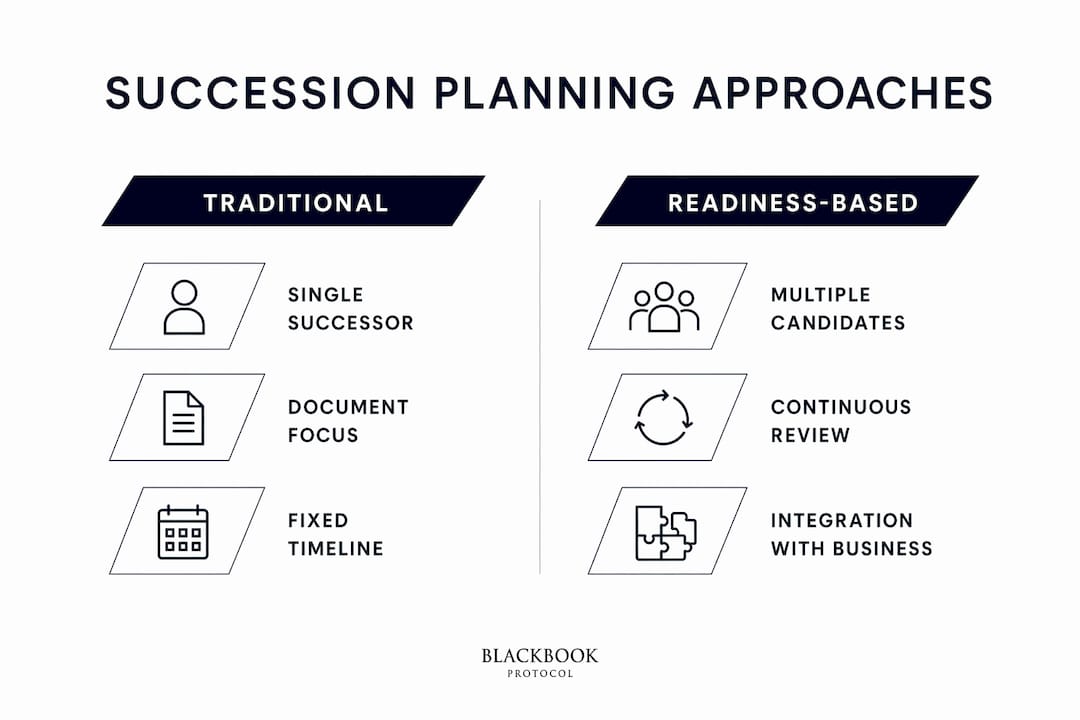
Wharton Executive Education research shows that 86% of leaders say succession planning is critical, yet 70% feel it is futile because of how rapidly business conditions change. That gap is not a reason to abandon planning. It is a reason to plan differently.
Readiness-based planning shifts the focus from “who will fill this role” to “what capabilities does the business need, and who is developing them now.” Rather than locking in a single successor, you build a bench. You invest in leadership development across multiple people, so the business is not hostage to any one individual’s availability or willingness.
Leadership cycles average eight years across critical business roles. That means a business of any meaningful size will face multiple leadership transitions over its life. Planning for one handover is not enough. The goal is an enterprise-wide culture of stewardship, where leadership continuity is built into how the business operates, not bolted on at the end.
- Audit all critical roles, not just the CEO or founder position.
- Identify two or three internal candidates for each role and track their development.
- Review the plan annually against changes in the market and the business model.
- Build flexibility into the plan to account for unexpected departures or market disruption.
- Treat leadership development as a recurring operational cost, not a one-off project.
Pro Tip: Link your succession plan to your annual business review cycle. A plan that sits in a drawer for five years is not a plan. It is a liability.
What are the biggest risks of poor succession communication?
Legal and financial structures alone do not protect a business during a leadership transition. Communication does. Succession planning is a critical communication tool, and the absence of clear dialogue stalls decisions and undermines client confidence even when the legal paperwork is in order.

Approximately one in three CEOs exit with little notice. When that happens without a communicated plan, the consequences are immediate. Clients question whether their contracts will be honoured. Key staff start looking for exits. Banks review covenants. Suppliers tighten terms. None of these outcomes are inevitable. All of them are preventable with transparent, early communication.
The practical steps are straightforward. Identify your key stakeholders: employees, clients, lenders, and suppliers. Decide what each group needs to know and when. Document role clarity and career pathways for internal staff so that a leadership change does not feel like an existential threat to their positions. Clients need reassurance that service continuity is guaranteed. Lenders need evidence that the business has operational depth.
- Map your stakeholders and their specific concerns about a leadership transition.
- Draft a communication plan that addresses each group separately.
- Share the succession plan with your board or advisory body and get formal sign-off.
- Communicate role clarity and career pathways to key employees before any transition begins.
- Brief your most important clients personally, not through a generic announcement.
Pro Tip: Transparent communication during succession planning is not a sign of weakness. It is the single most effective way to preserve client confidence and staff loyalty during a transition.
How to start succession planning as a business owner
The most common reason business owners delay succession planning is the belief that it is only relevant at retirement. It is not. The tax-advantaged structures that maximise exit value, such as QSBS exclusions and ESOP rollover provisions, require holding periods of three to five years. Waiting until you are ready to sell disqualifies you from savings that could be worth millions.
Start with these practical steps:
- Document the plan now. A written plan, reviewed by legal and financial advisers, is the foundation. Verbal agreements are not enforceable and do not signal credibility to buyers or lenders.
- Involve the right people. Family members, key employees, and external advisers all have a role. Excluding any of these groups creates blind spots and resentment.
- Establish interim leadership. Identify who runs the business if you are incapacitated tomorrow. This is not morbid planning. It is basic risk management.
- Take out key-person insurance. This protects the business’s financial position during a transition and signals to lenders that the risk is managed.
- Integrate tax-advantaged structuring early. Work with a specialist to identify structures that reduce your tax liability on exit. The earlier you start, the more options you have.
- Use a board or advisory body. A formal governance structure that reviews and approves the succession plan adds credibility and accountability.
Succession planning also connects directly to legacy and wealth preservation. The business you build is likely your largest asset. Protecting it through a formal succession plan is the same discipline as protecting any other asset in your portfolio.
| Approach | Traditional planning | Readiness-based planning |
|---|---|---|
| Focus | Naming a single successor | Developing a leadership bench |
| Flexibility | Low | High |
| Risk of failure | High if named successor leaves | Low, multiple candidates prepared |
| Review frequency | Once at retirement | Annual, linked to business cycle |
| Scope | CEO or owner role only | All critical roles |
Key takeaways
Business succession planning is the highest-return document a founder will sign, protecting valuation, retaining talent, and preserving legacy across every stage of the business lifecycle.
| Point | Details |
|---|---|
| Valuation premium | Planned businesses sell at 20–35% higher multiples and 0.5–1.0x more EBITDA turns. |
| Talent retention | Firms with succession plans retain key staff at 2.4 times the rate of those without. |
| Communication is non-negotiable | Clear stakeholder dialogue prevents client loss and staff departures during transitions. |
| Start early for tax benefits | Tax-advantaged exit structures require three to five years of holding periods to qualify. |
| Plan for all critical roles | Succession planning covers every key position, not just the founder or CEO. |
Succession planning is a founder’s best investment
I have reviewed hundreds of business exits, and the pattern is consistent. The founders who planned early walked away with significantly more money, fewer legal complications, and businesses that continued to thrive. The ones who delayed, or assumed they had time, often did not.
The misconception I encounter most often is that succession planning threatens founder control. The opposite is true. A formal plan gives you control over the outcome. Without one, the outcome is controlled by circumstance, by whoever is available, by what the market will bear at the moment you are forced to exit.
The founder legacy planning checklist at Blackbookprotocol addresses this directly. The businesses that survive their founders are not the ones with the best products. They are the ones with the best governance. Succession planning is governance. It is also the clearest signal to every stakeholder that you take the long-term health of the business seriously.
One more point that rarely gets discussed: succession planning is not just for the C-suite. The departure of a key account manager, a lead engineer, or a finance director can be just as disruptive as losing a CEO. A plan that covers only the top of the organisation is incomplete. Build depth at every critical level, and review it every year.
— Blackbook
Protect your business with Blackbookprotocol resources
Succession planning works best when it sits inside a broader framework of asset protection and governance.

Blackbookprotocol has built a suite of resources specifically for business owners who want to protect what they have built. The asset protection audio, eBook, and templates cover UK Trust Law structures, 95/5 equity splits, and tax-efficient frameworks that support both succession and legacy planning. For owners who want a deeper reference, the Blackbook Protocol hardback provides a comprehensive governance blueprint. These resources are designed for founders who want financial sovereignty, not just a plan that sits in a drawer.
FAQ
What is business succession planning?
Business succession planning is the process of preparing a business for leadership transitions by identifying successors, documenting governance structures, and protecting business value. It applies to all critical roles, not just the founder or CEO.
How does succession planning increase business value?
Businesses with formal succession plans sell at 20–35% higher multiples and reduce key-person risk discounts that buyers apply at sale. Retained talent and documented leadership depth both contribute to higher valuations.
When should a business owner start succession planning?
Business owners should start succession planning as early as possible. Tax-advantaged exit structures require holding periods of three to five years, meaning late planning disqualifies owners from significant savings.
What happens if a business has no succession plan?
A business without a succession plan may lose 30–50% of its value within 12 months of an unplanned owner exit due to client departures, bank covenant issues, and staff turnover.
Is succession planning only relevant for large businesses?
Succession planning applies to businesses of all sizes. Small and medium-sized businesses face the same key-person risks as large corporations, and the financial consequences of an unplanned exit are proportionally just as severe.
0 commentaire