

TL;DR:
- The trust wind-up process involves systematically closing a trust by fulfilling all legal, financial, and administrative obligations before distributing assets. Proper preparation, documentation, and following a fixed sequence ensure legal compliance and protect trustees from liability. Disputes and errors during the process can cause delays, legal risks, and ongoing tax obligations if not managed carefully.
The trust wind-up procedure, known formally as the winding-up period, is the systematic process of closing a trust by fulfilling all its legal, financial, and administrative obligations before distributing assets and formally dissolving the arrangement. Under UK trust law, governed by the Trustee Act 2000 and HMRC guidelines, trustees carry personal fiduciary responsibility throughout this process. Errors at any stage, from premature distributions to incomplete tax filings, expose trustees to direct legal liability. This guide covers every stage of the trust dissolution process, from initial preparation through to final tax closure, so you can complete each step correctly and protect everyone involved.
What prerequisites and documents are needed before starting?
Preparation determines whether the wind-up runs smoothly or stalls. Before taking any formal action, the trustee must review the trust deed in full, including all amendments, to confirm the exact termination provisions and any conditions that must be satisfied first. Understanding the trust deed terms is non-negotiable at this stage.
The following documents must be gathered before proceeding:
- The original trust deed and all deed of variation documents
- A full list of beneficiaries, including contingent beneficiaries
- Current financial statements and asset appraisals
- Tax records for all years the trust has been active
- Trustee appointment and resignation documents
- Bank and investment account statements
- Any outstanding creditor claims or pending litigation records
Written notices to beneficiaries must identify the trustee, explain the reason for termination, and state the timeline for distribution. This sets clear expectations and reduces the risk of later disputes. Under UK rules, creditors must also receive formal notice so they can submit any outstanding claims before distributions begin.
| Document | Purpose |
|---|---|
| Trust deed and amendments | Confirms termination conditions and distribution instructions |
| Beneficiary schedule | Identifies all parties entitled to receive assets |
| Asset appraisals | Establishes current market value for distribution calculations |
| Tax records | Supports preparation of final tax returns |
| Creditor notices | Protects trustee from post-distribution claims |

Pro Tip: Engage a solicitor, tax adviser, and accountant before sending any notices. Professional input at this stage prevents costly corrections later in the process.
What are the step-by-step actions to wind up a trust properly?
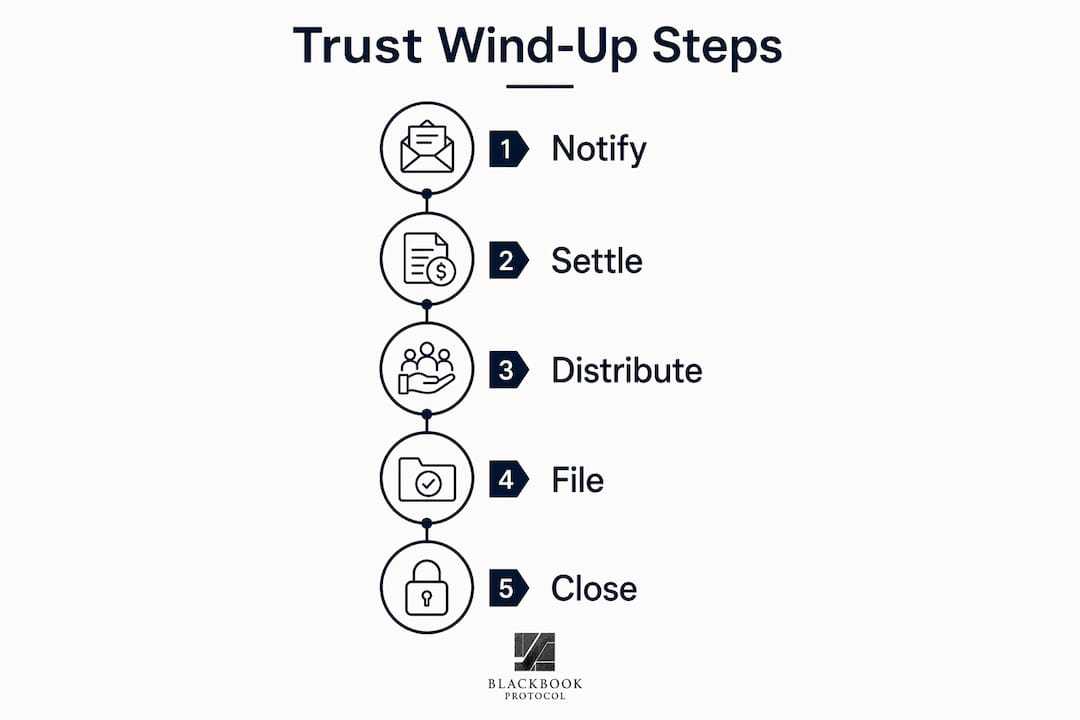
The trust wind up procedure step by step follows a fixed sequence. Skipping or reordering steps creates legal and tax exposure. Closing a trust typically spans several months to over a year, depending on asset complexity and whether disputes arise. That timeline matters because the legal termination date and the completion of all administrative tasks are distinct events. The winding-up period covers everything that happens between those two points.
The ten core steps
-
Notify beneficiaries and creditors in writing. The notice must identify the trustee, state the reason for termination, and give a clear distribution timeline.
-
Settle all debts and expenses. Pay outstanding trustee fees, legal costs, and administrative charges before any asset distribution. Creditors take priority over beneficiaries.
-
Liquidate trust assets where necessary. Convert illiquid or specialist assets, such as property or private company shares, to cash if required by the trust deed or by beneficiary agreement. Specialist valuations are required for non-standard assets.
-
Prepare the final trust accounting. This document records every transaction during the winding-up period. It must be accurate, complete, and presented to beneficiaries for review.
-
Obtain beneficiary consent or court approval. Under UTC Section 414(a), any qualified beneficiary objection stops a non-judicial termination. If a beneficiary objects, the trustee must petition the court.
-
Distribute assets per the trust deed. Follow the deed’s instructions precisely. Deviation, even with good intentions, constitutes a breach of fiduciary duty.
-
Obtain signed releases of liability. Signed releases confirm each beneficiary’s approval of the final accounting and waive their right to sue over the trustee’s administration. Distributing assets before receiving these releases exposes the trustee to significant legal risk.
-
Close all trust bank and financial accounts. Financial institutions require proof of authority and confirmation of zero balances before closing accounts. Retain all closure documentation.
-
File the final tax returns. In the UK, this means submitting a final Self Assessment return for the trust to HMRC, reporting all income and gains up to the date of termination. Issue final tax statements to beneficiaries so they can report their share of trust income correctly.
-
Formally deactivate the trust’s tax identity. Notify HMRC that the trust has ceased. Failure to do this correctly results in continued tax obligations and potential penalties.
Warning: Premature asset distributions, made before debts are settled and releases obtained, are one of the most common and costly mistakes in trust closure. They can trigger personal liability for the trustee and require costly legal remedies to unwind.
| Step | Timing | Key document |
|---|---|---|
| Notify beneficiaries and creditors | Immediately on decision to wind up | Written notice letter |
| Settle debts and expenses | Before any distribution | Creditor receipts and fee invoices |
| Prepare final accounting | After all transactions complete | Final trust accounts |
| Obtain signed releases | Before final distribution | Release and indemnity forms |
| File final tax returns | Within statutory deadlines | HMRC Self Assessment return |
Pro Tip: For trusts with straightforward assets and cooperative beneficiaries, a non-judicial settlement agreement can reduce cost and time significantly. Always confirm eligibility with a solicitor before proceeding without court involvement.
How can trustees handle complications or disputes during wind-up?
Disputes are the single biggest cause of delays in the trust dissolution process. Beneficiary objections to distribution calculations, disagreements over asset valuations, and challenges to the trustee’s conduct all have the potential to extend the winding-up period by months. Trustees who understand the most common complications can address them before they escalate.
The most frequent complications include:
- Beneficiaries disputing their share of the final distribution
- Disagreements over the valuation of illiquid assets such as property or business interests
- Creditors submitting claims after the notice period has closed
- Legal challenges to the trustee’s conduct during the trust’s lifetime
- Beneficiaries who cannot be located or who lack legal capacity to consent
Clear, documented communication is the primary defence against disputes. Every decision the trustee makes during the wind-up must be recorded in writing, with the reasoning stated. This creates an audit trail that protects the trustee if a beneficiary later challenges the process. The trust review process for complex estates highlights how thorough documentation prevents the majority of post-distribution disputes.
When a beneficiary formally objects, the trustee has two main options. The first is a non-judicial settlement agreement, where all parties negotiate a resolution without court involvement. The second is a court petition, which is necessary when agreement cannot be reached. Court involvement adds cost and time, but it also provides the trustee with a binding order that eliminates personal liability for the disputed decision.
Pro Tip: Appoint a professional mediator at the first sign of disagreement. Mediation resolves most trust disputes faster and at lower cost than litigation, and it preserves relationships between beneficiaries.
Trustees must also watch for warning signs that indicate a dispute is developing. These include beneficiaries requesting independent valuations, solicitors writing on behalf of beneficiaries, and beneficiaries refusing to sign the final accounting. Each of these signals requires immediate professional advice.
What are the tax and legal formalities after final distributions?
Tax closure is the final stage of the step by step trust closure process, and it is where many trustees make avoidable errors. Filing the final tax return is not sufficient on its own. The trustee must also issue tax statements to each beneficiary, formally notify HMRC that the trust has ceased, and retain all records for the required period.
In the UK, HMRC requires the trustee to file a final Self Assessment trust return, reporting all income and capital gains up to the date of termination. Each beneficiary must receive a statement showing their share of trust income and gains so they can include this in their own tax returns. Failure to file final trust tax returns correctly and on time leads to penalties and continued obligations. The trust’s tax identity remains active until HMRC confirms closure, which means ongoing filing obligations if the trustee does not act promptly.
Capital gains arising on asset disposals during the wind-up are taxable in the year they occur. The trustee must calculate gains on each asset sold or transferred, applying the correct base cost and any available reliefs. Depreciation and income accrued up to the termination date must also be reported accurately.
| Final requirement | Deadline | Responsible party |
|---|---|---|
| Final Self Assessment trust return | 31 january following tax year end | Trustee |
| Beneficiary tax statements | Before beneficiary’s filing deadline | Trustee |
| HMRC trust cessation notification | On or after final distribution | Trustee |
| Record retention | Minimum six years post-closure | Trustee |
Pro Tip: Retain all trust records, including correspondence, accounts, and tax filings, for at least six years after closure. HMRC can open an enquiry into a closed trust, and complete records are the only reliable defence.
Post-closure, the trustee may receive notices or queries from HMRC. These must be responded to promptly and accurately. Ignoring post-closure correspondence does not end the obligation. It creates additional penalties and can reopen the trust’s tax affairs. Working with a tax professional who specialises in trust taxation reduces this risk considerably. The UK trust law compliance checklist provides a practical reference for confirming all legal and tax obligations have been met before considering the wind-up complete.
Key takeaways
The most reliable way to wind up a trust is to follow a fixed sequence of legal, financial, and tax steps, obtaining signed releases before any distribution and filing all HMRC returns promptly after closure.
| Point | Details |
|---|---|
| Prepare thoroughly before acting | Gather the trust deed, beneficiary schedule, asset appraisals, and tax records before sending any notices. |
| Follow the ten-step sequence | Each step builds on the last; skipping steps creates fiduciary and tax liability for the trustee. |
| Obtain signed releases before distributing | Releases protect the trustee from future litigation and formally end fiduciary duties to each beneficiary. |
| File final tax returns promptly | HMRC requires a final Self Assessment return and beneficiary statements; delays create ongoing obligations. |
| Retain records for six years | Post-closure enquiries from HMRC are possible; complete documentation is the only reliable defence. |
What I have learned from trust wind-ups done well and done badly
The procedural steps in a trust wind-up are well established. What separates a clean closure from a drawn-out dispute is almost always the quality of communication and recordkeeping, not the complexity of the assets involved.
The most common mistake I see is trustees treating the legal termination date as the finish line. It is not. The winding-up period, the time between legal termination and the completion of all administrative tasks, is where the real work happens. Trustees who underestimate this phase end up rushing the final accounting, missing creditor claims, or distributing assets before releases are signed. Each of those errors is avoidable with a clear checklist and professional support.
Irrevocable trusts present a particular challenge. They can be dissolved through court orders or non-judicial agreements when they no longer serve a material purpose, but the process requires careful legal advice. Trustees who attempt to dissolve an irrevocable trust without proper authority expose themselves to serious personal liability.
The trustees who manage wind-ups most effectively are those who communicate early, document everything, and engage professionals before problems arise rather than after. That approach costs less in the long run and protects both the trustee and the beneficiaries.
— Blackbook
Blackbookprotocol resources for trust wind-up and estate planning
Completing a trust wind-up correctly requires more than a checklist. It requires a working understanding of UK trust law, fiduciary duties, and tax compliance that most trustees build over years of practice.

Blackbookprotocol has produced a suite of resources specifically for individuals and professionals managing trust structures and asset protection. The asset protection audio, eBook, and templates cover UK trust law, 95/5 equity splits, and tax-efficient governance in practical, structured formats you can apply directly to your situation. Whether you are managing a straightforward family trust or a complex nested arrangement, these resources give you the frameworks to act with confidence and protect your legacy at every stage.
FAQ
What is the winding-up period in a trust?
The winding-up period is the time between a trust’s legal termination date and the completion of all administrative tasks, including settling debts, distributing assets, and filing final tax returns. It is distinct from the termination date and is critical for trustee accountability.
How long does it take to wind up a trust?
Closing a trust typically spans several months to over a year, depending on asset complexity, the number of beneficiaries, and whether any disputes arise during the process.
Do trustees need signed releases before distributing assets?
Yes. Signed releases confirm each beneficiary’s approval of the final accounting and waive their right to sue over the trustee’s administration. Distributing assets without releases exposes the trustee to significant legal risk.
What happens if the final trust tax return is not filed?
Failure to file the final trust tax return correctly and on time results in penalties and keeps the trust’s tax identity active with HMRC, creating ongoing filing obligations until the matter is resolved.
Can an irrevocable trust be wound up?
Irrevocable trusts can be dissolved through court orders or non-judicial settlement agreements when they no longer serve a material purpose. Trustees must obtain proper legal authority before proceeding, as acting without it creates personal liability.
Recommended
- Trust deed drafting checklist: your complete 2026 guide – BLACKBOOK PROTOCOL
- Trust review process for UK high-net-worth clients – BLACKBOOK PROTOCOL
- Nested trust arrangement checklist: 10 steps to get it right – BLACKBOOK PROTOCOL
- Navigating trust registration service UK: 2026 guide – BLACKBOOK PROTOCOL
0 commentaire