

Without a structured approach to setting up a trust review process for clients, even the most carefully drafted trust deed can become a liability. Circumstances change. Tax rules shift. Beneficiaries are born, married, divorced, or estranged. For high-net-worth individuals in the UK, where trust structures often sit at the centre of inheritance tax planning, asset protection, and multi-generational wealth transfer, a trust that is not actively reviewed is a trust that is quietly failing. This guide covers preparation, execution, and verification so your trust arrangements remain legally sound and aligned with your intentions.
Table of Contents
- Understanding what you need before setting up the trust review process
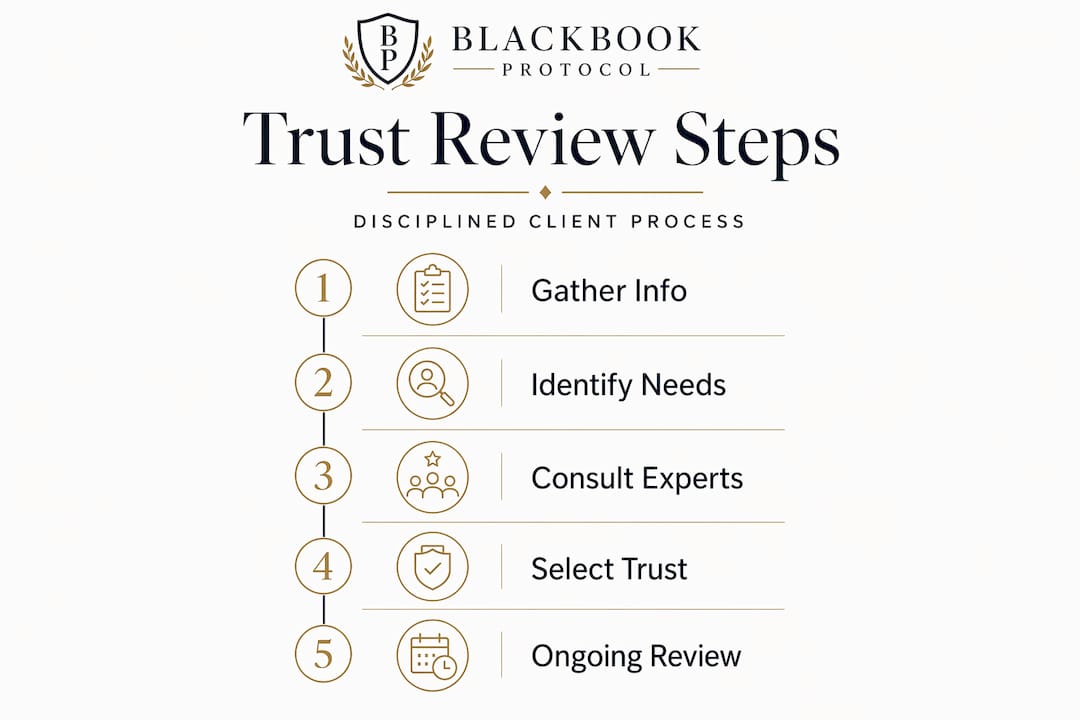
- Step-by-step: setting up your trust review process for clients
- Maintaining and verifying the trust review process for ongoing compliance
- Governance and trustee roles in the trust review process
- A fresh perspective: why conventional trust review approaches often fall short
- Further support: guides and tools to strengthen your trust review process
- Frequently asked questions
Key Takeaways
| Point | Details |
|---|---|
| Comprehensive preparation | Gather detailed client financial, residency, and trust information before starting the review process to ensure suitability. |
| Structured setup | Establish a clear trust review process including deed execution, trustee appointment, asset transfer, registration, and record keeping. |
| Ongoing compliance | Review trusts periodically and update beneficiary and trustee details promptly to meet HMRC requirements. |
| Governance matters | Implement strong trustee governance and oversight to align decisions with settlor intentions and protect client interests. |
| Effective documentation | Maintain detailed decision logs and communications to support trustee accountability and prevent disputes. |
Understanding what you need before setting up the trust review process
Before any review can begin, you need a clear picture of the client’s full financial and personal circumstances. This is not simply a matter of pulling together a list of assets. It requires coordinating information across several professional disciplines, and gaps at this stage lead to misaligned advice later.
The information you need to gather includes:
- Inheritance tax (IHT) position: current estate value, available nil-rate bands, and any prior chargeable transfers
- Access-to-capital requirements: whether the settlor or beneficiaries need liquidity from trust assets in the short or medium term
- Pension arrangements: defined benefit or defined contribution pensions can interact significantly with trust planning
- International residency elements: domicile status, non-UK assets, and any cross-border tax obligations
- Existing trust arrangements: details of any trusts already in place, including their type, assets held, and trustee structure
Referrals for trust planning should include the client’s IHT position, access-to-capital needs, pension position, international residency elements, and current trusts to ensure the review covers the full scope. Missing even one of these dimensions can produce advice that is technically correct but practically unworkable.
The multi-disciplinary nature of UK trust work is also worth stating plainly. Wealth managers, solicitors, and accountants each hold a piece of the picture. Establishing client trust process correctly means building a referral and communication structure between these professionals before the review begins, not after problems arise.
| Information category | Why it matters |
|---|---|
| IHT position | Determines trust type suitability and tax exposure |
| Residency and domicile | Affects which assets can be held in trust and how they are taxed |
| Existing trusts | Prevents duplication and identifies interaction risks |
| Pension arrangements | Pensions may sit outside the estate; trusts must be planned around this |
| Capital access needs | Informs whether a discretionary or fixed interest trust is appropriate |
With a clear understanding of foundational requirements, let us explore how to establish the actual trust review process.
Step-by-step: setting up your trust review process for clients
A practical workflow for establishing a trust review process follows a logical sequence. Each step builds on the last, and skipping any one of them creates compliance risk or administrative confusion down the line.
- Draft and execute the trust deed. The trust deed must be signed by the settlor and all appointed trustees. It should specify trustee powers, the class of beneficiaries, and any restrictions on distributions. Vague drafting at this stage is the single most common source of dispute later.
- Appoint trustees formally. Trustees must understand and accept their fiduciary duties before signing. Where professional trustees are used, confirm their terms of engagement in writing.
- Transfer assets into the trust. This is a formal legal step, not an administrative formality. Property requires a deed of transfer, investments require re-registration, and cash requires a direct transfer to the trust’s bank account.
- Open a dedicated trust bank account. Mixing trust funds with personal funds is a serious breach of trustee duty. A separate account is non-negotiable.
- Register with HMRC’s Trust Registration Service (TRS). Most UK trusts must be registered with the TRS. Setting up a lifetime trust includes executing the trust deed, appointing trustees, transferring assets, and registering with HMRC’s Trust Registration Service. Failure to register on time attracts penalties.
- Establish a record-keeping system. From day one, trustees need a clear method for recording decisions, financial transactions, and any changes to the beneficiary class. Discretionary trusts require detailed records of distribution decisions, income and expenditure, asset valuations, and trustee and beneficiary changes.
Pro Tip: Draft a simple decision log template at the point of trust creation. Trustees are far more likely to document decisions consistently if the format is already in place rather than something they need to create under pressure.
The following table compares the two most common trust types used by high-net-worth individuals in the UK, to help frame the review process appropriately.
| Feature | Discretionary trust | Bare trust |
|---|---|---|
| Beneficiary entitlement | Trustees decide who benefits and when | Beneficiary has absolute entitlement |
| Flexibility | High | Low |
| IHT treatment | Subject to periodic and exit charges | Assets treated as beneficiary’s own |
| Record-keeping burden | Significant | Minimal |
| Typical use case | Family wealth protection, IHT planning | Holding assets for minors |
Now that you know how to set up the review process, let us examine how to maintain it effectively over time.
Maintaining and verifying the trust review process for ongoing compliance
Setting up the trust is only the beginning. The review process must be structured, recurring, and responsive to change. Without it, trust review best practices exist only on paper.
Key maintenance activities include:
- Scheduled review cycles. Align reviews with the trust deed’s terms and the client’s life stage. A trust holding property for minor children requires different review triggers than one designed for IHT mitigation across multiple generations.
- Prompt TRS updates. Beneficiary changes and TRS updates should happen within 90 days, with reviews recommended every three to five years or after major life events. This is not optional. Late updates can result in HMRC penalties and compliance failures.
- Proactive beneficiary communication. Effective trust administration depends on understanding settlor intentions, documenting decisions, and proactive communication with beneficiaries to prevent disputes. Silence breeds suspicion. Regular, clear communication reduces conflict before it starts.
- Documented discretionary decisions. Every time trustees exercise a discretionary power, the rationale must be recorded. This protects trustees personally and demonstrates that decisions are made in good faith and in line with the trust deed.
Pro Tip: Set a recurring calendar reminder for every trust under administration, timed three months before the five-year review mark. This gives enough time to gather updated valuations, tax positions, and beneficiary information before the formal review meeting.
“The most effective trust administration is not reactive. It is built around a consistent rhythm of review, documentation, and communication that trustees and beneficiaries can both rely on.”
Understanding ongoing maintenance lays the foundation for deeper governance insights, so let us explore important governance considerations.
Governance and trustee roles in the trust review process
Governance is where many trust review processes quietly break down. The legal structure may be sound, but without clear roles and oversight, decision-making becomes inconsistent and disputes become likely.
Key governance considerations include:
- Multiple trustees. A sole trustee concentrates all decision-making power in one person. This creates risk, particularly if that trustee becomes incapacitated or acts outside the trust deed’s terms.
- Professional trustees. For complex or high-value trusts, a professional trustee brings independence, expertise, and continuity. They are also subject to regulatory oversight, which adds a layer of accountability.
- Protectors. Sole trusteeship can concentrate decision power; families often implement protectors or oversight mechanisms to ensure alignment with settlor and beneficiary wishes. A protector can hold the power to remove and replace trustees, providing a governance check without taking on trustee duties.
- Decision logs. Every exercise of a discretionary power should be recorded with the date, the decision, and the reasoning. This is not bureaucracy. It is the primary evidence that trustees are acting properly.
When reviewing existing trust arrangements for clients, follow this governance checklist:
- Confirm the number and identity of current trustees, and whether any changes are needed.
- Review the trust deed for any protector provisions and confirm they are functioning as intended.
- Assess whether the trustee composition still reflects the settlor’s intentions and the trust’s complexity.
- Check that decision logs are up to date and cover all distributions made in the review period.
- Confirm that all trustees understand their duties and have access to current legal and tax advice.
Trustee administration should be driven by trust deed terms and settlor intentions, not generic checklists, to avoid interpretation problems. This point deserves emphasis. A governance framework that is not grounded in the specific trust deed is worse than no framework at all, because it creates a false sense of compliance.
Pro Tip: Where a trust has been in place for more than ten years without a formal governance review, treat the first review as a full audit. Check trustee appointments, TRS registration, decision logs, and beneficiary records from the beginning.
Having examined governance essentials, we now share a unique perspective on common pitfalls and expert tips for improving your trust review process.
A fresh perspective: why conventional trust review approaches often fall short
Most trust review failures do not begin with bad intentions. They begin with generic processes applied to specific situations. A trust review checklist downloaded from a legal website tells you what to look for in any trust. It does not tell you what matters in this trust, for this client, at this point in their life.
The two-stage review model is more reliable. The first stage is purely interpretive: read the trust deed, identify the powers available to trustees, and confirm that current administration has been consistent with those powers. The second stage is operational: review distributions made, confirm they align with the trustee’s documented rationale, and identify any decisions that need to be revisited. Many failures stem from assuming that discretionary powers allow unchecked trustee discretion; a consistent standard and clear communication to beneficiaries is essential.
The other common failure is siloed advice. A wealth manager recommends a trust structure. A solicitor drafts it. An accountant handles the annual tax return. None of them talk to each other regularly. Failing to incorporate residency analysis and multi-disciplinary coordination can result in disconnected advice and suboptimal trust outcomes. The review process must include a formal mechanism for these three professionals to share information and align their recommendations.
Finally, beneficiary communication is not a courtesy. It is a governance tool. Trustees who communicate proactively with beneficiaries, explaining decisions without necessarily disclosing confidential details, build the kind of trust that prevents litigation. It costs very little to do well. It costs a great deal to fix when it has been neglected.
Further support: guides and tools to strengthen your trust review process
If you are reviewing existing trust arrangements for clients or building a trust structure from the ground up, having the right reference material makes a material difference to the quality of decisions you make.

The Blackbook Protocol provides detailed legal and governance frameworks designed specifically for UK trust administration and asset protection. Whether you prefer a physical reference or a digital format, the hardback edition and Kindle eBook both cover trust law, 95/5 equity structures, and tax-efficient planning in depth. These resources are built for individuals who want to understand the mechanics of trust governance, not just the headlines.
Frequently asked questions
What information should I prepare before initiating a trust review process?
Prepare comprehensive details including your IHT position, trust objectives, access-to-capital needs, pension plans, residency status, and existing trust arrangements. Referrals for trust planning should include all of these elements to ensure the review covers the full scope.
How often should trusts be reviewed to maintain compliance and relevance?
Trusts should be reviewed every three to five years and following significant life events such as marriage, divorce, or bereavement. Reviews every three to five years are recommended, with TRS updates required within 90 days of any beneficiary or trustee changes.
What governance mechanisms can help improve trustee decision-making and client satisfaction?
Appointing multiple or professional trustees and using oversight roles such as protectors can ensure decisions align with settlor intentions and support accountability. Families often implement protectors to align trustee decisions with settlor and beneficiary wishes.
Why is documentation important in the trust review process?
Thorough documentation of trustee decisions, distributions, and communications protects trustees legally and ensures compliance with HMRC and trust deed requirements. Trustees should document decision-making processes, particularly for discretionary powers, to protect themselves and provide clarity.
What role does the HMRC Trust Registration Service play in trust reviews?
The HMRC Trust Registration Service requires timely registration and updates for trusts, including beneficiary and trustee changes, to maintain legal compliance. Trusts must be registered with HMRC’s TRS and updates made within 90 days of beneficiary or trustee changes.
Recommended
- Blackbook Protocol Hardback | Asset Protection & Corporate Governance – BLACKBOOK PROTOCOL
- Blackbook Protocol | UK Trust & Asset Protection Guide – BLACKBOOK PROTOCOL
- Blackbook Protocol | UK Trust Law & Asset Protection Guide 2026 – BLACKBOOK PROTOCOL
- Your Privacy Choices – BLACKBOOK PROTOCOL
0 commentaire