

TL;DR:
- Getting client onboarding trust documentation wrong can slow processes, erode trust, and introduce legal risks before work begins. Structured onboarding with enforceable steps and proper document collection ensures compliance, builds confidence, and reduces disputes. Ongoing verification and automation are essential for maintaining trust and regulatory adherence throughout the client relationship.
Getting the client onboarding trust documentation process wrong does not just slow things down. It erodes trust, creates compliance gaps, and exposes your business to legal risk before a single piece of work is delivered. Structured onboarding builds trust, prevents scope creep, and protects both parties. This guide gives you a practical framework: the documents you need, the steps to enforce them, and the verification habits that keep your practice compliant and your client relationships intact.
Table of Contents
- Key takeaways
- Essential documents for a compliant onboarding process
- Structured onboarding steps with enforceable documentation
- Verification and compliance monitoring after onboarding
- Common challenges and how to resolve them
- My take on where onboarding actually breaks down
- Take your trust documentation further with Blackbookprotocol
- FAQ
Key takeaways
| Point | Details |
|---|---|
| Start onboarding immediately | Send portal access and intake forms on the same day the contract is signed to prevent trust erosion. |
| Enforce, do not just track | Workflow enforcement gates progress so no step can be skipped, creating an immutable audit trail. |
| Document everything upfront | Gather contracts, KYC/KYB records, trust deeds, and compliance certifications before any work begins. |
| Verify and reconcile monthly | Trust accounts require monthly reconciliation reports and transaction logs retained for at least five years. |
| Prepare for KYC failures | Know the difference between image quality failures and fraud flags, and have an escalation process ready. |
Essential documents for a compliant onboarding process
Before any client relationship can be formalised under trust law, you need to know exactly which documents are required and why each one exists. Incomplete document collection at this stage is the single most common cause of delayed kickoffs, compliance breaches, and client disputes.
The term most widely used in regulated industries for this phase is client intake. It covers every piece of documentation gathered between contract signature and the point at which active work begins. For trust-related engagements, the stakes are higher because the documentation forms part of a legal structure that must be defensible to a regulator, a court, or a beneficiary.
The table below sets out the core documents, their function, and who is responsible for providing them.
| Document | Purpose | Provided by |
|---|---|---|
| Engagement letter | Defines scope, fees, and obligations | Adviser / firm |
| Signed contract | Creates the legal relationship | Both parties |
| Trust deed | Establishes the trust structure and parties | Client / solicitor |
| Proof of identity (government ID) | Satisfies KYC requirements | Client |
| Proof of address | Confirms residential or registered address | Client |
| AML screening confirmation | Flags politically exposed persons and sanctions | Compliance team |
| NDA (if applicable) | Protects confidential information shared during onboarding | Both parties |
| Authorised signatory forms | Records who can act on the trust account | Client / trustee |
| Compliance certification | Confirms the firm meets regulatory standards | Firm |
Identity verification must be completed before permitting account activities such as transfers or distributions. This is not a courtesy step. It is a legal requirement that integrates directly with the client’s account status within your system.

Trust accounts also carry specific structural requirements. Compliant trust account setup means using an approved bank, applying correct account titling, and recording authorised signatories from day one. If these prerequisites are not met before onboarding completes, you are building the relationship on a foundation that cannot withstand scrutiny.
Pro Tip: Create a master document checklist specific to trust engagements and attach it to every new client record. Mark each item as received, pending, or waived with a reason. This single habit prevents the majority of disputes about what was agreed.
Gathering complete, accurate documents upfront is not about bureaucracy. It is about preventing the kind of ambiguity that turns into disputes six months later. Clients who experience a thorough, professional intake process are significantly more likely to view the relationship as trustworthy from the outset.
Structured onboarding steps with enforceable documentation
Having the right documents listed is one thing. Getting them collected, signed, and verified in a traceable sequence is another entirely. The client onboarding process must be structured so that no step can be bypassed and every action leaves a record.
Starting onboarding immediately after contract signature is the single most important timing decision you will make. Send the client portal link and intake questionnaire on the same day as the contract. Every day of delay between signing and first contact increases the chance of confusion, second-guessing, and disengagement.
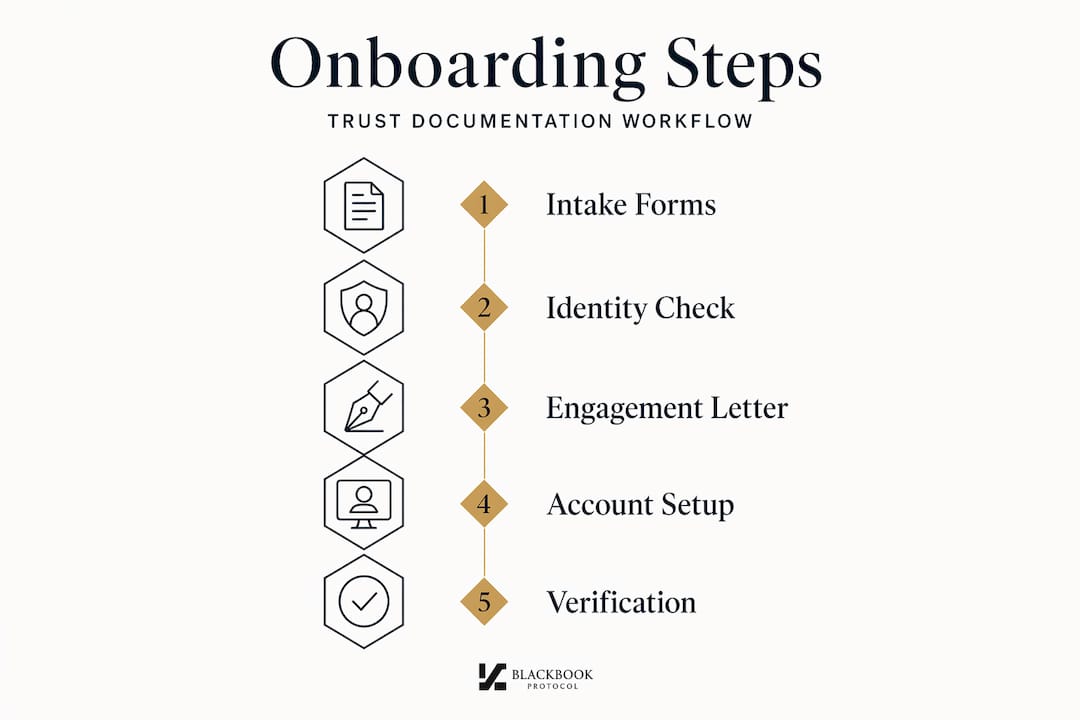
The steps below represent a sequential, enforceable onboarding workflow for trust documentation engagements.
- Send portal access and intake questionnaire on the day of contract signature. Include a clear list of required documents and a deadline for submission.
- Collect all documents via the secure portal using e-signatures and timestamped uploads. Do not accept documents by email. Email has no enforceable audit trail and creates version control problems.
- Run identity and AML screening as soon as identity documents are received. Flag any issues immediately rather than waiting until the kickoff meeting.
- Gate the kickoff meeting on completion of the intake checklist. If documents are missing, the meeting does not proceed. This is a firm rule, not a preference.
- Schedule the kickoff call for three to five days after contract signature. Keep the call to sixty minutes maximum and send the agenda at least twenty-four hours beforehand.
- Confirm the trust structure and authorised signatories during the kickoff. Any discrepancies identified at this stage are far cheaper to resolve now than after the trust account is active.
- Send a written recap within twenty-four hours of the kickoff. This recap becomes part of the onboarding record and closes any ambiguity about what was agreed.
- Set a two-week completion target for the full onboarding process. Onboarding beyond thirty days should be flagged as an active risk to the engagement.
Workflow enforcement and automated reminders are not optional extras. Enforcement means a client cannot tick a step as complete without the required action having taken place. Reminders reduce the bottlenecks caused by clients who intend to submit documents but do not prioritise it without a prompt.
Pro Tip: Set automated reminders at 48 hours and 24 hours before any document deadline. A second reminder the morning of the deadline recovers the majority of late submissions without requiring manual follow-up.
Verification and compliance monitoring after onboarding
Completing the initial intake is not the end of the trust documentation process. It is the beginning of an ongoing compliance obligation. The records gathered during onboarding must remain accurate, searchable, and auditable for the duration of the client relationship.
Auditability requires tying each document to a specific onboarding step with timestamps, signers, and approval status. A static checklist is not sufficient. The record must show who submitted what, when it was received, and who approved it. Any gap in this chain becomes a liability.
For trust accounts specifically, monthly reconciliation is mandatory. This means maintaining individual client ledgers, producing reconciliation reports, and retaining transaction logs. The recommended retention period for these records is five years, though specific regulatory requirements in your jurisdiction may extend this.
The following checks should form part of your ongoing compliance monitoring routine.
- Verify that all onboarding documents are signed, dated, and stored in the client record
- Confirm that AML and KYC screening is current and has not expired
- Check that authorised signatory records match the current trust deed
- Reconcile trust account balances against individual client ledgers monthly
- Review client communication logs for any instructions that have not been formally documented
- Confirm that any amendments to the trust structure are reflected in updated documentation
- Archive all correspondence related to the trust account in a searchable, timestamped system
The table below summarises key compliance checks and their frequency.
| Compliance check | Frequency | Record required |
|---|---|---|
| KYC / identity review | Annually or on material change | Updated screening report |
| Trust account reconciliation | Monthly | Three-way reconciliation report |
| Signatory verification | On any personnel change | Updated authorised signatory form |
| Document completeness audit | Quarterly | Signed checklist with reviewer name |
| Client communication log review | Monthly | Communication archive |
Pro Tip: Store all onboarding and compliance documentation in a system that supports full-text search. When a regulator or a client challenges a decision, the ability to retrieve the relevant record in under two minutes changes the entire character of the conversation.
Placing identity verification early in the onboarding cycle mitigates fraud and AML risk. It also signals to clients that your process is rigorous, which itself builds confidence in the relationship.
Common challenges and how to resolve them
Even well-designed onboarding processes run into resistance. Knowing which problems occur most frequently, and having a prepared response, separates practices that handle onboarding with confidence from those that are perpetually chasing paperwork.
The table below maps the most common challenges in trust documentation onboarding to practical, tested solutions.
| Challenge | Recommended solution |
|---|---|
| Client delays document submission | Automate reminders at 48h and 24h before deadline; gate kickoff on submission |
| Incomplete or incorrect identity documents | Provide a document guide at intake; use portal validation to flag issues before manual review |
| KYC failure due to image quality | Prompt client to resubmit with guidance notes; do not treat as a fraud flag without further evidence |
| KYC failure indicating potential fraud | Pause onboarding; escalate to compliance officer; do not proceed until review is complete |
| Informal document collection via email | Migrate entirely to a secure portal; communicate the reason to the client as a compliance requirement |
| Unclear authorised signatories | Request a signed resolution from the trustee confirming current signatories before account activation |
| Internal role confusion during onboarding | Assign a single named onboarding lead per client; document handoff points explicitly |
KYC failures come in two categories. The first is a technical failure caused by poor image quality or an expired document. These are retryable and should be handled quickly with clear guidance to the client. The second is a failure that signals a potential compliance concern. These require immediate escalation and must never be bypassed to maintain goodwill with the client.
Centralising onboarding tasks and scheduling follow-ups in one system reduces the frequency of missed documentation and creates accountability. When the process lives across email threads, shared drives, and verbal agreements, things fall through the gaps. Not because anyone intended to be careless, but because no system caught the omission.
For further guidance on trust account compliance requirements specific to UK engagements, Blackbookprotocol maintains a detailed 2026 checklist that covers authorised signatory standards and audit trail obligations.
My take on where onboarding actually breaks down
I have reviewed enough onboarding processes to say with confidence that the majority of trust documentation failures are not caused by ignorance of the rules. They are caused by the gap between knowing what to do and having a system that makes it impossible not to do it.
The window between contract signature and kickoff is where client trust either solidifies or begins to fracture. I have seen clients who were genuinely committed at signing become uncertain and disengaged within a week simply because nothing happened. That silence reads as disorganisation, and disorganisation does not belong in a trust relationship.
The other pattern I see repeatedly is tracking without enforcement. Teams use checklists and feel they have the situation under control, but a checklist does not prevent a step from being skipped. It only records that it was. Enforced workflows change that equation entirely. When the system will not allow progress without completion, the compliance record looks after itself.
One more thing worth saying plainly: the onboarding process needs to survive staff turnover. If the knowledge of how your process works lives in one person’s head, it is not a process. It is a dependency. Every step should be documented, named, and owned by a role rather than an individual.
I have also found that clients respond well to structured onboarding when it is explained correctly. Frame the document requirements as protection for them as much as for your firm. When clients understand that KYC requirements protect the integrity of their trust structure, compliance becomes a shared objective rather than a hurdle.
— Blackbook
Take your trust documentation further with Blackbookprotocol
Knowing the steps is one thing. Having the templates, frameworks, and legal blueprints to execute them with confidence is another.

Blackbookprotocol has developed a set of resources designed specifically for business owners and advisers working within UK trust law. Whether you are structuring a new trust, managing compliance across multiple clients, or looking to professionalise your onboarding process, the protocols cover the documentation and governance frameworks you need. The Blackbook Protocol hardback provides expert blueprints for UK trust law, 95/5 equity splits, and tax-efficient asset protection in a format built for practical use. For those who prefer digital formats with ready-to-use templates, the asset protection blueprint includes audio, ebook, and template resources that map directly to the documentation workflows covered in this guide. Both resources are available to download today from Blackbookprotocol.
FAQ
What documents are required for a client trust onboarding process?
The core documents include a signed engagement letter, trust deed, proof of identity, proof of address, AML screening confirmation, authorised signatory forms, and a signed contract. All must be collected and verified before account activity begins.
How quickly should onboarding start after a contract is signed?
Portal access and intake forms should be sent on the same day as contract signature. The kickoff meeting should be scheduled for three to five days after signing, with full onboarding completed within two weeks.
What is the difference between tracking and enforcing onboarding steps?
Tracking records whether steps have been completed. Enforcement prevents progress to the next step until completion is confirmed. Enforced workflows with audit trails are the only reliable method for maintaining a compliant onboarding record.
How often must trust account records be reconciled?
Trust accounts require monthly reconciliation, producing individual client ledgers, three-way reconciliation reports, and transaction logs. Records should be retained for a minimum of five years.
What should you do if a KYC check fails during onboarding?
A failure caused by poor image quality can be retried with clear guidance to the client. A failure indicating a potential fraud or compliance concern must be escalated to your compliance officer immediately, and onboarding must not proceed until the review is complete.
0 commentaire