

TL;DR:
- Trustees must ensure timely registration, accurate record-keeping, and compliance with evolving UK trust laws to avoid significant penalties and operational disruptions. Ongoing duties include annual reporting, updating trust records, and preparing for data protection requirements from June 2026, regardless of trust type or tax status. Proper preparation and habit-building are essential to maintaining regulatory compliance and safeguarding trust integrity.
Getting UK trust law compliance wrong is not simply an administrative inconvenience. Trustees who miss registration deadlines, misfiled returns, or overlook anti-money laundering obligations face financial penalties and operational disruption that can be entirely avoided with the right preparation. This UK trust law compliance checklist covers everything from foundational documentation through to ongoing reporting duties, HMRC registration requirements, and the data protection obligations taking effect in 2026. Whether you are an individual trustee managing a family settlement or a business overseeing a corporate trust structure, this guide gives you a clear, practical framework to stay on the right side of UK trust regulations.
Table of Contents
- Key takeaways
- UK trust law compliance checklist: foundational documents
- Registering with HMRC and the Trust Registration Service
- Ongoing compliance: reporting, governance and records
- Common mistakes and how to avoid them
- Compliance deadlines by trust type
- My perspective on trust compliance
- Take your compliance further with Blackbookprotocol
- FAQ
Key takeaways
| Point | Details |
|---|---|
| TRS registration is mandatory | Most express trusts must register on HMRC’s Trust Registration Service regardless of tax liability. |
| Deadlines have already passed | Non-taxable trusts created before 6 October 2020 had a registration deadline of 1 September 2022. |
| AEOI classification matters | How your trust is classified under international tax compliance rules changes your reporting duties significantly. |
| Penalties are substantial | Late AEOI registration carries an initial £1,000 fine plus £300 per day after notice. |
| Data protection rules change in 2026 | From 19 June 2026, trustees acting as data controllers must acknowledge complaints within 30 days. |
UK trust law compliance checklist: foundational documents
Before you can address any registration or reporting obligation, you need your documentation in order. Many trustees underestimate how much time gathering the right paperwork takes, and incomplete records are the most common reason compliance processes stall.
Your trust document checklist should include the following:
- Trust deed or declaration of trust. This is the primary legal instrument. If the trust was created by will, you need a copy of the probate grant and the relevant will.
- Details of all trustees. Full legal names, addresses, dates of birth, and National Insurance numbers or passport details for identity verification.
- Details of the settlor. The person who created the trust. If the settlor is deceased, you still need their details for HMRC registration purposes.
- Beneficiary register. A full list of named beneficiaries and, for discretionary trusts, a description of the class of potential beneficiaries.
- Asset schedule. A clear list of assets held in the trust, including property titles, investment account details, and any liabilities secured against trust assets.
- Legal and financial adviser contacts. Solicitor, accountant, and any financial institution holding trust assets.
- Existing registration references. Any Unique Taxpayer Reference (UTR) or Trust Registration Service reference already issued.
| Document | Purpose | Who provides it |
|---|---|---|
| Trust deed | Establishes the trust’s terms | Solicitor or settlor |
| Beneficiary register | Identifies who benefits | Trustee |
| Asset schedule | Lists trust property | Trustee or accountant |
| UTR / TRS reference | HMRC identification | HMRC on registration |
| Trustee ID documents | Identity verification | Each trustee |
Pro Tip: Scan and store all trust documents in a single secure digital folder. HMRC and financial institutions will request these repeatedly, and having them instantly accessible prevents delays that can trigger compliance issues.
Registering with HMRC and the Trust Registration Service
The Trust Registration Service is the sole route for registering UK express trusts with HMRC. As of August 2025, 835,000 trusts and estates were registered and open on the TRS. If your trust is not among them, you are already at risk.
Here is a step-by-step overview of the registration process:
- Confirm whether your trust must register. Most express trusts, whether taxable or non-taxable, are required to register. Excluded categories include bare trusts holding assets for a single absolute beneficiary in certain circumstances, but the exclusions are narrow.
- Gather your foundational documents. Use the checklist in the previous section before you begin the online process.
- Access the TRS via the Government Gateway. You will need a Government Gateway account with agent or trustee access.
- Complete the registration form. You will need to enter details of trustees, the settlor, beneficiaries, and trust assets.
- Obtain your Unique Reference Number (URN). This is issued on completion and is your proof of registration.
- Apply for a UTR if the trust has a tax liability. A UTR is required to file Self Assessment returns.
Registration deadlines are strict. Non-taxable trusts created before 6 October 2020 had a deadline of 1 September 2022. Taxable trusts created after 6 April 2021 must register within 90 days of the trust becoming liable to tax.
Beyond TRS, certain trusts must also register under HMRC’s International Tax Compliance regulations. UK trustee-documented trusts and reporting financial institutions must register with HMRC for AEOI purposes even if they hold no reportable accounts. The first step for AEOI compliance is determining whether the trust is UK-resident and confirming its classification under the International Tax Compliance Regulations.

Failing to register on time carries real financial consequences. Late AEOI registration triggers an initial £1,000 penalty, with daily charges of £300 continuing after formal notice. Beyond the financial cost, failure to produce TRS references can disrupt account openings or maintenance at financial institutions, creating operational problems even before HMRC takes formal action.
Pro Tip: Keep your TRS Unique Reference Number and UTR in your trust’s core document folder. Banks and investment platforms will ask for these routinely, and not having them to hand can delay transactions and account reviews.
Ongoing compliance: reporting, governance and records
Registration is not the end of your trust law obligations. It is the beginning. Once registered, trustees carry a continuing set of duties that must be met year on year.
The core ongoing obligations include:
- Self Assessment tax returns. Trusts with income or capital gains must file an SA900 trust tax return annually. The filing deadline is 31 January for online returns.
- Updating TRS records. Any change to trustees, beneficiaries, trust assets, or contact details must be reported to HMRC within 90 days of the change occurring.
- Anti-money laundering compliance. TRS data directly supports the Money Laundering, Terrorist Financing and Transfer of Funds Regulations 2017. Accurate and current registration records are a legal requirement, not optional housekeeping.
- Trustee reports and accounts. Larger trusts or those with professional trustees may be required to prepare formal accounts and trustee reports for beneficiaries.
- Data protection compliance. From 19 June 2026, trustees acting as data controllers must have structured processes for handling data protection complaints, including acknowledging complaints within 30 days and responding without undue delay.
| Obligation | Frequency | Key deadline |
|---|---|---|
| SA900 tax return | Annual | 31 January (online) |
| TRS record updates | As changes occur | Within 90 days of change |
| AEOI reporting | Annual | 31 May for prior tax year |
| Data protection complaint process | Ongoing from June 2026 | 30-day acknowledgement |
| Beneficiary register review | Annual minimum | No fixed date, best practice |
Pro Tip: Set a recurring calendar reminder each October to review your TRS record for accuracy before the year-end. Small changes in trustee addresses or beneficiary details are easy to miss and can accumulate into a significant compliance gap.
Common mistakes and how to avoid them
Even well-intentioned trustees make compliance errors. The following are the most frequent problems encountered under UK trust regulations, along with practical steps to address each one.
Delayed registration. Many trustees assume that because the main TRS deadlines have passed, there is nothing urgent to address. This is incorrect. New trusts must register promptly, and existing trusts must keep records current. Treating registration as a one-time event rather than an ongoing obligation is a persistent source of risk.
Misclassifying the trust under AEOI. Whether a trust is classified as a Financial Institution or a specified Non-Financial Entity changes the entire scope of registration and reporting duties. Trustees who assume their trust falls outside AEOI scope without taking professional advice frequently discover otherwise, sometimes after penalties have already been issued.
Failing to update trustee contact details. When a trustee changes address, retires, or is replaced, HMRC must be notified within 90 days. This is one of the most overlooked trust compliance requirements, and it creates discrepancies between TRS records and reality that can complicate future filings.
Overlooking data protection timelines. The new data protection requirements for trustees taking effect in June 2026 are not widely known. Trustees who have not reviewed their complaint handling procedures are already behind.
Poor record-keeping. Trusts that lack a clear, centralised record system routinely struggle when HMRC requests information or when a trustee change requires a full handover of documentation.
“Trust compliance is not just about tax. It encompasses anti-money laundering regulation, data protection, and international reporting, all of which require accurate and up-to-date registrations.”
Pro Tip: Appoint one trustee as the designated compliance lead with responsibility for monitoring deadlines, updating records, and liaising with advisers. Shared responsibility without a named lead is the single biggest cause of things being missed.
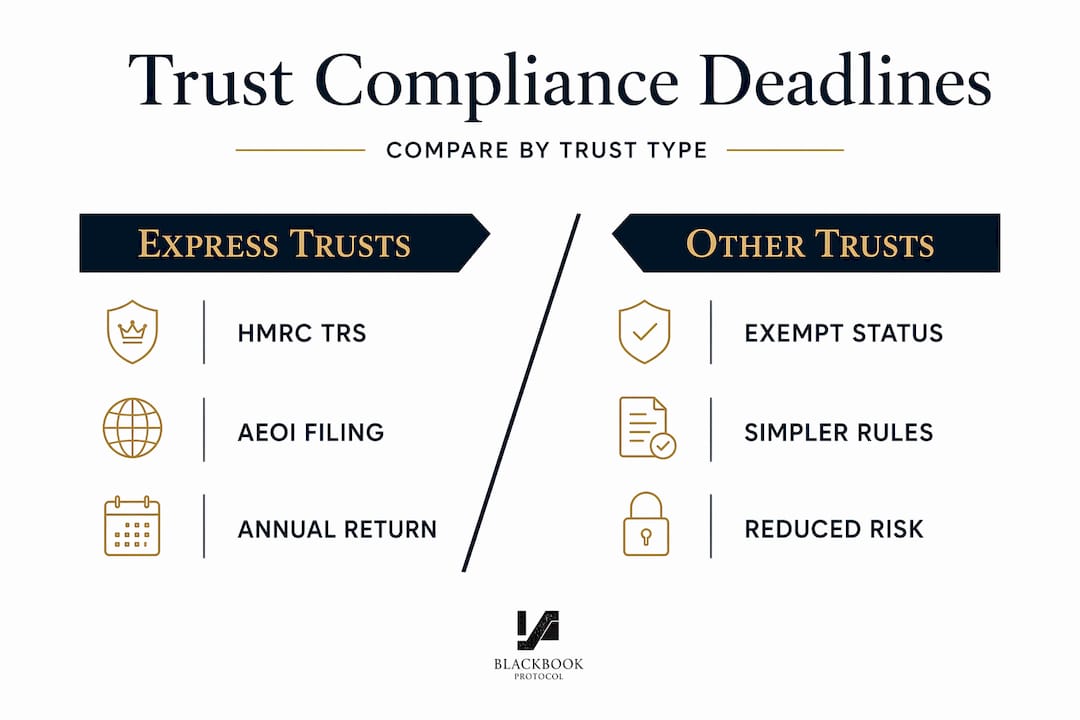
Compliance deadlines by trust type
The table below gives you a quick-reference overview of the key obligations and deadlines that apply to different categories of UK trust. Use it alongside the detailed sections above to identify which requirements apply to your specific situation.
| Trust type | TRS registration required | AEOI registration | Annual tax return | Key penalty risk |
|---|---|---|---|---|
| Taxable express trust | Yes | Depends on classification | Yes (SA900) | £1,000 plus daily charges |
| Non-taxable express trust | Yes | Depends on classification | No (unless tax arises) | Penalty for late TRS update |
| Discretionary trust | Yes | Likely Financial Institution | Yes | Full AEOI and TRS penalties |
| Trustee-documented trust | Yes | Yes, even with no reportable accounts | Depends | £1,000 AEOI penalty |
| Bare trust (excluded) | Narrow exclusions apply | Generally no | Only if tax liability | Lower risk but verify status |
This table is a starting point, not a substitute for professional advice. The classification of your trust under AEOI rules in particular requires careful analysis before any assumption is made.
My perspective on trust compliance
I have seen trustees approach compliance in two ways. The first group treats it as a box-ticking exercise, doing the minimum required at the last possible moment. The second group builds a simple system, keeps it current, and rarely has a problem. The gap between those two groups is not expertise. It is habit.
What I have found consistently is that the operational side of compliance catches people out more than the legal side. Knowing that you must register is straightforward. Having your TRS reference number ready when a bank asks for it at 4pm on a Friday is where the real test lies. Trustees who treat their reference numbers, updated records, and document folders as live tools rather than archived paperwork handle compliance with far less stress.
The AEOI classification question is the area I would flag most urgently. Most trustees have never heard of it, and the consequences of getting it wrong are significant. If you are not certain whether your trust qualifies as a Financial Institution under the International Tax Compliance Regulations, that question needs an answer before the next reporting period.
The data protection changes arriving in June 2026 are the other area where I am seeing trustees unprepared. These are not theoretical future obligations. The deadline is close, and the requirement to have a structured complaint handling process in place is specific and enforceable.
— Blackbook
Take your compliance further with Blackbookprotocol
This checklist gives you the framework. The Blackbook Protocol gives you the depth.

Blackbookprotocol is built for individuals and businesses who want to go beyond basic compliance and build genuinely resilient trust structures. The protocol covers UK trust law in detail, including 95/5 equity structures, tax-efficient asset protection strategies, and the governance frameworks that protect your position over the long term. Whether you prefer the hardback edition for a permanent reference or the Kindle eBook for on-the-go access, the protocol is the next step after you have your compliance foundations in place. Secure your legacy with a resource built specifically for the UK regulatory environment.
FAQ
What trusts must register on the TRS?
Most UK express trusts must register on HMRC’s Trust Registration Service, including both taxable and non-taxable trusts. Exclusions are narrow and should be confirmed with a legal adviser before assuming they apply.
What is the penalty for missing the AEOI registration deadline?
Late registration for AEOI purposes carries an initial £1,000 penalty, followed by daily charges of £300 after HMRC issues formal notice of non-compliance.
How often must TRS records be updated?
Any change to trustees, beneficiaries, or trust assets must be reported to HMRC within 90 days of the change occurring. Annual reviews are recommended as a minimum to catch any accumulated changes.
What are the new data protection requirements for trustees in 2026?
From 19 June 2026, trustees acting as data controllers must have a formal process for handling data protection complaints, including a 30-day acknowledgement requirement and a duty to respond without undue delay.
Does AEOI registration apply even if the trust has no reportable accounts?
Yes. UK trustee-documented trusts and certain other trust types must register with HMRC for AEOI purposes even when they hold no reportable accounts. Classification under the International Tax Compliance Regulations determines the full scope of obligations.
0 comentarios