

Terminology note: In Blackbook Protocol, 95/5 means Vault ~95% / founder ~5% of the Engine — not a co-founder 95/5 cap table. See What is a 95/5 trust structure? and the disambiguation post 95/5 trust vs startup equity split.
TL;DR:
- The 95/5 split allocates beneficial interest in UK trusts, balancing risk, tax efficiency, and legacy planning. Its legal enforceability depends on precise documentation like trust deeds and HMRC Form 17, with careful tax modeling required for credible client presentations. Effective communication, tailored to individual objectives and supported by coordinated legal, tax, and investment advice, is essential for building trust and ensuring compliance.
The 95/5 split is defined as a strategic allocation of beneficial interest or portfolio assets where 95% is assigned to one party or asset class and 5% to another, used in UK trust structures and investment planning to achieve tax efficiency, risk separation, and legacy control. Presenting this split to high net worth clients requires more than a portfolio chart. It demands a coordinated explanation that covers legal enforceability, HMRC compliance, and after-tax outcomes in plain language. Blackbookprotocol has worked with advisors navigating exactly this challenge, where the gap between a technically sound structure and a client who genuinely understands it can determine whether the arrangement holds up or falls apart.
What does the 95/5 split mean for HNW portfolios?
The 95/5 split strategy, in practical terms, describes an allocation where the dominant share of an asset or equity structure sits with one beneficiary or asset class, while a smaller 5% portion is held separately. In portfolio management, this often reflects a core-satellite model: 95% in stable, income-generating assets and 5% in higher-risk, growth-oriented positions. The logic is straightforward. You protect the bulk of capital while retaining exposure to upside.

For high net worth clients, the rationale goes further than diversification. The split can reflect differing income tax positions between spouses in a jointly held property, where unequal beneficial interests are documented in a trust deed and declared to HMRC via Form 17. This is not a product. It is a legal arrangement that must be evidenced correctly.
| Allocation model | Risk profile | Liquidity | Typical use case |
|---|---|---|---|
| 95/5 split (core-satellite) | Low to moderate | High on 95% | Capital preservation with growth exposure |
| 70/30 split | Moderate | Moderate | Balanced growth and income |
| 50/50 split | Moderate to high | Variable | Equal risk-sharing between parties |
| 95/5 beneficial interest | Low | Asset-dependent | Tax-efficient joint ownership via trust deed |
Pro Tip: When presenting the split to a client, anchor the 95% to their stated priority, whether that is income stability, inheritance tax planning, or liquidity. The 5% then becomes a deliberate, purposeful allocation rather than a residual.
Legal and compliance requirements for the 95/5 split in UK trusts
No universal UK trust mechanism is formally called a “95/5 split.” This distinction matters enormously when presenting investment options to sophisticated clients. Absence of a standard 95/5 structure in UK trust law means advisors must define the term clearly at the outset of every presentation, or risk undermining their credibility with clients who have encountered conflicting definitions elsewhere.
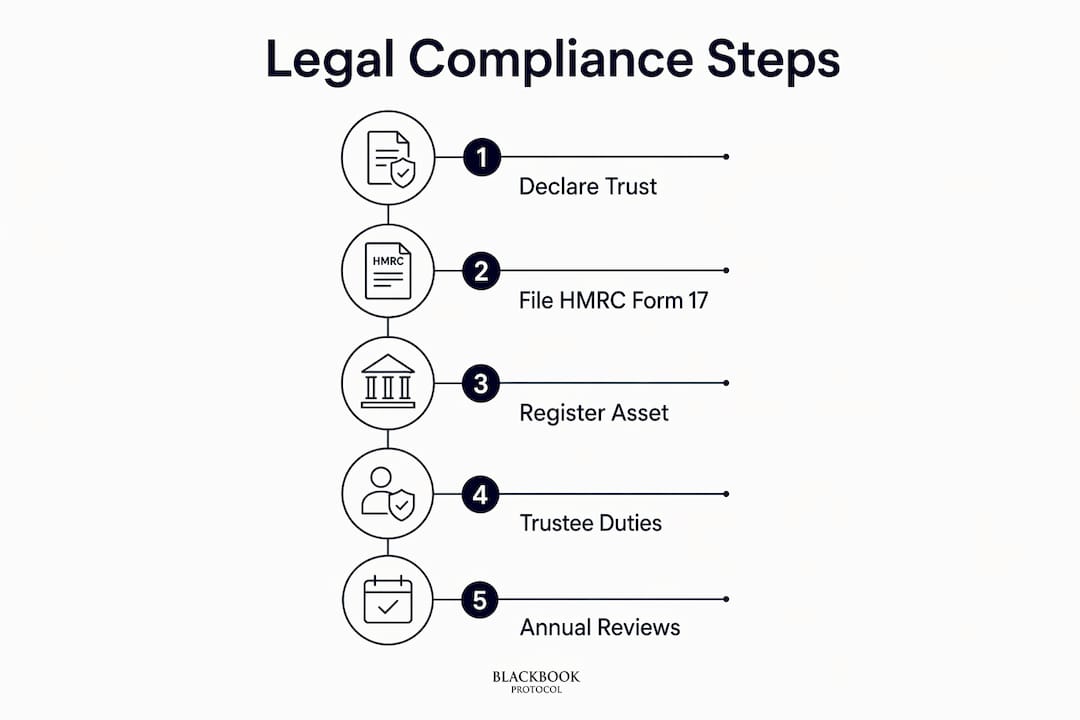
The legal foundation for any unequal beneficial interest arrangement rests on three documents. A declaration of trust establishes the split in writing. HMRC Form 17 is required where married couples or civil partners hold property jointly and wish to be taxed on shares other than 50/50. The trust deed and Form 17 must correspond precisely. A mismatch between the two creates an unenforceable arrangement.
UK trust taxation adds another layer of complexity. HMRC trust income tax increased by 26% in the tax year ending 2024, reflecting both greater use of trust structures and tighter enforcement. Advisors presenting a 95/5 split within a trust context must account for this environment. Clients need to understand that HMRC scrutiny of trust arrangements is rising, not falling.
Key legal terms and documents to include in every 95/5 split presentation:
- Declaration of trust. The founding document that records each party’s beneficial interest percentage.
- HMRC Form 17. Required for married couples and civil partners to declare unequal property income splits.
- Trust deed. Sets out the terms, powers, and obligations of the trustees.
- Trust Registration Service (TRS) filing. Most UK trusts must be registered with HMRC’s TRS under the 2022 regulations.
- Annual trust tax return (SA900). Required where the trust generates income or gains above the relevant thresholds.
- Exit charge calculations. Relevant where assets leave a discretionary trust, triggering inheritance tax charges.
The UK trust law compliance checklist from Blackbookprotocol covers each of these requirements in detail for 2026.
How to integrate tax planning into the split presentation
92% of advisors serving clients with £5 million or more are asked for tax guidance, yet only 17% prioritise after-tax returns in portfolio decisions. That gap is where most investment split presentations fail. Clients do not experience gross returns. They experience what arrives after tax, and the 95/5 split must be explained in those terms.
UK trust taxation in 2025 to 2026 applies a 45% rate on non-dividend income and 39.35% on dividend income above the standard rate band. The capital gains tax exemption for trusts stands at £1,500. These figures are not incidental. They determine whether the split delivers the net benefit the client expects, and they must appear in any credible presentation.
| Tax category | Rate (2025 to 2026) | Exemption or threshold | Client impact |
|---|---|---|---|
| Trust non-dividend income | 45% | Standard rate band applies | High income trusts face significant tax drag |
| Trust dividend income | 39.35% | Above standard band | Dividend-heavy splits require careful structuring |
| Capital gains (trust) | 24% (residential) | £1,500 annual exemption | Low exemption amplifies gains on property splits |
| Inheritance tax exit charge | Up to 6% | Periodic charge every 10 years | Timing of distributions affects total tax cost |
Distribution timing is a critical variable. UK trust taxation is a multi-layered regime where when income or gains are distributed affects income tax, capital gains, and inheritance tax exit charges simultaneously. Presenting the split without a distribution schedule is presenting an incomplete picture.
Pro Tip: Present the client’s net benefit figure first, then work backwards to explain the gross allocation and tax treatment. Clients retain the net number. Starting with gross figures and deducting tax creates confusion and erodes confidence in the structure.
58% of HNW clients prefer consolidating tax, estate, and investment services with a single provider. This preference is a presentation opportunity. When you frame the 95/5 split as a structure that integrates all three disciplines, you position yourself as the coordinating adviser rather than one voice among several.
Best practices for preparing and delivering the split presentation
Preparation determines whether a complex structure lands clearly or creates doubt. For HNW client presentations on the 95/5 split, the materials must be client-specific, not template-driven. Personalisation in HNW presentations builds confidence and retention. A standardised slide deck adapted with the client’s name is not personalisation. Personalisation means the allocation percentages, tax figures, and legacy objectives in the presentation reflect that client’s actual position.
The preparation process follows a clear sequence:
| Stage | Action | Output |
|---|---|---|
| 1. Client data review | Gather income, asset values, existing trust structures | Client-specific allocation model |
| 2. Legal documentation check | Confirm trust deed, Form 17 status, TRS registration | Compliance confirmation note |
| 3. Tax modelling | Calculate after-tax outcomes under 95/5 vs alternatives | Net benefit comparison table |
| 4. Presentation build | Assemble materials using client data and legacy goals | Tailored presentation deck |
| 5. Pre-meeting briefing | Align tax, legal, and investment team on key messages | Unified adviser position |
| 6. Client meeting | Deliver with plain language, address questions in real time | Signed documentation or agreed next steps |
Operational depth and relationship management differentiate advisers in the HNW space more than product complexity. The client who receives a coordinated briefing from a team that has already resolved the technical questions internally will trust the structure far more than one who watches advisers defer to each other in the room.
Common pitfalls to avoid when presenting the 95/5 split:
- Presenting the split without a signed trust deed already in place. The structure has no legal weight without documentation.
- Using gross return figures without showing the after-tax position. Clients make decisions on net outcomes.
- Failing to explain the Form 17 requirement to married couples. Omitting this step creates a compliance gap.
- Conflating the 95/5 split with other allocation models without defining which interpretation applies to the client’s situation.
- Leaving the client to coordinate between their solicitor, accountant, and investment manager independently.
The client trust planning best practices guide from Blackbookprotocol covers adviser-specific compliance and communication protocols in detail.
How to address common misunderstandings about the 95/5 split
The 95/5 split is frequently a communication heuristic rather than a fixed legal structure. Clients who have encountered the term from multiple sources often arrive with conflicting expectations. Clarifying this at the start of the meeting prevents the conversation from derailing later.
The most common points of confusion advisers encounter:
-
Confusion with the 5-by-5 withdrawal rule. The 5-by-5 power in trust law refers to a beneficiary’s right to withdraw the greater of £5,000 or 5% of trust assets annually. It has no connection to a 95/5 beneficial interest split. Conflating these two concepts undermines adviser credibility with clients who have done their own research.
-
Assumption that the split is automatically enforceable. A verbal agreement or informal understanding does not create a legally binding beneficial interest. The split requires a trust deed and, where applicable, Form 17.
-
Misunderstanding of tax consequences. Clients sometimes assume that allocating 5% to one party eliminates that party’s tax liability entirely. The tax treatment depends on the nature of the income, the trust structure, and the individual’s personal tax position.
-
Belief that the split is a product. The 95/5 split is a structural arrangement, not a financial product. It cannot be purchased. It must be designed, documented, and administered.
Mapping responsibilities clearly across your investment, tax, and legal teams before the client meeting removes the burden of coordination from the client and presents a unified, credible position.
Key takeaways
Presenting the 95/5 split to HNW clients requires a legally documented structure, a tax-modelled net benefit analysis, and a coordinated team presentation built around the client’s specific legacy and income objectives.
| Point | Details |
|---|---|
| Define the term precisely | The 95/5 split has no single legal definition; clarify which interpretation applies before the meeting. |
| Document the legal basis | A trust deed and HMRC Form 17 are required for the split to be enforceable and tax-compliant. |
| Present after-tax figures | UK trust tax rates of 45% on non-dividend income make net outcome figures the only credible basis for client decisions. |
| Coordinate the advisory team | Clients retain more confidence when tax, legal, and investment messages are aligned before the meeting. |
| Personalise to legacy goals | Standardised splits adapted to client-specific objectives produce stronger retention and clearer client understanding. |
Why the presentation matters as much as the structure
From where Blackbookprotocol sits, the single most common failure in presenting the 95/5 split strategy is not a legal error or a tax miscalculation. It is an adviser who understands the structure perfectly but cannot explain it without jargon. HNW clients are sophisticated. They are not always technically trained in trust law. The distinction matters.
What I have observed consistently is that clients who receive a clear, net-figure-led explanation of the split, with the legal documentation already prepared and the tax position already modelled, sign off with confidence. Clients who receive a technically accurate but poorly sequenced presentation ask for time to consult their accountant, their solicitor, and sometimes a second adviser. That delay costs the structure its momentum and occasionally its viability.
The other point worth stating plainly: the 95/5 split is not a one-meeting conversation. Regulations change. The UK trust tax environment in 2025 to 2026 is materially different from three years ago, and it will change again. Advisers who build ongoing client education into their service model, rather than treating the initial presentation as the end point, retain HNW clients at a significantly higher rate. The structure is the beginning of the relationship, not the conclusion of it.
— Blackbook
Take the next step with Blackbookprotocol

The 95/5 split is one of the most powerful structures available to UK high net worth clients, but only when it is built on the correct legal foundations and presented with precision. Blackbookprotocol provides the frameworks, templates, and governance blueprints that advisers and clients need to move from concept to compliant structure. The Blackbook Protocol hardback covers UK trust law, equity split mechanics, and tax-efficient asset protection in a format designed for both advisers and informed clients. For those who prefer digital access, the asset protection blueprint includes audio, ebook, and template formats that support every stage of the presentation and implementation process.
FAQ
What is the 95/5 split in UK trust law?
The 95/5 split refers to an unequal allocation of beneficial interest in a jointly held asset, where one party holds 95% and another holds 5%. It is not a formally defined UK trust structure but must be documented in a trust deed and declared to HMRC via Form 17 to be legally enforceable.
Does the 95/5 split reduce tax for HNW clients?
It can reduce the overall tax burden where one party has a lower marginal rate, but the split does not eliminate tax liability. UK trusts face a 45% rate on non-dividend income and a £1,500 capital gains exemption, so the net benefit depends on the specific structure and distribution timing.
How should advisers present the 95/5 split to avoid confusion?
Advisers should define the term precisely at the outset, distinguish it from unrelated concepts such as the 5-by-5 withdrawal rule, and present after-tax outcome figures rather than gross allocations. A coordinated briefing across tax, legal, and investment teams before the meeting removes ambiguity.
What documents are required to implement a 95/5 beneficial interest split?
The minimum documentation includes a declaration of trust, HMRC Form 17 for married couples or civil partners, and registration with HMRC’s Trust Registration Service. An annual SA900 trust tax return is also required where the trust generates income or gains above the relevant threshold.
Why do HNW clients prefer integrated presentations of the 95/5 split?
Research from Cerulli cited by AssetMark shows that 58% of HNW clients prefer consolidating tax, estate, and investment services with one provider. An integrated presentation that addresses all three disciplines in a single meeting aligns with this preference and reduces the client’s coordination burden.
0 comentarios