

TL;DR:
- A sub-trust is a legally distinct trust within a master trust, activated by a specific event like death. Trustees must follow precise legal procedures, including deed authority and registration, to properly establish and manage sub-trusts. In family law, sub-trust interests can be treated as financial resources if distributions are likely, making proper governance essential.
A sub-trust is a legally distinct trust embedded within a master trust deed, which activates upon a specified triggering event such as the death of the settlor. Until that event occurs, the sub-trust exists only as dormant language within the master deed. Upon activation, it becomes a fully operational trust with its own assets, trustees, and distribution rules. Understanding how sub-trust arrangements function legally is essential for anyone managing or planning a UK trust structure, whether as a trustee, beneficiary, or legal adviser.
LegalClarity confirms that sub-trust provisions activate upon specified triggering events, at which point the successor trustee must allocate assets according to the master deed’s instructions. The UK Trust Registration Service (TRS), administered by HMRC, then becomes relevant for compliance. LexisNexis guidance on discretionary trust taxation further shapes how these structures are treated once operational.

How sub-trust arrangements function legally: the governing authority
The legal authority to divide a master trust into sub-trusts depends entirely on the express powers written into the trust deed. If the deed contains a clear division or severance power, trustees may act on it without court involvement. If the deed is silent on the matter, trustees require court approval before proceeding, which increases both cost and legal risk considerably.
Two distinct powers appear in well-drafted deeds: severance powers and decanting powers. Severance splits the trust fund into separate sub-trusts, each governed by its own terms. Decanting transfers assets from one trust into a new trust with different terms, effectively rewriting the arrangement. The two are not interchangeable, and using one when the deed authorises the other creates a legal defect.
| Power type | What it does | When court approval is needed |
|---|---|---|
| Severance | Splits the fund into separate sub-trusts | Only if the deed lacks express authority |
| Decanting | Moves assets into a new trust with revised terms | If the deed does not grant decanting power |
| Neither specified | No division permitted without court order | Always required |
Deed authority and trustee adherence govern legal validity more than the label “sub-trust” itself. A trustee who proceeds without the correct express authority exposes the trust to challenge and may face personal liability for any resulting loss.
Pro Tip: Before any division is attempted, instruct a solicitor to review the master deed specifically for severance and decanting language. A trust law compliance checklist can help identify gaps before they become disputes.
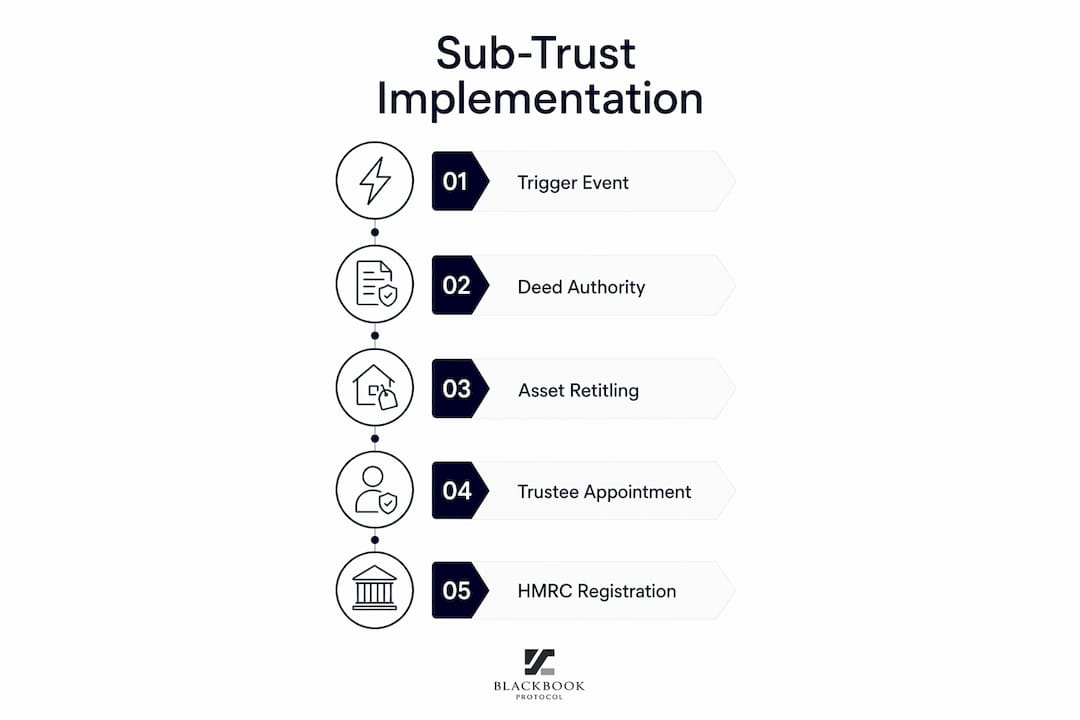
What steps must trustees follow to implement a sub-trust?
Practical implementation begins the moment the triggering event occurs. The successor trustee must act promptly and follow the deed’s instructions precisely. Delay or informal handling of assets at this stage creates tax and liability exposure that is difficult to remedy later.
The core procedural steps are as follows:
- Confirm the triggering event. Obtain the death certificate, court order, or other documentary proof that activates the sub-trust provisions.
- Identify and value the assets. Produce a full inventory of the master trust’s assets at the date of activation, including property, investments, and cash.
- Retitle real estate. Real estate requires new deeds naming each sub-trust as the registered owner. Errors in this step cause title defects and potential CGT complications.
- Transfer financial accounts. Open separate bank and investment accounts in the name of each sub-trust. Do not commingle funds between sub-trusts after division.
- Prepare a deed of appointment or distribution. Document the allocation of assets to each sub-trust in a formal written instrument signed by the trustee.
- Update trust records. Maintain separate accounting ledgers, minute books, and correspondence files for each sub-trust from the date of activation.
Retitling assets into sub-trust names must be thorough and documented to avoid tax or trust administration liabilities. A single mislabelled account can trigger a dispute about which sub-trust holds the relevant asset.
Governance complexity rises sharply after division. Multiple trusteeship relationships and separate accounting streams expand the surface area for conflict. Where different individuals act as trustee for different sub-trusts, the risk of inconsistent decisions and inter-trust disputes increases. A nested trust arrangement checklist is a practical tool for keeping this complexity under control.
Pro Tip: Appoint a professional trustee for at least one sub-trust where the beneficiaries are minors or where the asset base includes illiquid property. This reduces the risk of administrative deadlock.
What are the tax and compliance obligations for UK sub-trusts?
Each sub-trust is treated as a separate legal entity for UK tax purposes once activated. That means separate tax registrations, separate self-assessment returns, and separate accounting records. Trustees who treat the sub-trusts as a single fund after division breach their fiduciary duty and risk HMRC penalties.
The tax treatment depends on how each sub-trust is classified:
- Discretionary trusts pay income tax at the trust rate (currently 45% on most income) and are subject to ten-year anniversary charges and exit charges under the relevant property regime.
- Interest in possession trusts treat income as belonging to the life tenant, who pays tax at their own marginal rate.
- Bare trusts treat the beneficiary as the outright owner for tax purposes, which simplifies reporting but removes trustee discretion.
Trust classification affects beneficiary entitlements and the tax credits available on distributions. A discretionary sub-trust must maintain a tax pool, recording income tax paid at the trust rate so that a tax credit can accompany distributions to beneficiaries. Errors in the tax pool calculation lead to either over-taxation of beneficiaries or HMRC assessments against the trustees.
HMRC’s TRS imposes a “register first” rule for trusts holding UK property. Trustees must register with TRS before submitting any Capital Gains Tax return. Failure to do so may incur penalties, though HMRC may mitigate these where trustees can show reasonable steps were taken. The TRS registration process for sub-trusts requires each sub-trust to be registered individually, not as a single entry under the master trust.
Compliance with TRS registration deadlines directly affects trustees’ ability to meet CGT reporting obligations without penalties. Building sufficient lead time into the administration timetable is not optional. It is a legal requirement with financial consequences for non-compliance.
How do sub-trusts interact with family law proceedings?
Courts in England and Wales treat sub-trust interests as potential financial resources in divorce and financial remedy proceedings. A beneficiary’s interest in a discretionary sub-trust does not automatically count as an asset, but it is far from invisible to the court.
The leading test comes from Charman v Charman [2007] EWCA Civ 503. Courts assess the likelihood and timing of trustee distributions to determine whether a discretionary interest constitutes a financial resource. The court examines:
- The terms of the sub-trust deed and the scope of trustee discretion
- The nature and liquidity of the assets held
- The history of past distributions to the beneficiary
- The relationship between the trustee and the beneficiary
- Whether the trustee is a professional or a connected party
“Courts look beyond trust paperwork, assessing the likelihood that beneficiaries will benefit realistically, making discretionary trust documentation critical in family law.” — Bolt Burdon LLP
Non-disclosure of a sub-trust interest in financial remedy proceedings carries serious consequences. Courts treat deliberate concealment as contempt and may draw adverse inferences about the value of the concealed interest. Nuptial agreements can ringfence sub-trust assets, but only where the agreement meets the criteria set out in Radmacher v Granatino [2010] UKSC 42 and full disclosure was made at the time of signing.
Courts look beyond trust paperwork and assess realistic access to assets. A sub-trust with a sole connected trustee and a history of regular distributions to the beneficiary is far more likely to be treated as a resource than one administered by an independent professional with no distribution history.
Key takeaways
Sub-trust arrangements are legally effective only when the master deed contains clear division authority, triggering events are precisely defined, and trustees follow documented procedural steps from activation through to HMRC registration.
| Point | Details |
|---|---|
| Deed authority is foundational | Division without express deed power requires court approval and creates legal risk. |
| Triggering events must be precise | Ambiguous trigger language causes disputes about when and whether a sub-trust has activated. |
| Asset retitling is non-negotiable | Each sub-trust requires separately titled accounts, deeds, and records from the date of activation. |
| Each sub-trust registers with HMRC separately | TRS registration and tax returns are required per sub-trust, not per master trust. |
| Family courts assess realistic access | Discretionary sub-trust interests are treated as financial resources if distributions are likely. |
The governance gap most trustees overlook
Working closely with trust structures over many years, the single most consistent failure I observe is not in the deed drafting. It is in the gap between activation and administration. Trustees receive the death certificate, confirm the triggering event, and then treat the sub-trust as a formality rather than a live legal entity requiring immediate, separate governance.
Ambiguous trigger event language or inconsistent trustee action causes contention about which trust holds rights post-activation. That contention is expensive to resolve and often avoidable. The deed must specify not just what triggers the sub-trust, but what the trustee must do within what timeframe after the event.
The family law dimension surprises many trustees. They assume that because a sub-trust is discretionary, it is invisible to divorce courts. It is not. Courts’ equitable inherent jurisdiction is a powerful remedy in contested trust scenarios, and the risk grows with every additional accounting stream created after division. Trustees who manage sub-trusts with connected beneficiaries going through divorce proceedings should take independent legal advice immediately.
The practical lesson is straightforward. Treat each sub-trust as a standalone legal entity from day one. Register it, account for it, and govern it as if it were the only trust you administer. That discipline protects both the beneficiaries and the trustees.
— Blackbook
Structured resources for trust and sub-trust compliance
Understanding the legal mechanics of sub-trust arrangements is one thing. Having the tools to implement them correctly is another. Blackbookprotocol has developed a suite of practical resources for trustees, advisers, and high-net-worth individuals who need to get this right.

The Blackbookprotocol asset protection audio, eBook, and templates cover trust structuring, HMRC compliance, and asset protection frameworks in formats designed for practical use. Whether you are a trustee working through a first sub-trust activation or an adviser reviewing an existing structure, these resources provide the procedural clarity that generic legal guides do not. The Blackbookprotocol hardback edition offers a comprehensive reference for those who prefer a structured, authoritative format for ongoing use.
FAQ
What is a sub-trust within a UK master trust?
A sub-trust is a legally distinct trust embedded within a master trust deed, which activates upon a specified triggering event such as death. Until that event occurs, the sub-trust exists only as dormant provisions within the master deed.
Do sub-trusts need to be registered with HMRC separately?
Yes. Each sub-trust must be registered individually with HMRC’s Trust Registration Service. The TRS “register first” rule also requires registration before any Capital Gains Tax return can be submitted for trusts holding UK property.
What happens if a trust deed has no division power?
Trustees must obtain court approval before dividing the master trust into sub-trusts. Acting without express deed authority or court sanction exposes trustees to personal liability and may invalidate the division.
Can a discretionary sub-trust be treated as an asset in divorce proceedings?
Yes. Under the Charman v Charman test, courts assess the realistic likelihood of distributions to determine whether a discretionary sub-trust interest constitutes a financial resource in financial remedy proceedings.
How do sub-trusts differ from decanting?
Severance splits the existing trust fund into separate sub-trusts under the same or similar terms. Decanting transfers assets into a new trust with revised terms. Both require express deed authority, and the two powers are not interchangeable.
0 comentarios