

TL;DR:
- A share trust agreement is a legal arrangement where trustees hold company shares on behalf of beneficiaries, defined by a trust deed that sets out powers and duties. Trustees exercise fiduciary responsibilities, such as voting and corporate management, while beneficiaries hold economic interests without control over voting decisions. Proper governance, registration, and well-drafted deeds are essential for effective asset protection and estate planning in UK share trusts.
A share trust agreement is a legal arrangement where trustees hold company shares on behalf of beneficiaries, managing those shares according to a trust deed that defines powers, duties, and distributions. Understanding how share trust agreements function is the foundation of effective asset protection and estate planning for UK individuals and business owners. The core mechanism is a deliberate separation: trustees carry legal title, beneficiaries carry the economic interest. This structure, governed by UK trust law, gives families and business owners a degree of control, privacy, and succession planning that direct share ownership cannot match.
How share trust agreements function: the trust deed as governing document
The trust deed governs the operation of the entire arrangement, defining trustee powers, distribution rules, and administrative mechanics essential for the trust to function. Without a well-drafted deed, the structure has no operational backbone. Every decision a trustee makes, from voting at a company AGM to distributing dividends, must trace back to authority granted in that document.
A typical trust deed for shareholding trusts covers the following:
- Trustee powers: Authority to vote shares, manage investments, appoint or remove company directors, and approve major corporate transactions.
- Distribution provisions: Rules specifying when and how income or capital passes to beneficiaries, including discretionary or fixed entitlements.
- Spendthrift clauses: Spendthrift provisions protect trust assets from beneficiary creditors, preventing a beneficiary’s financial difficulties from reaching the trust’s shareholding.
- Successor trustee appointment: Procedures for replacing a trustee who resigns, dies, or becomes incapacitated, preserving trust continuity.
- Administrative rules: Decision-making thresholds, record-keeping obligations, and reporting duties to beneficiaries.
The practical effectiveness of a share trust hinges on the clarity of these provisions. Vague deed terms are the single most common cause of governance disputes in UK shareholding trusts. A deed that says trustees “may” vote shares but does not specify how decisions are reached between co-trustees creates operational paralysis at the worst possible moment, such as a contested board vote.
Pro Tip: When commissioning a trust deed, instruct your solicitor to draft explicit decision-making rules for co-trustees, including quorum requirements and tie-breaking mechanisms. Generic template deeds rarely address these scenarios with sufficient precision.
What roles do trustees and beneficiaries play?
Trustees and beneficiaries occupy entirely distinct positions in a share trust, and conflating the two is the most common misconception among business owners new to these structures.
Trustees hold legal ownership) and must manage trust assets for beneficiaries who hold equitable ownership and benefit from the trust’s income or capital. This means:
- Trustees appear on the register. In UK share trusts, trustees are recorded as shareholders on Companies House records and hold voting rights. The trust itself is not a legal person and cannot appear on the register.
- Trustees owe fiduciary duties. They must act prudently, loyally, and solely in the interests of the beneficiaries. Personal interests cannot override trust obligations.
- Beneficiaries hold economic rights. They receive dividends, capital distributions, and ultimately the value of the shares, but they do not control how those shares are voted.
- Beneficiaries cannot dictate company management. Many business owners assume that placing shares in trust for a family member gives that person control over the company. It does not. The trustee exercises shareholder voting power subject to fiduciary duties and the trust deed, not the beneficiary’s preferences.
- Trustees carry reporting obligations. They must keep beneficiaries reasonably informed about the trust’s affairs, including the value of shareholdings and any significant corporate decisions made on their behalf.
Pro Tip: If you are a settlor placing your own business shares into trust, consider whether you also wish to serve as a trustee. Doing so preserves practical influence over voting decisions while the trust structure still delivers estate planning benefits. Take legal advice on the tax implications before proceeding.
Trustees may be individuals or corporate trustees operating under company law with fiduciary duties aligned to the trust deed. Corporate trustees offer continuity and professional governance, which is particularly valuable for trusts holding significant business shareholdings.

How do trustees exercise voting rights and protect trust value?
The authority to instruct votes, appoint or remove directors, and manage corporate actions flows from the trust deed’s powers combined with fiduciary duties, not from beneficiaries’ preferences. This is where share trust agreements move from legal theory into practical corporate governance.
Courts expect trustees to act as prudent stewards safeguarding trust value not only through direct asset control but also via strategic corporate governance and decision-making oversight. In practice, this means trustees cannot simply hold shares passively and collect dividends. They must engage with the company’s direction.
The table below illustrates the key trustee actions in a typical shareholding trust scenario:
| Trustee action | Trigger | Fiduciary standard |
|---|---|---|
| Voting at AGM or EGM | Routine or extraordinary company resolutions | Must vote in beneficiaries’ best interests, not personal preference |
| Appointing or removing directors | Governance concerns or succession events | Must assess competence and alignment with trust objectives |
| Approving major transactions | Mergers, asset sales, significant capital raises | Must evaluate impact on trust asset value before consenting |
| Engaging with company board | Underperformance or strategic risk | Proactive engagement required; passive inaction may constitute breach |
| Reviewing dividend policy | Income distribution to beneficiaries | Must balance income needs of beneficiaries against company growth |
Trustees must also take proactive steps to steward trust assets prudently beyond mere share holding, including voting strategies and engagement with company boards. A trustee who ignores a deteriorating board or fails to vote against a transaction that damages share value risks a breach of fiduciary duty claim from beneficiaries.
What are the compliance requirements for UK share trusts?
Understanding trust agreement basics is one thing. Meeting the UK’s compliance obligations is another, and failure here carries real financial and legal consequences.
- Trust Registration Service (TRS): Express trusts must register with HMRC and maintain accurate information for compliance and taxation. The TRS requires details of settlors, trustees, and beneficiaries. Failure to register on time attracts penalties.
- Keeping records current: Trustee and beneficiary information must be updated within 90 days of any change. This includes changes in beneficial ownership, trustee appointments, and contact details.
- Aligned governance documents: The trust deed, any shareholders agreement defining decision-making and dividend policies, and the company’s articles of association must be consistent. Contradictions between these documents create governance gaps that courts will not resolve in the trust’s favour.
- Tax filing and reporting: Trusts with income or gains must file self-assessment returns with HMRC. Trustees are personally liable for tax obligations arising from the trust’s shareholding.
- Record-keeping: Trustees must maintain minutes of decisions, correspondence with beneficiaries, and records of all corporate actions taken on behalf of the trust.
You can find a detailed breakdown of current obligations in the UK trust law compliance checklist published by Blackbookprotocol, which covers the 2026 registration requirements in full. For TRS-specific guidance, the Trust Registration Service guide provides step-by-step instructions for UK trustees.
Share trusts versus other asset protection structures
Share trusts are not the only mechanism for holding and protecting company shares. Understanding where they sit relative to alternatives helps you choose the right structure for your circumstances.
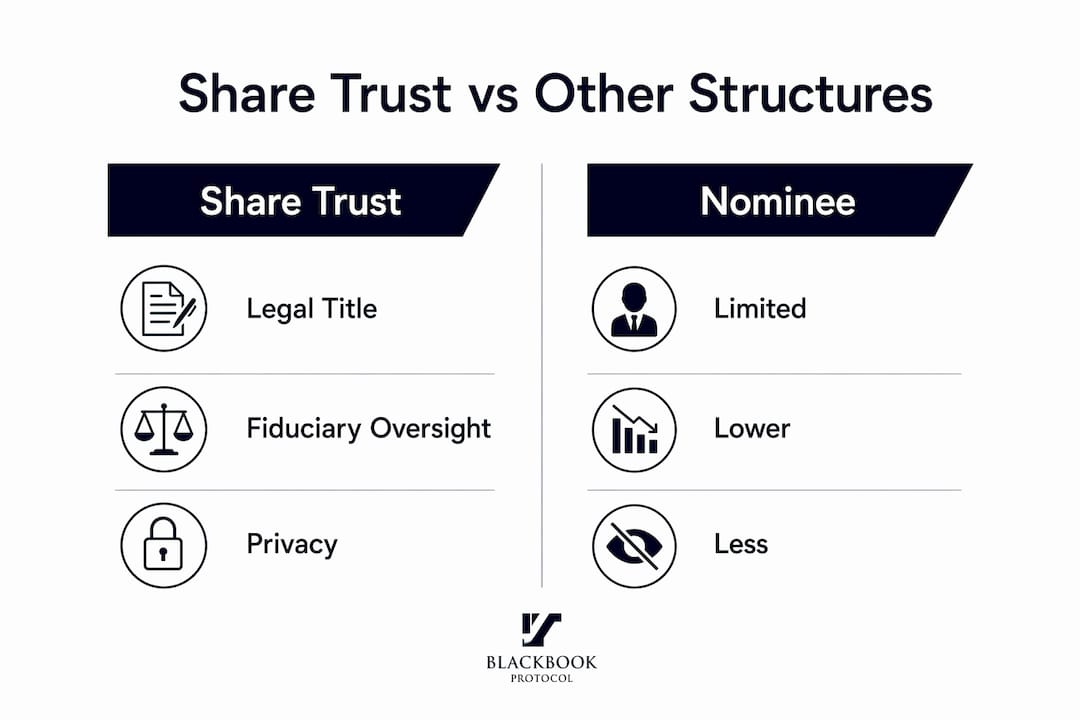
| Structure | Legal title | Fiduciary oversight | Privacy | Complexity | Best suited for |
|---|---|---|---|---|---|
| Direct ownership | Shareholder | None | Low | Low | Simple, sole ownership |
| Nominee shareholder | Nominee holds legal title | Contractual only | Medium | Low to medium | Short-term or privacy arrangements |
| Share trust agreement | Trustee holds legal title | Full fiduciary duty | Medium to high | Medium to high | Estate planning, asset protection, succession |
| Family investment company | Company holds assets | Directors’ duties | Medium | High | Multigenerational wealth, tax planning |
Share trusts provide the strongest combination of legal title separation and fiduciary oversight. A nominee shareholder trust offers privacy but lacks the formal fiduciary framework that protects beneficiaries if the nominee acts improperly. Family investment companies offer tax efficiency but require full company administration and are subject to corporation tax on retained profits.
The administrative complexity and cost of a share trust are higher than direct ownership or nominee arrangements. However, for business owners with succession concerns, creditor protection needs, or multigenerational wealth objectives, the structural advantages justify the additional overhead. The key is matching the structure to the specific objective rather than defaulting to the simplest option.
Key takeaways
Share trust agreements function by separating legal ownership from beneficial ownership, with trustees exercising fiduciary duties over company shares according to the trust deed’s precise terms.
| Point | Details |
|---|---|
| Trustees hold legal title | Trustees appear on Companies House records and exercise all shareholder voting rights. |
| Trust deed governs everything | Powers, distributions, and administrative rules must be explicitly drafted to avoid governance disputes. |
| Beneficiaries hold economic rights | Beneficiaries receive income and capital but cannot direct how trustees vote shares. |
| Compliance is mandatory | UK trusts must register with HMRC’s Trust Registration Service and maintain current records. |
| Structure choice matters | Share trusts offer stronger fiduciary protection than nominee arrangements but carry higher administrative obligations. |
Why the trust deed deserves more attention than the structure itself
Most conversations about share trusts focus on the structure: the separation of legal and beneficial ownership, the asset protection benefits, the estate planning advantages. These are real and significant. But in my experience working through UK trust law and corporate governance frameworks, the structure is the easy part. The trust deed is where trusts succeed or fail.
I have reviewed arrangements where the deed was drafted using a generic template that granted trustees broad investment powers but said nothing specific about exercising shareholder voting rights in a private company. When a contentious board vote arose, the trustees had no clear authority to act decisively. The beneficiaries suffered. The company suffered. The dispute cost more to resolve than the trust had saved in tax.
The other misconception I encounter regularly is that beneficiaries believe they are in control. They are not. Trustees are. This is not a flaw in the structure. It is the point. The separation of control from economic benefit is precisely what makes the trust effective for asset protection. If a beneficiary could simply instruct the trustee to vote shares in a particular way, the trust’s protection against creditors and estate claims would collapse.
My practical advice: treat the trust deed as a governance document, not a formality. Invest in specialist legal drafting. Review it every three to five years as the company and family circumstances change. And appoint trustees who understand their active obligations, not just their passive role as registered shareholders.
— Blackbook
Build your share trust with the Blackbook Protocol

The Blackbook Protocol is the definitive resource for UK business owners and individuals who want to move beyond theory and build share trust structures that actually work. The Blackbook Protocol Hardback covers trust deed mechanics, 95/5 equity splits, fiduciary governance, and HMRC compliance in a single authoritative reference. For those who prefer digital formats, the asset protection blueprint includes audio, ebook, and template resources designed to support trust deed drafting and ongoing governance. If you are serious about securing your legacy through a properly structured share trust, the Blackbook Protocol gives you the blueprint to do it correctly from the outset.
FAQ
What is a share trust agreement?
A share trust agreement is a legal arrangement where a trustee holds company shares on behalf of one or more beneficiaries, managing those shares according to a trust deed that defines the trustee’s powers, duties, and distribution rules.
Who appears as the shareholder when shares are held in trust?
In UK share trusts, trustees appear as shareholders on Companies House records and exercise voting rights. The trust itself is not a legal person and cannot be registered as a shareholder.
Can a beneficiary instruct the trustee how to vote shares?
Beneficiaries cannot direct trustee voting decisions. Trustees exercise shareholder voting power according to their fiduciary duties and the trust deed’s terms, not the beneficiary’s preferences.
Does a UK share trust need to register with HMRC?
Express trusts holding shares must register with HMRC’s Trust Registration Service and keep trustee and beneficiary information current. Failure to register on time attracts financial penalties.
How does a share trust differ from a nominee shareholder arrangement?
A share trust imposes full fiduciary duties on the trustee and is governed by a formal trust deed, whereas a nominee shareholder arrangement is contractual only and lacks the same level of legal protection for beneficiaries.
0 comentarios