

TL;DR:
- The Blackbook Protocol applies privacy-preserving governance principles from decentralized finance to wealth management, emphasizing real-time auditability and client control. Its implementation faces challenges in integrating comprehensive governance frameworks into existing workflows, requiring structured mapping and control design. This approach enhances legacy planning, asset protection, and compliance, offering a legally grounded alternative to traditional methods.
Understanding how blackbook protocol applies to wealth management requires separating genuine technical innovation from marketing terminology. As of May 2026, no regulatory body recognises Blackbook Protocol as a defined standard within wealth management. What does exist is a coherent set of principles drawn from privacy-preserving compliance architecture and trust governance, which wealth managers can map onto legacy planning, asset protection, and client confidentiality. This article clarifies what those principles are, where they come from, and how to apply them operationally.
Table of Contents
- Key takeaways
- How blackbook protocol applies to wealth management: conceptual foundations
- Implementation challenges within existing workflows
- Enhancing legacy planning and asset protection
- Blackbook Protocol versus other wealth management approaches
- My perspective on where this is heading
- Get the Blackbook Protocol for your practice
- FAQ
Key takeaways
| Point | Details |
|---|---|
| Not yet a regulatory standard | Blackbook Protocol is not formally recognised by financial regulators; it draws on DeFi-inspired governance principles. |
| Privacy and compliance are inseparable | Effective application requires embedding controls directly into transaction workflows, not just policy documents. |
| Governance outweighs technology | The hardest implementation challenge is auditable, end-to-end control across data, decisions, and operations. |
| Trust law alignment is non-negotiable | UK wealth managers must map any protocol adoption to current trust law compliance requirements for 2026. |
| Checklists drive practical execution | Portfolio succession and legacy planning checklists are the most practical tools for operationalising protocol concepts. |
How blackbook protocol applies to wealth management: conceptual foundations
The closest technical parallel to the Blackbook Protocol framework comes from BlackBox privacy-preserving compliance infrastructure within decentralised finance. BlackBox uses a curator-relayer architecture alongside cryptographic commitments, specifically zero-knowledge proofs, to maintain compliance without exposing client wallet addresses or transaction data. That architecture is worth understanding because its logic translates directly to wealth management challenges around client confidentiality and regulatory accountability.
Non-custodial vaults, in practical terms, mean that asset control remains with the client rather than a central intermediary. Zero-knowledge proofs allow a party to prove a fact, such as “this transfer is compliant,” without revealing the underlying data that supports that fact. Curator-relayer models separate the party who validates a transaction from the party who executes it, creating an audit trail without compromising privacy.
For wealth managers, the relevance is straightforward. Clients increasingly want documented proof of governance without sacrificing privacy. The Blackbook Protocol approach, applied to wealth management, offers a framework for achieving both simultaneously.

Pro Tip: Understand the tradeoff before you implement. Privacy-preserving architecture reduces exposure but adds complexity to audit trails. Make sure your compliance team is briefed on how zero-knowledge proofs affect evidence standards before you commit to any protocol-driven workflow.
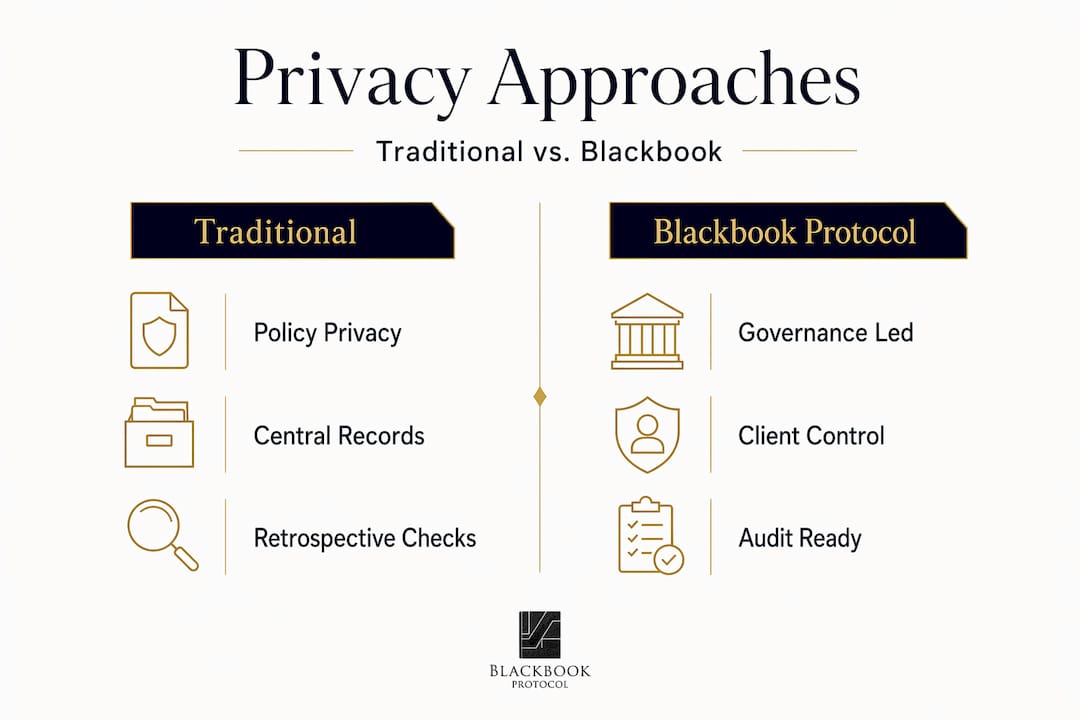
The table below contrasts traditional wealth management privacy practices with the privacy and compliance model that Blackbook Protocol principles draw from.
| Feature | Traditional wealth management | Blackbook Protocol approach |
|---|---|---|
| Client data access | Centralised, advisor-controlled | Distributed, client-controlled permissions |
| Compliance evidence | Paper-based or third-party reports | Cryptographic proofs embedded in transaction flow |
| Audit trail | Retrospective, manual | Real-time, automated logging |
| Privacy model | Confidentiality by policy | Confidentiality by technical design |
| Regulatory interaction | Disclosure on request | Verifiable without full disclosure |
Implementation challenges within existing workflows
The BCG analysis on AI and wealth management makes the point directly: successful implementation requires thorough integration into firm workflows, governance, and operations. Technology is not the obstacle. Governance is. And that distinction shapes everything about how you approach a Blackbook Protocol-informed practice.
Wealth managers who try to layer protocol concepts onto existing processes without redesigning their control frameworks will encounter specific friction points. Data capture must be formalised at every stage of client interaction. Decision logging, meaning the documented reasoning behind investment or trust decisions, must become standard practice rather than an optional annotation. Permissions need to be granular, specifying who can access, modify, or execute at each phase of a client engagement.
The critical challenge is building auditable, end-to-end control frameworks across data, decisions, and governance simultaneously. Most firms handle these as separate concerns. Protocol-informed wealth management treats them as a single system.
Pro Tip: Build your control framework before you select your technology. Mapping governance requirements first means your technology choices are constrained by what you actually need to audit, not by vendor marketing.
The following stages outline a structured approach to implementation for wealth management firms.
-
Governance mapping. Document every decision point in your client lifecycle, from onboarding and suitability assessments through to portfolio rebalancing and estate transitions. Identify where controls currently exist and where they are absent.
-
Permission architecture. Define who has read, write, and execute access at each stage. This applies to both internal staff and any third-party platforms involved in client asset management.
-
Data capture standardisation. Implement consistent data collection at each touchpoint, including structured formats for compliance documentation and client instructions.
-
Decision logging. Record the rationale for every material decision. This is not a narrative summary. It is a structured log with timestamps, the information available at the time, and the outcome selected.
-
Exception management. Define what constitutes an exception, who is authorised to approve it, and how it is documented. Exceptions handled outside the system create audit gaps.
-
Testing and review cycles. Run quarterly reviews of the control framework against actual transaction data to identify drift between documented process and practice.
Enhancing legacy planning and asset protection
Blackbook Protocol principles have direct application in estate planning and trust governance. UK trust law compliance is evolving in 2026, and the formal review processes now expected of trustees align closely with the protocol-driven approach to documentation and auditability. Advisors who have already adopted structured governance frameworks will find compliance significantly less burdensome.
Privacy-preserving controls embedded in transaction flows protect client interests at the execution level, not just at the policy level. That distinction matters in trust administration, where decisions made by trustees carry fiduciary weight and must be defensible years or decades later. A governance model that documents decisions in real time, with access controls that prevent post-hoc modification, is inherently stronger than one that relies on retrospective file notes.
The investment portfolio succession checklist published by Blackbookprotocol addresses portfolio segregation, beneficiary management, and legal oversight in structured form. These tools are the operational expression of protocol-informed wealth management.
Consider the following when integrating Blackbook Protocol principles into legacy and asset protection work:
- Audit-ready trust documentation. Every trustee decision should be logged against the relevant clause of the trust deed, with supporting rationale.
- Portfolio segregation. Assets held under different legal structures should be maintained in separate accounts with distinct governance trails. Explore portfolio segregation structures to understand the mechanics.
- Beneficiary management protocols. Changes to beneficiary designations require documented instruction, identity verification, and dual authorisation.
- Succession triggers. Define the events that initiate succession procedures and ensure those triggers are tested in advance.
- Tax-aware transition planning. Tax optimisation embedded in portfolio transitions is now a standard expectation in high-net-worth client engagements. Blackbook Protocol governance supports this by ensuring the decisions behind each transition are documented and auditable.
- Risk. Protocol-informed governance increases operational overhead in the short term. Firms without adequate staffing or technology infrastructure risk creating documentation that is incomplete, which is worse than no documentation at all.
Blackbook Protocol versus other wealth management approaches
The table below positions the Blackbook Protocol approach against traditional estate planning, AI-assisted advisory, and DeFi asset privacy tools. This is a directional comparison, not a performance ranking.
| Dimension | Traditional estate planning | AI-assisted advisory | DeFi asset privacy tools | Blackbook Protocol approach |
|---|---|---|---|---|
| Automation | Low | High | Medium | Medium |
| Compliance integration | Manual | Embedded | Variable | Embedded by design |
| Client control | Limited | Moderate | High | High |
| Privacy model | Policy-based | Data-minimisation | Cryptographic | Cryptographic plus legal |
| Cost | Low to medium | Medium to high | Low | Medium |
| Regulatory acceptance | High | Growing | Low | Emerging |
| Scalability | High | High | Low | Medium |
| Audit trail quality | Retrospective | Automated | On-chain | Real-time and structured |
AI and automation are already reshaping wealth management workflows, but bespoke relationship management remains the differentiating factor in high-net-worth advisory. The Blackbook Protocol approach does not replace that relationship. It creates the governance infrastructure that makes the relationship documentable, defensible, and transferable across time and personnel.
DeFi privacy tools offer cryptographic rigour but operate in a regulatory grey area that most UK wealth managers cannot accept. Traditional estate planning has the regulatory standing but lacks real-time auditability. The Blackbook Protocol model sits between the two: technically informed, legally grounded, and operationally structured.
My perspective on where this is heading
I have worked across both sides of this. The firms that struggle with protocol adoption are not struggling because of technology. They are struggling because governance was never built into their operational DNA. Policies exist. Checklists exist. But the actual decision-making, the moment a trustee signs off on a distribution or an advisor recommends a transition, often happens outside any structured logging system.
What I find genuinely useful about the Blackbook Protocol framework is that it forces that conversation. It asks you to prove, before a problem arises, that your governance is real and not performative. That is uncomfortable for firms that have built relationships on trust rather than documentation. But the two are not mutually exclusive. The best practice for advisors in trust planning is increasingly to make governance visible to clients, not hidden from them.
Client education is underestimated here. Advisors who explain why a governance framework protects the client, rather than just presenting it as a compliance requirement, consistently see stronger engagement and lower attrition during estate transitions. That is not a technology outcome. It is a communication outcome that technology enables.
Adopt cautiously, but do not wait for perfect conditions. The firms building these capabilities now will have a structural advantage within three years.
— Blackbook
Get the Blackbook Protocol for your practice
If you are implementing governance-led wealth management and need a structured starting point, Blackbookprotocol has produced resources designed specifically for UK advisors and wealth managers working on legacy planning and asset protection.

The Blackbook Protocol hardback covers UK trust law frameworks, 95/5 equity split structures, and tax-efficient protection strategies in operational detail. It is written for practitioners, not theorists. The asset protection blueprint includes audio and ebook templates you can adapt directly to client workflows. For advisors managing high-net-worth UK clients, the trust review process guide provides a structured oversight model that maps to current 2026 compliance requirements. These resources do not replace qualified legal advice. They organise your governance thinking before you engage with counsel, which makes those engagements more productive and less expensive.
FAQ
What is the Blackbook Protocol in wealth management?
Blackbook Protocol is not a formally recognised regulatory standard. It refers to a governance-led approach to asset protection and legacy planning, drawing on privacy-preserving compliance principles from decentralised finance architecture.
How does the Blackbook Protocol differ from traditional estate planning?
Traditional estate planning relies on policy-based privacy and retrospective documentation. The Blackbook Protocol approach embeds compliance controls and audit logging directly into decision-making workflows, creating real-time, defensible records.
Is the Blackbook Protocol suitable for UK wealth managers?
Yes, when applied within existing UK trust law frameworks. Advisors should align any protocol-informed governance model with current UK trust law compliance requirements and seek qualified legal counsel for bespoke structures.
What is the biggest challenge in applying Blackbook Protocol concepts?
The primary challenge is governance integration, specifically building auditable, end-to-end control frameworks across data capture, decision logging, and exception management within existing advisor workflows.
Can Blackbook Protocol principles be applied to succession planning?
Yes. Portfolio segregation, beneficiary management, and succession trigger documentation are all areas where protocol-informed governance adds measurable rigour to existing succession planning processes.
Recommended
- Blackbook Protocol Hardback | Asset Protection & Corporate Governance – BLACKBOOK PROTOCOL
- Business wealth preservation checklist for owners – BLACKBOOK PROTOCOL
- Asset Protection & Corporate Governance Blueprint | BLACKBOOK PROTOCOL
- Client trust planning best practices for advisors – BLACKBOOK PROTOCOL
0 comentarios