

TL;DR:
- Most founders neglect structured legacy planning, risking their business and assets’ future stability. Beginning early, using trusts strategically, and coordinating succession with estate planning are essential to ensure a smooth transition. Regular reviews and clear family communication significantly enhance the effectiveness of founder estate and succession strategies.
Most founders spend years building something worth protecting, then leave the protection to chance. The business grows, the equity compounds, and the legal scaffolding stays as a vague item on a to-do list. A structured founder legacy planning checklist is not a luxury for later. It is the framework that determines whether your business, your assets, and your intentions survive you intact. 40% of business owners have no succession plan in place, which puts both family futures and company value at serious risk.
Table of Contents
- Key takeaways
- The founder legacy planning checklist: where to begin
- 1. Last will and testament tailored for founders
- 2. Living trusts: revocable and irrevocable
- 3. Equity legacy planning trust structures
- 4. Power of attorney for financial and medical decisions
- 5. Beneficiary designation reviews
- 6. Business succession planning options
- 7. Leadership development for successors
- 8. Tax-efficient transfer strategies
- 9. Family governance and communication
- 10. Selecting and professionalising trustees
- 11. Checklist summary and comparison of key instruments
- My perspective on founder legacy planning
- Take your legacy plan further with Blackbookprotocol
- FAQ
Key takeaways
| Point | Details |
|---|---|
| Start planning early | Begin your legacy plan 3 to 5 years before any planned transition to allow adequate time for tax and leadership preparation. |
| Use trusts strategically | Instruments such as dynasty trusts and IDGTs protect future appreciation from estate taxes and give you control over distributions. |
| Integrate succession with estate planning | Business succession planning and personal estate planning must be coordinated, not treated as separate exercises. |
| Review your plan regularly | Estate planning documents require annual review and full updates every 3 to 5 years or after major life events. |
| Address the human side | Family governance, documented values, and professional trustees reduce conflict and protect transitions. |
The founder legacy planning checklist: where to begin
Before you open a single legal document, you need clarity on what you are actually trying to protect and who you are protecting it for. This is the step most founders skip because it feels soft compared to the mechanics of trust law or equity transfer. It is not soft. It is the entire point.
Define your personal and business legacy goals separately, then map where they intersect. Are you preserving a business to pass to family? Positioning for a management buyout? Ensuring income for dependants regardless of what happens to the company? These answers determine every instrument you select.
The relationship between your personal estate and your business succession plan is not incidental. They are the same plan viewed from two angles. A multi-year succession strategy rather than a single reactive document is the standard for good reason: it allows you to align business valuation, leadership development, and tax preparation simultaneously.
Pro Tip: Identify the five most significant life events that would materially change your plan, such as a new child, a business acquisition, a key partnership, a marriage, or a change in UK trust law. Build a calendar trigger for each one.
Key preliminary considerations before proceeding:
- Clarify your goals for both personal wealth and business continuity
- Identify all major assets, including equity stakes, intellectual property, and property holdings
- List all dependants, potential heirs, and business stakeholders who have a legitimate interest
- Consult a solicitor, an accountant, and a financial planner before proceeding. These three professionals often work from separate briefs; your job is to make them work from one
- Set a date for your first comprehensive review and treat it as non-negotiable
1. Last will and testament tailored for founders
A standard will is insufficient for a founder. Your will needs to account for business interests specifically, including how equity is valued, who receives voting rights, and how disputes between heirs and co-founders are resolved.
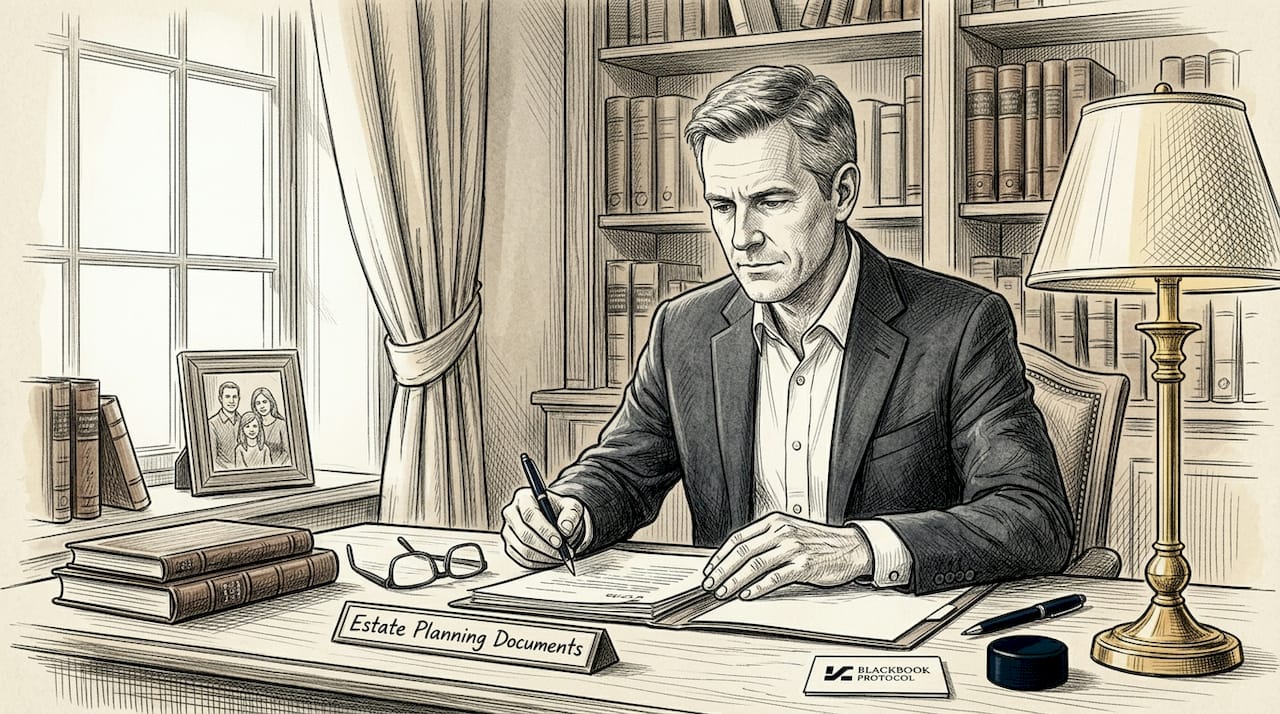
Without explicit direction, business interests can fall into probate limbo or trigger a forced sale at an unfavourable valuation. Specify who receives what class of shares, whether you want a trust to hold those shares rather than an individual, and what happens if the named beneficiary predeceases you.
2. Living trusts: revocable and irrevocable
A revocable living trust lets you retain control during your lifetime while avoiding probate on death. An irrevocable trust removes assets from your estate permanently, which has significant tax advantages but requires you to relinquish direct control.
The choice between the two is not binary. Many founders use both: a revocable trust for day-to-day estate management and an irrevocable structure such as a dynasty trust or an Intentionally Defective Grantor Trust for equity and high-value business assets. Dynasty trusts protect wealth across generations, minimise transfer taxes, and provide controlled distributions. In certain jurisdictions, they can persist for hundreds of years.
3. Equity legacy planning trust structures
This is where founder estate planning diverges sharply from standard estate planning. The timing of when you transfer equity into a trust is not procedural. It is a tax decision with permanent consequences.
Transferring equity into irrevocable trusts immediately after an 83(b) filing locks in the stock value at its lowest point, shielding all future appreciation from estate taxes. Waiting until after a liquidity event or a valuation round eliminates this advantage entirely. The window is often narrow and founders frequently miss it because the legal and accounting teams are not coordinating.
A further option worth examining is recapitalisation into voting and non-voting shares. This allows you to transfer economic interest to heirs or a trust at a discounted valuation while retaining control through voting shares. It is one of the most tax-efficient structures available for founders with significant business equity.
4. Power of attorney for financial and medical decisions
Your legacy plan cannot function if you become incapacitated and no one has legal authority to act on your behalf. A Lasting Power of Attorney for property and financial affairs covers business decisions, banking, and asset management. A separate one covers health and welfare.
Both documents need to be registered before they are needed. An unregistered LPA is unusable in a crisis.
5. Beneficiary designation reviews
Beneficiary designations on pensions, life insurance policies, and some investment accounts override what your will says. This is one of the most common and expensive mistakes in founder estate planning. A will drafted three years after a pension was set up can be completely contradicted by an outdated beneficiary form.
Review every designation annually. After a divorce, a new child, or a significant change in your business ownership structure, treat this as urgent rather than routine.
6. Business succession planning options
When it comes to transferring the business itself, you have four principal routes: transfer to family members, a management buyout, a sale to an external buyer, or an Employee Stock Ownership Plan. Each has different tax, control, and timeline implications.
The options in order of planning complexity:
- Family transfer. Requires early leadership development, clear governance structures, and a plan for handling siblings or relatives who are not involved in the business.
- Management buyout. Requires financing structures and often a phased handover. Needs to begin years before the exit date.
- External sale. Tax-efficient if structured correctly, but you lose control entirely. Requires clean financials and documented systems.
- ESOP. Highly tax-advantaged in the US context, less prevalent in the UK but growing. Allows gradual transfer with retained involvement.
Succession planning should begin 3 to 5 years before a planned transition to allow leadership development and financial preparation. Starting late compresses every decision and typically reduces business value.
Pro Tip: Do not select a succession route based solely on tax efficiency. The option that survives depends on whether the people involved are actually prepared to execute it. Leadership readiness matters more than the legal structure.
7. Leadership development for successors
Succession fails more often because of people than paperwork. If you are transitioning to a family member or a management team, the successor needs structured exposure to every material aspect of the business well before the handover.
This means defined timelines, formal mentoring, and gradual transfer of decision-making authority. A successor who receives the keys on day one without preparation typically either over-relies on the departing founder or makes avoidable errors born of inexperience.
8. Tax-efficient transfer strategies
The Great Wealth Transfer is estimated at 1.5 to 2 trillion dollars annually. For founders, the tax implications of that transfer are not incidental. They are strategic.
Annual gifting allowances, Business Relief (formerly Business Property Relief in the UK), and phased equity transfers all reduce the taxable value of your estate over time. Combining these with an irrevocable trust structure compounds the benefit. Work with a tax adviser who specialises in business owner estates, not a generalist.
You can also use IRS levy guidance and equivalent HMRC frameworks to plan around potential liabilities before they materialise, particularly if you hold assets in multiple jurisdictions.
9. Family governance and communication
The legal documents are not enough on their own. Family meetings and clear documentation of a founder’s story, values, and intentions are among the most important tools for preventing conflict and supporting stewardship across generations.
Schedule an annual family meeting with a structured agenda covering the status of the plan, any changes in assets or beneficiaries, and the founder’s current intentions. Keep minutes. They will matter later.
Beyond the meeting, document your reasoning. Why did you structure the trust the way you did? What do you want the business to stand for in twenty years? These notes are not legally binding, but they prevent heirs from filling silence with assumptions.
10. Selecting and professionalising trustees
A trustee who is also a beneficiary is a structural conflict of interest. It does not always result in problems, but it frequently does. Hiring a professional trustee provides neutral oversight and reduces the likelihood of litigation among heirs.
Professional trustees carry fiduciary obligations and have experience managing complex estates. For founders with multiple heirs, business interests, and cross-jurisdictional assets, a professional trustee is not an extra cost. It is a risk management decision.
11. Checklist summary and comparison of key instruments
| Instrument | Primary use | Tax advantage | Control retained? |
|---|---|---|---|
| Revocable living trust | Probate avoidance | None | Yes |
| Irrevocable trust (IDGT) | Estate tax reduction | High | No |
| Dynasty trust | Multi-generational wealth | High | Partial |
| Power of attorney | Incapacity planning | None | Yes |
| Will with business clauses | Asset distribution | Moderate | Post-death only |
| Recapitalisation structure | Equity transfer with control | High | Yes (voting shares) |
Priority action steps by stage:
- Immediate (now): Document all assets, review beneficiary designations, and engage your three core advisers
- Short term (3 to 12 months): Draft or update your will, establish trust structures appropriate to your equity position, and file any required LPAs
- Medium term (1 to 3 years): Begin leadership development for any identified successor, initiate annual family governance meetings, and model tax scenarios for each succession route
- Ongoing: Annual review of all documents, update after every major life or business event, and use a legacy planning tool to maintain a centralised record of your plan
My perspective on founder legacy planning
I have seen founders with sophisticated businesses and genuinely thoughtful intentions leave their estates in a state that their families spent years unravelling. The documents existed. The intentions were clear in conversation. But no one had pulled it together into a single coordinated plan.
What I have come to understand is that succession is a process, not a product. You cannot finish it. You can only maintain it. The founders who transition well are not necessarily the ones with the most complex trust structures. They are the ones who treat their plan as a living document and revisit it deliberately.
The human dynamics in these situations consistently outweigh the legal structures. I have watched technically sound trusts fracture because the family did not understand what was in them or why. And I have seen simpler arrangements work beautifully because the founder communicated clearly and the trustees were chosen with care.
Trusts are tools for stewardship and clarity, not mechanisms for locking wealth away. That framing changes how founders approach them. Proactive planning reduces stress at every stage of a transition and makes the process significantly faster when a trigger event actually occurs. Use your checklist as a living document, not a filing cabinet.
— Blackbook
Take your legacy plan further with Blackbookprotocol
If this checklist has surfaced gaps you had not previously considered, that is the intended outcome. Knowing where the gaps are is the first step to closing them.

Blackbookprotocol has built a practical protocol specifically for UK founders and entrepreneurs who want to go beyond generic estate planning advice. The guides cover UK Trust Law in detail, 95/5 equity split structures, tax-efficient asset protection, and governance frameworks you can implement without a law degree. Available as a hardback edition for those who want a working reference on their desk, or as a Kindle eBook for immediate access. Both formats deliver the same depth of practical instruction drawn from real asset protection and corporate governance structures. If you are serious about financial sovereignty, the protocol gives you the blueprint.
FAQ
What should a founder legacy planning checklist include?
A founder legacy planning checklist should cover a will with business-specific provisions, trust structures suited to your equity position, powers of attorney, beneficiary designation reviews, a business succession plan, and a family governance framework. Documents should be reviewed annually and updated every 3 to 5 years.
When should founders start legacy planning?
Succession planning should begin 3 to 5 years before any planned transition to allow adequate time for leadership development, financial preparation, and tax structuring. Starting earlier gives you more options, particularly around equity transfers and trust formation.
What is a founder equity legacy planning trust?
A founder equity legacy planning trust is a legal structure, typically an irrevocable trust such as an IDGT or a dynasty trust, used to hold and transfer business equity in a tax-efficient manner. Transferring equity early, ideally after an 83(b) filing, locks in low valuations and shields future appreciation from estate taxes.
How often should a founder review their legacy plan?
Estate planning documents should be reviewed annually, with comprehensive updates every 3 to 5 years or immediately after significant life or business events such as a new child, an acquisition, or a major change in ownership structure.
Should founders use a professional trustee?
For estates with multiple heirs, business interests, or cross-jurisdictional assets, a professional trustee significantly reduces the risk of family conflict and litigation. Professional trustees carry fiduciary obligations and provide neutral, experienced oversight that family members often cannot.
0 comentarios