

TL;DR:
- Trusts are legal arrangements where assets are managed by trustees for beneficiaries, with over 120,000 set up in the UK during 2024/25, showing their continued popularity. Clear client objectives, appropriate trust type selection, and ongoing compliance are essential for effective estate planning and avoiding legal pitfalls. Advisers should follow a structured process for trust setup, maintain regular reviews, and ensure trustees are qualified to protect clients’ interests and stay within legal requirements.
A trust is defined as a legal arrangement in which one party, the settlor, transfers assets to trustees who hold and manage them for the benefit of named beneficiaries. Advising clients on UK trust setup requires a clear understanding of legal structure, tax obligations, and long-term compliance. In the 2024/25 tax year, around 121,000 trusts were set up in the UK. That figure confirms trusts remain a mainstream tool for estate planning, not a niche strategy. Most express trusts must register with HMRC’s Trust Registration Service, and failure to do so breaches UK law. Getting the setup right from the start protects both the client and the adviser.
What are the key prerequisites for advising clients on UK trust setup?
Setting up a trust begins with clarifying client goals, not selecting a trust type. Advisers who jump straight to structure risk recommending something that does not fit the client’s actual circumstances. The first conversation must establish what the client wants the trust to achieve.
Common client objectives include:
- Asset protection from creditors, divorce settlements, or future care costs
- Succession planning to pass wealth to children or grandchildren in a controlled way
- Tax efficiency, particularly around Inheritance Tax and Capital Gains Tax
- Control over distributions to vulnerable, young, or financially inexperienced beneficiaries
Advisers must also assess whether the client is genuinely comfortable relinquishing legal ownership of assets. A trust transfers full legal and beneficial ownership to the trustees. Clients who expect to retain day-to-day control will find the arrangement frustrating and may inadvertently trigger the Gift with Reservation of Benefit rule.
Cost is a factor that advisers frequently understate. Establishing a living trust in the UK costs between £2,500 and £7,500 in setup fees, plus £1,000 to £3,000 in annual administration costs. Those figures mean a trust is not cost-effective for clients with modest estates or short-term tax goals. For those clients, simpler alternatives such as life insurance written in trust or direct gifting may deliver better outcomes at lower cost.

Costly and complex trusts are unsuitable for clients seeking only short-term tax savings without broader estate or protection aims. Advisers who recommend trusts in those situations expose clients to unnecessary expense and administration.
Pro Tip: Before any trust structure is discussed, produce a one-page summary of the client’s estate planning objectives. This document becomes the benchmark against which every trust decision is tested.
How to choose the right trust type and trustees for your client
The UK recognises several trust types, each suited to different client needs. Choosing the wrong structure creates tax inefficiency, inflexibility, or compliance problems that are difficult to reverse.
The main trust types advisers consider are:
- Discretionary trusts: trustees decide who benefits and when, making them ideal for families with young or vulnerable beneficiaries
- Life interest trusts: a named beneficiary receives income during their lifetime, with capital passing to others on death
- Bare trusts: the beneficiary has an absolute right to assets, often used for straightforward gifts to children
- Charitable trusts: assets held for charitable purposes, with specific tax advantages
Discretionary trusts allow settlors to retain influence over who benefits and when, which makes them the most popular choice for families with complex dynamics. That flexibility comes with higher administrative obligations and specific ten-year anniversary charges under the relevant property regime.
Trustee selection is as important as trust type. Trustees carry personal legal liability for errors, missed filings, and poor decisions. Advisers should assess candidates against three criteria: reliability, financial competence, and willingness to commit time over many years.
Professional or corporate trustees are advisable in complex or international trust arrangements. They bring expertise in compliance, tax reporting, and investment management that lay trustees often lack. The added cost is justified when the trust holds significant assets or involves multiple jurisdictions.
A letter of wishes sits alongside the trust deed and guides trustees on the settlor’s intentions without creating binding obligations. It gives trustees context for discretionary decisions and reduces the risk of family disputes. Advisers should always recommend one, updated whenever family circumstances change.
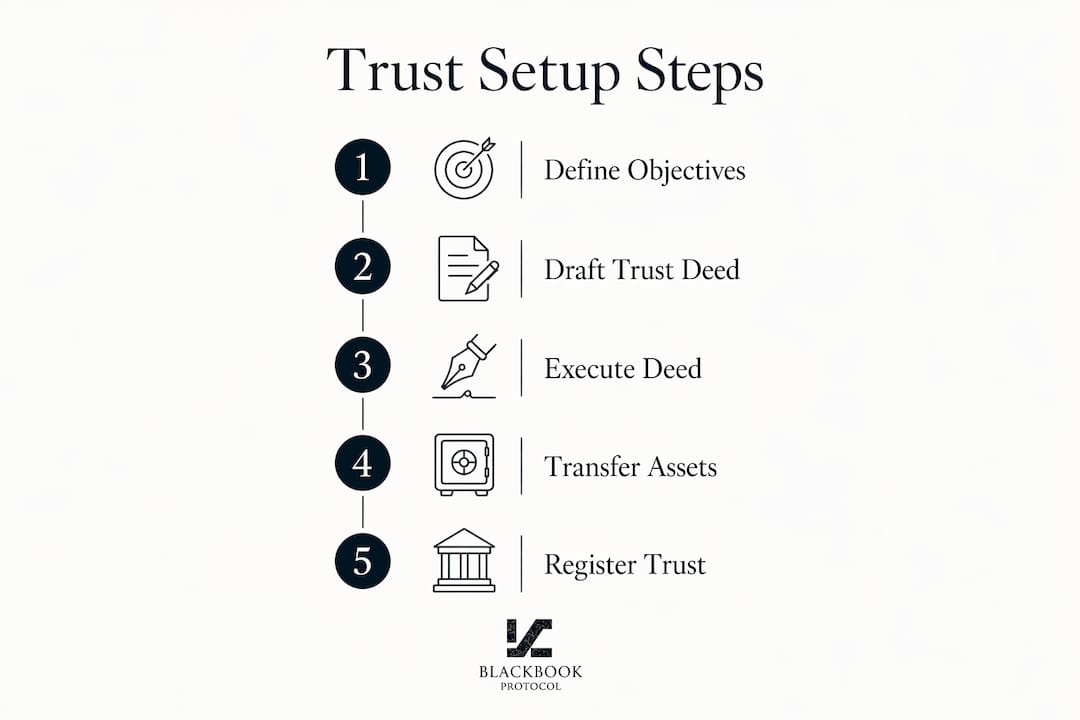
What is the step-by-step process for legally setting up a trust?
The legal formation of a UK trust follows a defined sequence. Deviating from it creates gaps in documentation that HMRC or beneficiaries can later challenge.
- Define the trust objectives with the client and confirm the trust type, assets to be transferred, and intended beneficiaries.
- Instruct a solicitor to draft the trust deed, tailored to the client’s specific circumstances and the chosen trust structure.
- Execute the trust deed with the required signatures from the settlor and trustees, witnessed in accordance with the Trustee Act 1925.
- Transfer assets into the trust, which requires formal legal steps depending on asset type. Property requires a Land Registry transfer; shares require stock transfer forms.
- Register with the Trust Registration Service via HMRC’s online portal. Trust registration requires detailed information on settlors, trustees, beneficiaries, and trust assets.
- Assess immediate tax liabilities, including any Inheritance Tax entry charge if the transfer exceeds the nil-rate band, and any Capital Gains Tax arising on the transfer of chargeable assets.
- File the initial SA900 trust tax return if the trust generates income or gains in its first tax year.
| Step | Action | Key document |
|---|---|---|
| 1 | Define objectives | Client briefing note |
| 2 | Draft trust deed | Solicitor-prepared deed |
| 3 | Execute deed | Signed and witnessed deed |
| 4 | Transfer assets | Land Registry form or stock transfer |
| 5 | Register with HMRC | Trust Registration Service submission |
| 6 | Assess tax | Tax calculation and payment |
| 7 | File SA900 | Annual trust tax return |
Timing matters. Advisers should co-ordinate trust execution with the client’s Will review, as the two documents must be consistent. A trust that contradicts the Will creates confusion and potential litigation for the estate.
Pro Tip: Schedule the trust deed signing and asset transfer in the same week. Delays between execution and funding create a window where the trust exists legally but holds no assets, which can complicate tax calculations.
How to maintain trust compliance and manage ongoing administration
Trustees carry ongoing legal obligations that do not diminish after the trust is formed. Advisers who set up a trust and then step back leave clients exposed to compliance failures.
Core ongoing obligations include:
- Filing the SA900 trust and estate tax return annually with HMRC
- Paying Income Tax, Capital Gains Tax, and any ten-year anniversary Inheritance Tax charges on time
- Updating the Trust Registration Service whenever settlor, trustee, beneficiary, or asset details change
- Maintaining a formal record of all trustee decisions, particularly discretionary distributions
- Reviewing the trust deed every 3–5 years to reflect changes in family circumstances or tax law
Trustees must keep detailed records and face personal accountability for errors or omissions. That accountability is not theoretical. HMRC actively investigates trusts with incomplete records or late filings, and trustees can face penalties and interest charges.
The Gift with Reservation of Benefit rule is the most common compliance trap. HMRC treats assets that still benefit the settlor as part of their estate for Inheritance Tax purposes, even if those assets are legally held in trust. Advisers must confirm that the settlor has genuinely given up all benefit from transferred assets.
“A trust deed requires a formal review every 3–5 years to remain effective amid family and legal changes. Changing family or tax law circumstances necessitate this review to maintain intended benefits and tax efficiency.”
Advisers should build a trust review schedule into their client service model. A formal deed review every three to five years catches problems before they become costly. It also gives the adviser a structured reason to re-engage the client and assess whether the trust still serves its original purpose.
What common mistakes must advisers help clients avoid?
Most trust failures trace back to errors made at the planning stage, not during administration. Advisers who address these risks early protect both the client’s estate and their own professional reputation.
The most frequent mistakes are:
- Vague objectives: setting up a trust without a clear written purpose leaves trustees without direction and creates disputes
- Underestimating costs: clients who are not warned about annual administration fees often resent the trust and neglect compliance
- Missing registration deadlines: failure to register with the Trust Registration Service breaches legal requirements and attracts HMRC penalties
- Triggering the Gift with Reservation of Benefit rule: settlors who continue to benefit from trust assets face an Inheritance Tax charge as if the trust never existed
- Appointing unsuitable trustees: family members chosen for sentiment rather than competence create administration problems and potential legal liability
- Ignoring the wider estate plan: a trust that conflicts with the client’s Will or pension nominations undermines the entire estate strategy
- Assuming trusts are reversible: once assets transfer to a trust, unwinding the arrangement is legally complex and often tax-inefficient
Trusts remain popular for multi-generational wealth transfer because of their flexibility and asset protection benefits. That popularity means advisers encounter clients who arrive with unrealistic expectations shaped by online research rather than professional advice.
Pro Tip: Use a structured client questionnaire before any trust recommendation. It forces the client to articulate their goals and gives you a documented record of the advice process, which is valuable if the recommendation is ever questioned.
Key takeaways
Effective UK trust setup depends on clear client objectives, correct trust type selection, and sustained compliance from day one.
| Point | Details |
|---|---|
| Clarify goals first | Define client objectives before selecting a trust type to avoid unsuitable structures. |
| Registration is mandatory | Most express trusts must register with HMRC’s Trust Registration Service or breach UK law. |
| Costs must be disclosed | Setup costs of £2,500–£7,500 and annual fees of £1,000–£3,000 must be communicated upfront. |
| Trustee choice is critical | Appoint trustees with genuine competence; use professional trustees for complex arrangements. |
| Review every 3–5 years | A formal deed review maintains tax efficiency and reflects changes in family or law. |
The reality of trust advice that most guides skip over
The regulatory environment around UK trusts has tightened considerably. HMRC’s expansion of the Trust Registration Service, combined with stricter reporting requirements, means that trusts which were set up a decade ago and left unreviewed are now non-compliant. Advisers who inherited these arrangements from retiring colleagues are discovering that the administration backlog is significant.
The honest position is that trusts are not suitable for every client who asks about them. The combination of setup costs, annual compliance obligations, and the irreversibility of asset transfer means that a trust must deliver clear, long-term benefit to justify the commitment. For clients with estates below the Inheritance Tax threshold or with straightforward succession wishes, a well-drafted Will and a life insurance policy written in trust will often achieve the same outcome at a fraction of the cost.
Where trusts do make sense, the quality of the advice process determines the outcome. Clients who understand what they are agreeing to, who the trustees are, and what the ongoing obligations involve, are far more likely to maintain compliance and achieve their estate planning goals. Advisers who rush the setup to close a case create problems that surface years later, usually at the worst possible moment for the family involved.
The UK trust law compliance checklist published by Blackbookprotocol is one of the more useful reference tools for advisers who want a structured approach to the registration and reporting obligations. The Trust Registration Service guide from Blackbookprotocol covers the registration triggers and record-keeping requirements in practical detail.
— Blackbook
Blackbookprotocol resources for trust setup and asset protection
Advisers who want structured, practical guidance on UK trust law and asset protection will find the Blackbookprotocol resource library directly relevant to their work.

The Audio, eBook and Templates package from Blackbookprotocol covers trust law frameworks, 95/5 equity structures, and tax-efficient asset protection in a format designed for professional use. The hardback edition provides a detailed reference for advisers who want a permanent desk resource covering corporate governance and trust structures. A Kindle edition is also available for advisers who prefer a digital format. Each resource is built around the Blackbookprotocol methodology, giving advisers a repeatable framework for client trust advisory work.
FAQ
What is the Trust Registration Service and who must use it?
The Trust Registration Service is HMRC’s online system for recording details of UK trusts. Most express trusts must register, providing information on settlors, trustees, beneficiaries, and trust assets.
How much does it cost to set up a trust in the UK?
Setting up a living trust typically costs between £2,500 and £7,500, with annual administration fees of £1,000 to £3,000. Trusts incorporated within a Will are generally less expensive.
What is the Gift with Reservation of Benefit rule?
The Gift with Reservation of Benefit rule applies when a settlor continues to benefit from assets transferred to a trust. HMRC treats those assets as still part of the settlor’s estate for Inheritance Tax purposes.
How often should a trust deed be reviewed?
A trust deed should be reviewed formally every 3–5 years. Changes in family circumstances, tax law, or the client’s financial position can all affect whether the trust continues to achieve its intended purpose.
When is a trust not the right choice for a client?
A trust is not appropriate when the client’s sole aim is short-term tax saving without broader estate or protection goals. Simpler alternatives such as direct gifting or life insurance written in trust may be more cost-effective in those cases.
0 comentarios