

TL;DR:
- An investment policy statement (IPS) guides trust asset management to meet specific goals and legal fiduciary duties. It clearly defines objectives, risk tolerance, asset allocation, and responsibilities, providing trustees with legal protection and operational clarity. Regular review and updates ensure the IPS remains aligned with changing circumstances and legal requirements.
An investment policy statement (IPS) is a formal document that sets out how a trust’s assets should be managed to meet specific objectives while complying with legal fiduciary responsibilities. The role of investment policy statements in trusts extends far beyond paperwork. A well-drafted IPS defines asset allocation targets, risk tolerance, liquidity requirements, and the responsibilities of every party involved, from trustees to investment managers. Under the Prudent Investor Rule, trustees must demonstrate that investment decisions are deliberate and documented. The IPS is the primary instrument for meeting that standard.

How do investment policy statements align trust strategy with beneficiary needs?
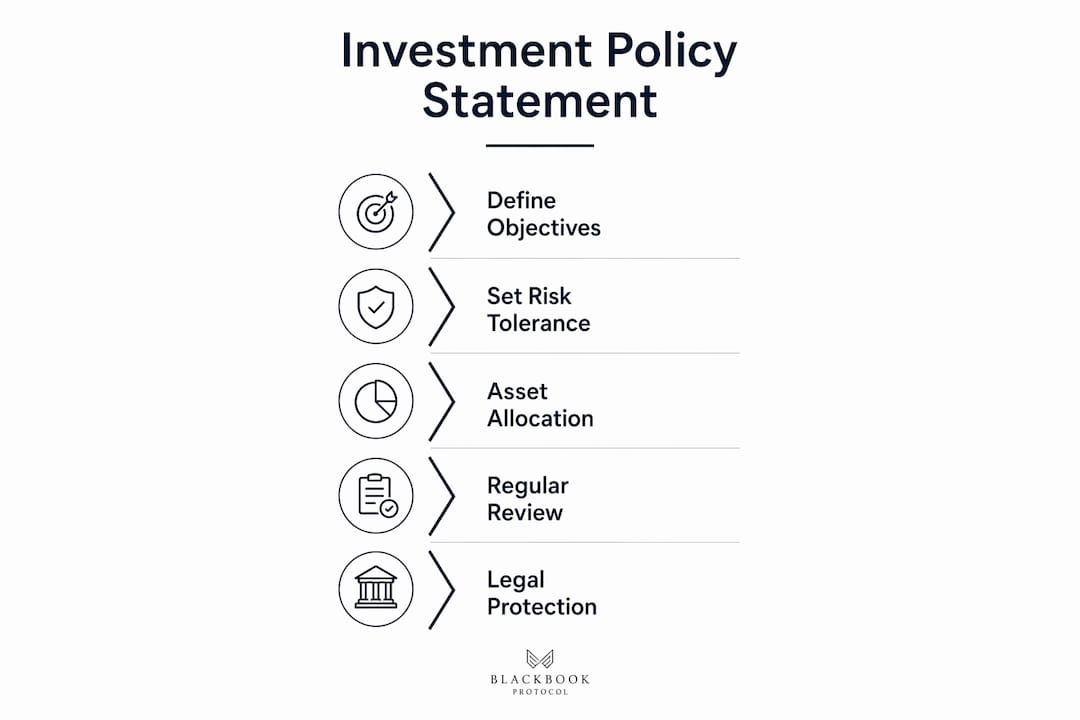
The IPS translates a trust’s purpose into a concrete investment strategy. Without it, trustees make decisions in isolation, with no shared reference point for what the trust is trying to achieve.
Setting clear investment objectives
Every IPS must state whether the trust prioritises growth, income, or capital preservation. These objectives flow directly from the trust deed and the beneficiaries’ circumstances. A discretionary family trust supporting young children will prioritise long-term growth. A trust paying regular income to an elderly beneficiary will prioritise yield and stability. Getting this distinction right at the drafting stage prevents costly misalignment later.
Defining risk tolerance and liquidity needs
Risk tolerance in a trust context is not simply a questionnaire score. It reflects the beneficiaries’ financial position, the trust’s time horizon, and any legal constraints embedded in the trust deed. Liquidity needs must also be stated explicitly. A trust that may need to distribute capital within three years cannot hold the same proportion of illiquid assets as one with a 20-year horizon. The IPS should state the target asset mix in percentages and define the time horizon for when funds are needed.
Asset allocation, diversification, and benchmarks
The IPS must specify target allocations across asset classes, such as equities, fixed income, property, and cash, along with permitted ranges around each target. Diversification rules prevent over-concentration in any single holding or sector. Performance benchmarks, such as a blended index reflecting the target allocation, give trustees and investment managers a measurable standard against which to assess results. Without benchmarks, trust investment management has no objective measure of success.
Key elements that every IPS must address include:
- Investment objectives, stated as growth, income, or preservation
- Risk tolerance, expressed as maximum acceptable drawdown or volatility range
- Liquidity requirements, with specific timeframes for potential distributions
- Target asset allocation with permitted drift ranges
- Performance benchmarks aligned to the target portfolio
Why does an IPS matter for fiduciary duty and legal protection?
The IPS is a trustee’s primary legal defence. Courts assess whether prudent investor standards were followed by reviewing contemporaneous documents, and the IPS sits at the centre of that review. A trustee who cannot produce a documented investment rationale faces significant exposure to claims of fiduciary breach.
The Uniform Prudent Investor Act (UPIA), which informs fiduciary standards across many jurisdictions, requires trustees to consider risk and return in the context of the whole portfolio. The IPS is the document that proves this analysis took place. Without it, even sound investment decisions can appear reactive rather than deliberate.
Pro Tip: Draft the IPS before making any investment decisions, not after. Courts look at whether the process was prudent from the outset, not whether the outcomes were favourable.
Role clarity is another area where the IPS provides legal protection. The document must define roles for custodians, trustees, and committee members to avoid inaction and conflicting decisions. When responsibilities overlap or go unassigned, operational confusion follows. That confusion can result in missed rebalancing, unauthorised trades, or delayed responses to market events, all of which create liability.
The governance benefits of a well-drafted IPS include:
- Documented evidence of a prudent investment process for regulatory review
- Clear assignment of responsibilities to trustees, custodians, and advisors
- A reference point for resolving disputes between co-trustees
- Continuity of investment strategy when trustees change
- Reduced litigation risk through transparent, recorded decision-making
Transparent communication and documented reassessment procedures significantly reduce litigation and compliance risk during market or governance changes. This is not a theoretical benefit. Trustees who document decisions and communicate clearly protect trust capital and reduce legal exposure in practice.
When should trustees review and update the IPS?
The IPS is not a document that trustees file and forget. Trustees should review and potentially rebalance the IPS every 6–12 months or immediately after material trigger events such as market shifts or beneficiary changes.
A structured review process follows these steps:
- Identify the trigger. Determine whether the review is calendar-based or prompted by a specific event, such as a significant market movement, a change in beneficiary circumstances, or a shift in the trust’s tax position.
- Classify the risk. Assess whether the trigger represents a minor drift from targets or a fundamental change requiring a revised strategy.
- Document the assessment. Record the analysis in writing, including the data reviewed, the conclusions reached, and the rationale for any changes made.
- Execute and record. Implement any rebalancing trades and record the rationale contemporaneously. Initial responses to material triggers should happen within 72 hours.
- Communicate with stakeholders. Inform co-trustees, investment managers, and, where appropriate, beneficiaries of any changes to the investment strategy.
Pro Tip: Build a standing agenda item for IPS review into every trustee meeting. Waiting for a crisis to review the document is the most common and most avoidable mistake in trust investment management.
Regular IPS reviews incorporate both quantitative assessments, covering valuation and liquidity, and qualitative assessments, covering governance and legal constraints. Both dimensions matter. A portfolio that meets its return targets but holds assets that no longer comply with updated legal constraints is still non-compliant.
How to create an effective IPS for complex trust structures
Drafting an IPS for a complex trust is a collaborative exercise. Trustees, investment managers, legal advisers, and, where appropriate, beneficiaries should all contribute to the process. Each party brings a different perspective. Trustees understand the legal constraints. Investment managers understand the market. Beneficiaries understand their own needs.
Investment decisions within trusts are most effective when integrated with trust administration, tax strategy, and liquidity needs. Each decision contributes to a cohesive plan rather than operating in isolation. This means the IPS cannot be drafted by the investment manager alone. Tax considerations, such as the impact of capital gains on distributions, must be factored into the asset allocation and rebalancing rules from the outset.
Common pitfalls in IPS drafting and how to avoid them:
- Vague objectives. State objectives in measurable terms. “Preserve capital” means nothing without a defined real return target or inflation benchmark.
- Undefined roles. Every party must have explicit responsibilities. Ambiguity leads to inaction.
- Static documents. An IPS that has not been reviewed in three years is a liability, not a protection.
- Ignoring tax. Rebalancing rules that trigger unnecessary capital gains events undermine the trust’s net returns.
The IPS functions as a living document that evolves with the trust’s circumstances. Regular updates reflect changing markets, family priorities, and trust goals. A multi-generational trust established in 2005 should look very different in 2026. The IPS is the mechanism that captures and formalises those changes.
How trustees and investment managers interact within the IPS framework is a practical matter that deserves careful attention. The relationship between trustees and managers works best when the IPS clearly defines the scope of delegated authority, the reporting requirements, and the conditions under which trustees must be consulted before a trade is executed.
Key takeaways
A well-drafted IPS is the single most important governance document in trust investment management, providing legal protection, strategic clarity, and operational continuity in one place.
| Point | Details |
|---|---|
| IPS defines investment objectives | State whether the trust prioritises growth, income, or capital preservation, linked to beneficiary needs. |
| Legal protection under fiduciary standards | Courts review the IPS to assess whether trustees followed the Prudent Investor Rule. |
| Review every 6–12 months | Reassess the IPS on a calendar basis and immediately after material trigger events. |
| Role clarity prevents operational failure | Explicitly assign duties to trustees, custodians, and managers to avoid confusion and inaction. |
| IPS is a living document | Update it regularly to reflect changing markets, tax positions, and beneficiary circumstances. |
The IPS is not a compliance box to tick
Most trustees I work with initially treat the IPS as a regulatory requirement. They produce it because they have to, file it, and move on. That is the wrong approach, and it is the approach most likely to result in a fiduciary claim.
The IPS is the clearest communication tool available to a trustee. It tells every party involved, including investment managers, co-trustees, and beneficiaries, exactly what the trust is trying to achieve and how decisions will be made. When a dispute arises, and in complex trusts they eventually do, the IPS is the document that either protects you or exposes you.
Many trustees mistakenly view the IPS as merely a compliance requirement, whereas it is a vital communication tool that fosters coordinated investment efforts. The trusts that manage wealth across generations successfully are the ones where the IPS is reviewed, debated, and updated as a matter of course. It is not a static record of past intentions. It is an active governance instrument.
The most common failure I see is not a bad IPS. It is an outdated one. A document drafted in 2019 that has never been touched does not reflect the trust’s current risk position, tax situation, or beneficiary needs. That gap between the document and reality is where liability lives. Treat the IPS as the foundation of trust governance, not the ceiling of it.
— Blackbook
Strengthen your trust investment framework with Blackbookprotocol
Drafting an IPS that genuinely protects trustees and serves beneficiaries requires more than a template. It requires a clear understanding of UK Trust Law, fiduciary standards, and the practical mechanics of asset allocation within a trust structure.

Blackbookprotocol provides the asset protection and governance tools that trustees and advisors need to build defensible, effective investment frameworks. The Blackbook Protocol hardback covers UK Trust Law, 95/5 equity structures, and tax-efficient asset protection in detail. For those who prefer digital formats, the audio, eBook, and templates bundle includes practical IPS drafting tools designed for complex trust structures. These resources complement professional advice and give trustees a documented, structured foundation for every investment decision.
FAQ
What is the role of an IPS in a trust?
An IPS defines the investment objectives, risk tolerance, asset allocation, and responsibilities of all parties managing a trust’s assets. It provides the documented framework trustees need to comply with fiduciary standards such as the Prudent Investor Rule.
How often should a trust IPS be reviewed?
Trustees should review the IPS every 6–12 months and immediately after material trigger events, such as significant market movements or changes in beneficiary circumstances.
Does an IPS protect trustees from legal claims?
A well-documented IPS provides strong protection against fiduciary breach claims. Courts assess whether investment decisions followed a prudent process, and the IPS is the primary evidence of that process.
Who should be involved in drafting a trust IPS?
Trustees, investment managers, legal advisers, and, where appropriate, beneficiaries should all contribute. Each party brings knowledge that the others lack, and the final document must reflect all relevant legal, financial, and personal considerations.
What happens if a trust does not have an IPS?
Without an IPS, trustees lack a documented rationale for investment decisions. This creates significant legal exposure and makes it difficult to demonstrate compliance with fiduciary duties during a dispute or regulatory review.
Recommended
- Trust held investment benefits: your 2026 guide – BLACKBOOK PROTOCOL
- How investment managers interact with trustees: a practical guide – BLACKBOOK PROTOCOL
- Why shareholder agreements need trusts: a founder’s guide – BLACKBOOK PROTOCOL
- How share trust agreements function in the UK – BLACKBOOK PROTOCOL
0 Kommentare