

TL;DR:
- Hiring a qualified professional trustee is crucial to avoid legal issues and beneficiary disputes in UK trust management. Effectively evaluating candidates involves verifying credentials, conducting interviews, and executing a formal deed under Section 36 of the Trustee Act 1925. Proper asset transition and clear cooperation protocols ensure smooth long-term trust administration and compliance.
A professional trustee is a qualified individual or institution appointed to manage trust assets and act as a fiduciary for beneficiaries under UK trust law. Appointing a professional trustee is one of the most consequential decisions in estate planning. The wrong choice creates legal complications, beneficiary disputes, and administrative failures that can persist for decades. This appointing professional trustee client guide covers the full process: from evaluating candidates and understanding the legal framework under the Trustee Act 1925 to managing the transition and maintaining compliance over the long term.
What qualifications should you look for when choosing a professional trustee?
The right professional trustee holds demonstrable trust-specific experience, not just general financial or legal credentials. A solicitor who has drafted wills for thirty years is not automatically qualified to administer a discretionary trust. You need someone whose practice centres on fiduciary management, investment oversight, and beneficiary communication.
Key credentials and screening criteria to assess:
- Regulatory authorisation: The trustee or their firm should be authorised by the Financial Conduct Authority (FCA) or regulated by the Solicitors Regulation Authority (SRA), depending on the services provided.
- Professional indemnity insurance: Confirm the level of cover. A trustee managing a £500,000 estate needs materially different cover than one managing £5,000,000.
- Trust-specific experience: Ask how many trusts they currently administer and what types. Discretionary trusts, bare trusts, and interest-in-possession trusts each carry distinct obligations.
- Minimum account thresholds: Institutional trustees often require minimum account sizes ranging from £250,000 to over £1,000,000. This filters out candidates early and helps you match the right tier of provider to your trust’s size.
- Fee transparency: Professional trustees typically charge between 1% and 2% of trust assets annually. Fee structures vary by trust size and services included, so request a written fee schedule before any formal discussion.
Assess candidates against the three criteria that matter most: skill, willingness to serve, and the resources to do so effectively. A trustee who lacks any one of these three will eventually fail the trust.
Pro Tip: Request a sample annual report from any candidate. The quality of their reporting to beneficiaries tells you more about their communication standards than any interview answer.

How do you conduct due diligence and interview prospective trustees?
Treat trustee selection like a structured hiring process. Interviewing at least 2–3 candidates is the recommended minimum to compare fees, communication styles, and relevant experience. One candidate gives you no benchmark. Three gives you a genuine comparison.
Follow this sequence when vetting candidates:
- Prepare your questions in advance. Focus on fee transparency, how they handle beneficiary disputes, their experience with trusts of your type and size, and their communication frequency. Vague answers to direct questions are a warning sign.
- Confirm licensing and regulatory standing. Check the FCA register or SRA database directly. Do not rely on the candidate’s own assurances.
- Evaluate communication commitments. Ask how often they report to beneficiaries, what format those reports take, and who your primary contact will be. Institutional trustees sometimes rotate relationship managers, which disrupts continuity.
- Request references from current clients. Speak to at least one beneficiary or settlor who has worked with the candidate for more than three years. Short-term satisfaction is easy. Long-term administration is where quality diverges.
- Assess co-trustee compatibility. If your trust will have both a professional and a lay trustee, confirm how the candidate handles disagreements. Undefined deadlock procedures force trustees toward risk-averse decisions that harm trust effectiveness.
The UK trust law compliance checklist from Blackbookprotocol provides a structured framework for evaluating fiduciary obligations during this stage.
What is the formal trustee appointment process under UK law?
The trustee appointment process in the UK is governed primarily by Section 36 of the Trustee Act 1925. Appointing a new trustee requires executing a trust deed or a formal deed of appointment. This is not a letter of instruction or a verbal agreement. It is a legally binding document that must meet specific formal requirements.
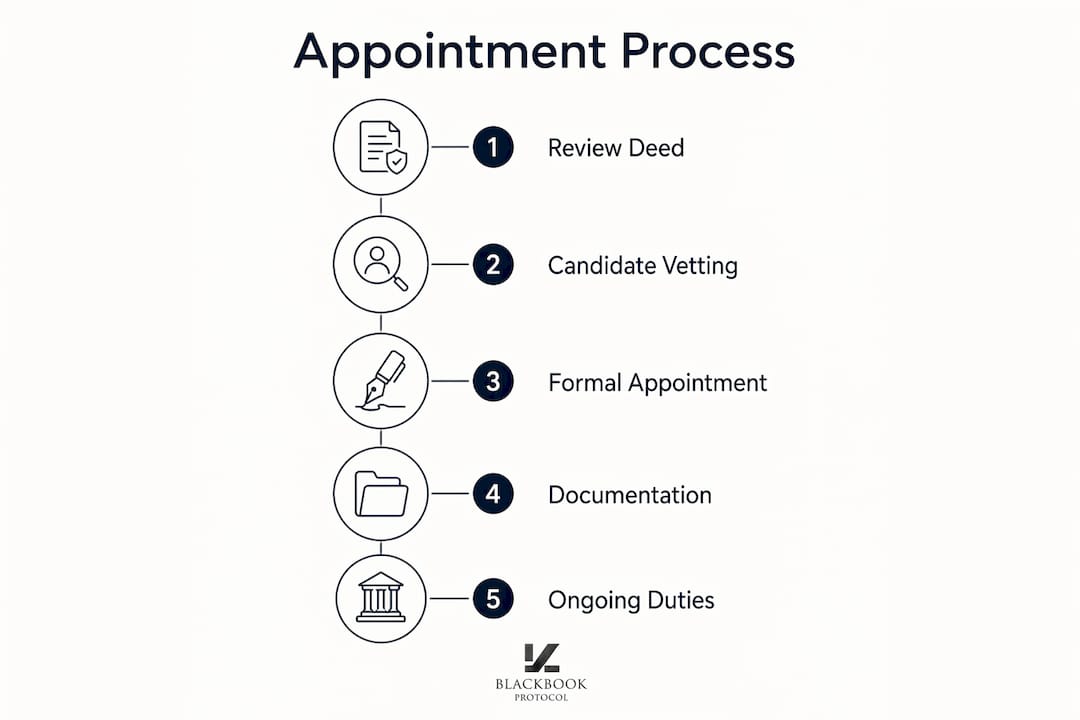
The key steps in the formal appointment process are set out below.
| Stage | Action required | Common issue |
|---|---|---|
| Review existing trust deed | Confirm appointment powers and any restrictions | Powers may be limited to named persons |
| Draft deed of appointment | Solicitor prepares deed naming the incoming trustee | Errors in trustee description cause delays |
| Execute the deed | All current trustees and the incoming trustee sign | Missing signatures invalidate the deed |
| Witness and date | Independent witnesses sign; deed is dated correctly | Undated deeds create legal uncertainty |
| Trustee acceptance | Incoming trustee formally confirms acceptance in writing | Verbal acceptance is not sufficient |
| Notify relevant parties | Banks, HMRC, land registry, and investment platforms informed | Failure to notify causes administrative deadlock |
Section 36 also permits the appointment of a replacement trustee where an existing trustee is incapable, refuses to act, or remains outside the UK for more than twelve months. Understanding which ground applies to your situation affects the wording of the deed.
Pro Tip: Use the trust deed drafting checklist from Blackbookprotocol to verify every formal requirement before execution. A missed witness or an incorrect trustee description can delay the entire appointment by months.
How do you manage the transition and ongoing trustee responsibilities?
The transition period is where most trustee appointments go wrong. A complete, audited inventory of trust assets and prompt retitling to the incoming trustee’s name are non-negotiable. Skipping either step creates legal complications that can take years to resolve.
The practical steps for a clean handover include:
- Conduct a full asset audit. List every trust asset: property, investments, bank accounts, intellectual property, and any beneficial interests. The outgoing trustee must sign off on this inventory.
- Retitle assets promptly. Property held in a former trustee’s name must be transferred via the Land Registry. Investment accounts require written instructions to the platform or custodian. Delays in retitling leave assets in legal limbo.
- Establish reporting protocols. Agree in writing how often the new trustee will report to beneficiaries, what those reports will contain, and how discretionary distributions will be communicated.
- Define co-trustee authority clearly. If the trust has multiple trustees, the trust document must specify how decisions are made and how deadlocks are resolved. Trusts without clear deadlock procedures risk court involvement and paralysed administration.
- Notify HMRC and the Trust Registration Service. Any change in trustee must be reflected on the Trust Registration Service register within the statutory deadline.
Corporate trustees provide continuity that individual trustees cannot guarantee. An individual trustee faces life events: illness, relocation, death, or incapacity. An institutional structure continues to administer the trust regardless of personnel changes, preserving the settlor’s intentions across decades.
The sub-trust arrangements guide from Blackbookprotocol covers how fiduciary obligations carry through complex trust structures, which is particularly relevant during multi-asset transitions.
My view on what clients consistently get wrong
Most clients focus almost entirely on fees when selecting a professional trustee. Fees matter, but they are the last thing to evaluate, not the first. The questions that actually determine long-term success are about availability, authority, and communication.
The trustees who cause the most damage are not the expensive ones or the cheap ones. They are the ones who were never clear about who has authority to act, who communicates with beneficiaries, and what happens when co-trustees disagree. Those gaps do not surface during the appointment process. They surface five years later, during a dispute, when fixing them costs ten times more than getting them right at the outset.
Clients who treat trustee selection like a job interview consistently make better appointments. That means objective criteria, structured questions, and reference checks. It means walking away from a candidate who cannot produce a clear fee schedule or a sample beneficiary report.
The other mistake I see regularly is underestimating the transition. Clients assume the legal appointment is the hard part. The hard part is the three months after: retitling assets, notifying institutions, and establishing the reporting rhythm. A trustee who is excellent at administration but poor at transition management will create problems that persist for the life of the trust.
— Blackbook
Blackbookprotocol resources for your trustee appointment
Appointing a professional trustee requires more than legal paperwork. You need governance frameworks, compliance checklists, and clear documentation to protect the trust and its beneficiaries from day one.

Blackbookprotocol’s asset protection audio, eBook, and templates give you the practical tools to structure trustee governance, maintain UK trust law compliance, and manage asset protection with clarity. The templates cover trustee appointment documentation, beneficiary reporting frameworks, and co-trustee authority definitions. These resources are built for individuals who want to get the appointment right the first time, without relying entirely on expensive professional advice for every step.
Key takeaways
Appointing a professional trustee under UK law requires a structured process covering candidate evaluation, deed execution under the Trustee Act 1925, and a fully audited asset transition.
| Point | Details |
|---|---|
| Verify credentials first | Confirm FCA or SRA authorisation and professional indemnity cover before any other assessment. |
| Interview at least three candidates | Comparing multiple candidates reveals fee differences, communication standards, and experience gaps. |
| Execute a formal deed of appointment | Section 36 of the Trustee Act 1925 requires a signed, witnessed deed. Verbal agreements are not valid. |
| Audit and retitle assets immediately | A complete asset inventory and prompt retitling prevents legal complications during the transition period. |
| Define co-trustee authority in writing | Clear deadlock procedures and distribution authority protect the trust from paralysed administration. |
FAQ
What is a professional trustee under UK law?
A professional trustee is a qualified individual or institution appointed to manage a trust’s assets and act as a fiduciary for its beneficiaries. Professional trustees are subject to regulatory oversight and owe statutory duties under the Trustee Act 1925 and the Trustee Act 2000.
How much does a professional trustee charge?
Professional trustees typically charge between 1% and 2% of trust assets annually, though fee structures vary by trust size and the scope of services provided. Always request a written fee schedule before appointment.
What legal document is needed to appoint a trustee in the UK?
A formal deed of appointment, executed under Section 36 of the Trustee Act 1925, is required. The deed must be signed by all current trustees and the incoming trustee, witnessed independently, and dated correctly.
How many trustee candidates should I interview?
Interview at least 2–3 candidates to compare fees, communication standards, and relevant experience. A single candidate gives you no meaningful benchmark for assessing suitability.
What happens if co-trustees cannot agree on a decision?
Without defined deadlock procedures in the trust document, co-trustees tend to default to inaction, which harms beneficiaries. The trust deed should specify a tie-breaking mechanism to avoid court involvement and preserve effective administration.
0 Kommentare