

TL;DR:
- A trust is a separate legal entity that owns assets and transfers them directly to beneficiaries without involving the court. Trusts bypass probate because they hold legal title during a person’s lifetime, avoiding the public and costly court process. Regularly retitling assets and reviewing the trust ensure it functions effectively for probate avoidance.
A trust is a separate legal entity that owns assets and transfers them directly to beneficiaries without court involvement, which is the core reason why trusts bypass probate UK estate planning relies on. Probate is the court-supervised process that verifies a will and authorises the transfer of a deceased person’s assets. Assets held inside a trust never form part of the deceased’s personal estate, so they never enter that process. This guide explains the legal mechanics behind probate avoidance, the differences between trusts and wills, and the practical steps you need to take to make a trust work as intended.
Why trusts bypass probate in the UK
Trusts bypass probate because they change who legally owns the assets. When you place property, investments, or cash into a trust, legal title transfers from you as an individual to the trust itself. At the point of death, there is nothing in your personal name to administer through the courts. A successor trustee simply follows the written terms of the trust and distributes assets to beneficiaries directly.

The probate process requires a grant of probate before any executor can act. That grant can take months to obtain, and the process is a matter of public record. Trust administration, by contrast, is entirely private between trustees and beneficiaries. No court filing is required, and no member of the public can inspect the terms.
Probate costs can range from 3% to 8% of an estate’s value. That figure includes executor fees, solicitor charges, and court fees. For a property-heavy estate worth £400,000, that represents up to £32,000 in costs before a single beneficiary receives anything.
The privacy and cost advantages are the two most cited reasons why individuals choose trusts over relying solely on a will. Speed is the third. A well-funded trust can distribute assets within weeks rather than the months or years a contested probate can take.
How do trusts differ from wills in avoiding probate?
Wills and trusts serve different legal functions, and understanding that difference is the foundation of effective estate planning.
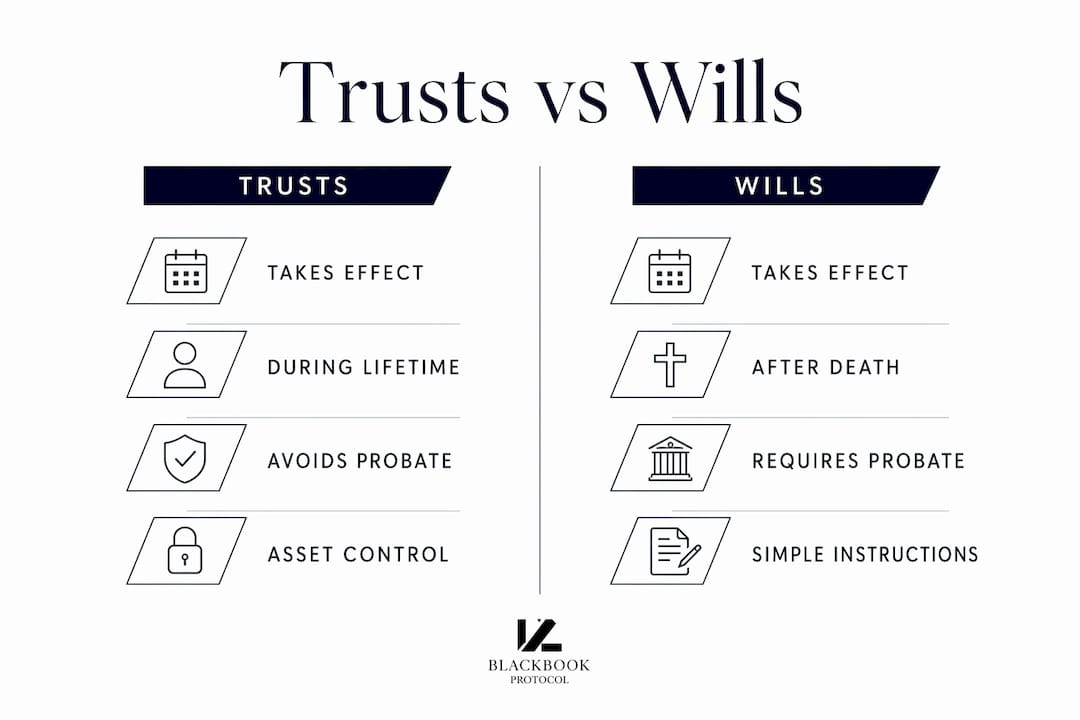
A will is a set of instructions that takes effect only after death. It must be submitted to the probate court, which verifies its validity before any executor can act. Every asset named in the will passes through that process. The will becomes a public document at that point.
A trust, by contrast, takes effect during your lifetime. You transfer assets into it now, and the trust holds legal title from that moment forward. When you die, the trust continues to operate. The successor trustee distributes assets according to the trust deed without any court involvement.
Revocable vs irrevocable trusts
A revocable trust allows you to retain control. You can amend it, add assets, or dissolve it entirely during your lifetime. Because you retain control, the assets inside a revocable trust are still counted as part of your estate for inheritance tax purposes. The probate avoidance benefit is real, but the tax position differs from an irrevocable trust.
An irrevocable trust transfers both legal and beneficial ownership permanently. Once assets are inside, you cannot reclaim them. The trade-off is that those assets are generally outside your estate for inheritance tax purposes after seven years, subject to HMRC rules.
| Feature | Will | Trust |
|---|---|---|
| Takes effect | After death | During lifetime |
| Requires probate | Yes | No |
| Public record | Yes | No |
| Controls assets during incapacity | No | Yes |
| Inheritance tax planning | Limited | Significant potential |
Pro Tip: A trust only works if assets are retitled into it. A trust deed sitting in a drawer with no assets transferred is legally valid but practically useless for probate avoidance.
What are the key mechanisms that allow trusts to skip probate?
The legal mechanism is straightforward. Assets titled in the trust at the point of death bypass probate because the trust, not the deceased individual, holds legal ownership. The successor trustee has authority under the trust deed to act immediately. No grant of probate is needed because no personal estate exists in relation to those assets.
The practical steps that make this work are:
- Draft a valid trust deed. The deed must name the settlor, trustees, and beneficiaries clearly. It must specify the terms on which assets are held and distributed.
- Retitle assets into the trust. Property must be transferred via a deed of transfer. Bank accounts must be re-registered in the trust’s name. Shares and investments require formal retitling through the relevant registrar.
- Appoint a successor trustee. This person or professional body takes over management on your death or incapacity. Their authority derives from the trust deed, not from any court order.
- Coordinate beneficiary designations. Pension pots and life insurance policies pass via named beneficiaries, not through the trust or the will. These designations must align with your overall estate plan.
- Review the trust regularly. Circumstances change. A trust that reflected your wishes in 2020 may not reflect them in 2026.
Trusts also provide a benefit that wills cannot: incapacity planning. If you lose mental capacity, the successor trustee can manage trust assets immediately. A will has no power until death, and a lasting power of attorney covers personal assets but operates separately from trust assets.
Pro Tip: Use a trust funding checklist when you acquire any new asset. Property, vehicles, business interests, and investment accounts all require separate retitling steps. Missing one asset means that asset goes through probate regardless of the trust.
Common misconceptions about trusts and probate avoidance
The most damaging misconception is that creating a trust is sufficient on its own. An unfunded trust does not avoid probate. If assets remain in your personal name at death, they pass through probate whether a trust exists or not. The trust deed is the framework; the retitling of assets is the substance.
A second misconception is that trusts are only for wealthy individuals. Probate costs weigh proportionally heavier on moderate estates than on large ones. A middle-class estate with a family home and modest savings can lose a significant share of its value to probate fees, solicitor charges, and delays. Trusts are, in many cases, more valuable to these estates than to large ones.
A third misconception concerns the role of the will. Some people assume that once a trust is in place, a will is unnecessary. A will remains essential for several reasons:
- It captures any assets that were not transferred into the trust before death.
- It appoints guardians for minor children.
- It handles personal possessions and smaller items not worth retitling.
- A pour-over will directs any overlooked assets into the trust at death, though those assets will still pass through probate first.
A fourth misconception is that joint ownership and beneficiary designations replace the need for a trust. These tools do bypass probate independently, but they carry limitations. Joint ownership can create unintended tax consequences and disputes. Beneficiary designations on pension pots and life insurance must be kept current and must align with the trust’s terms. Relying on these alone leaves gaps.
Pro Tip: Review beneficiary designations on all pension pots and life insurance policies every two to three years. An outdated designation can send assets to the wrong person regardless of what the trust says.
Practical steps to use trusts effectively for probate avoidance
Effective probate avoidance through a trust requires ongoing action, not a one-time setup. The trust funding process must be treated as a living obligation.
- Retitle assets promptly. Transfer property, bank accounts, and investments into the trust as soon as it is established. Delay creates risk. Any asset in your personal name at death is subject to probate.
- Update the trust when you acquire new assets. A property purchased after the trust was created must be retitled into the trust. The same applies to new investment accounts or business interests. Failing to do this is the most common pitfall that results in probate despite having a trust.
- Review trust documents every three to five years. Tax law changes, family circumstances change, and trust terms may need updating. A trust review is also an opportunity to confirm that all assets are correctly titled. The UK trust law compliance checklist 2026 from Blackbookprotocol covers the key review points.
- Coordinate beneficiary designations. Confirm that pension nominations and life insurance beneficiary forms align with the trust’s distribution terms. Misalignment creates disputes and unintended outcomes.
- Consider professional trustee support. A professional trustee or trust company brings continuity and expertise. This is particularly valuable for complex estates or where family relationships are complicated.
- Use a pour-over will alongside the trust. This captures any assets inadvertently left outside the trust and directs them into it at death. Those assets will still pass through probate, but the pour-over will prevents them from being distributed contrary to your wishes.
Understanding how share trust agreements function is also relevant if your estate includes business interests or shareholdings, as these require specific transfer procedures.
Key takeaways
Trusts bypass probate because they hold legal title to assets during your lifetime, removing those assets from your personal estate entirely at death.
| Point | Details |
|---|---|
| Legal ownership is the key | Assets titled in the trust bypass probate; assets in your personal name do not. |
| Funding is not optional | An unfunded trust offers no probate avoidance benefit regardless of how well it is drafted. |
| Wills remain necessary | A pour-over will captures assets outside the trust and appoints guardians for minor children. |
| Privacy is a real benefit | Trust administration is private; probate filings are public court records accessible to anyone. |
| Costs justify trusts for moderate estates | Probate costs of 3%–8% of estate value hit middle-class estates proportionally harder than large ones. |
Trusts are underused, and that is a planning failure
Most people who come to Blackbookprotocol with estate planning questions are surprised by the same thing: they assumed trusts were complicated, expensive, and reserved for the very wealthy. That assumption costs families real money and real time.
The privacy point alone changes the calculation for many people. When a will goes through probate, it becomes a public document. Anyone can read it. For families with business interests, property, or simply a desire for discretion, that exposure is a genuine problem. A trust removes it entirely.
The maintenance point is where most plans fail. I have seen well-drafted trusts rendered useless because a property was purchased after the trust was set up and never retitled. The trust existed. The asset did not. That asset went through probate. The fix is a simple checklist habit, not a legal overhaul.
Trusts are also underused because people conflate the cost of setting one up with the cost of probate. Setting up a trust has an upfront cost. Probate has a percentage cost applied to the entire estate value. For an estate with a family home in it, the probate cost almost always exceeds the trust setup cost by a significant margin.
The middle-class estate is where trusts deliver the most proportional value. A £350,000 estate losing 5% to probate costs loses £17,500. That is a meaningful sum for most families. A trust, maintained properly, prevents that loss entirely.
— Blackbook
How Blackbookprotocol supports your trust and probate planning
Blackbookprotocol provides structured resources for individuals who want to build a trust-based estate plan without relying on expensive solicitor hours for every decision.

The asset protection audio, eBook, and templates package covers trust formation, asset retitling, beneficiary coordination, and probate avoidance in practical, step-by-step detail. The templates are designed for UK law and include trust funding checklists that address the most common gaps. For those who prefer a physical reference, the Blackbookprotocol hardback covers asset protection and corporate governance alongside trust planning. These resources are built for individuals who want clarity and control over their estate, not a passive relationship with a solicitor.
FAQ
What does it mean for a trust to bypass probate?
A trust bypasses probate because it holds legal title to assets during the settlor’s lifetime. At death, the successor trustee distributes those assets directly to beneficiaries without any court involvement.
Do all assets in a trust avoid probate in the UK?
Only assets correctly retitled into the trust avoid probate. Assets that remain in the settlor’s personal name at death are subject to the standard probate process regardless of the trust’s existence.
Is a will still needed if I have a trust?
Yes. A will captures assets outside the trust, appoints guardians for minor children, and handles personal possessions. A pour-over will also directs any overlooked assets into the trust at death.
Does a trust help with inheritance tax in the UK?
A revocable trust does not reduce inheritance tax because the settlor retains control. An irrevocable trust can remove assets from the taxable estate after seven years, subject to HMRC rules on gifts and transfers.
How often should a trust be reviewed?
A trust should be reviewed every three to five years, and immediately after any major life event such as marriage, divorce, a property purchase, or the birth of a child.
0 comments