

TL;DR:
- Financial legacy involves the deliberate transfer of wealth, values, and business continuity across generations. It encompasses legal structures, succession, and stewardship, unlike inheritance, which only transfers tangible assets after death. Building a legacy requires early, regular planning with tools like trusts, wills, and mentoring to ensure lasting impact beyond mere wealth accumulation.
Financial legacy is defined as the deliberate, multigenerational transfer of wealth, values, and business continuity by a founder to sustain impact beyond their lifetime. This goes far beyond leaving money to heirs. For founders, the meaning of financial legacy includes succession structures, tax planning, family governance, and the intentional passing of a stewardship mindset. Understanding what does financial legacy mean for founders requires separating the concept from simple inheritance, which covers only tangible assets. The Blackbookprotocol framework addresses this directly, combining UK Trust Law, equity structures, and asset protection to help founders build something that genuinely lasts.
How is financial legacy different from inheritance for founders?
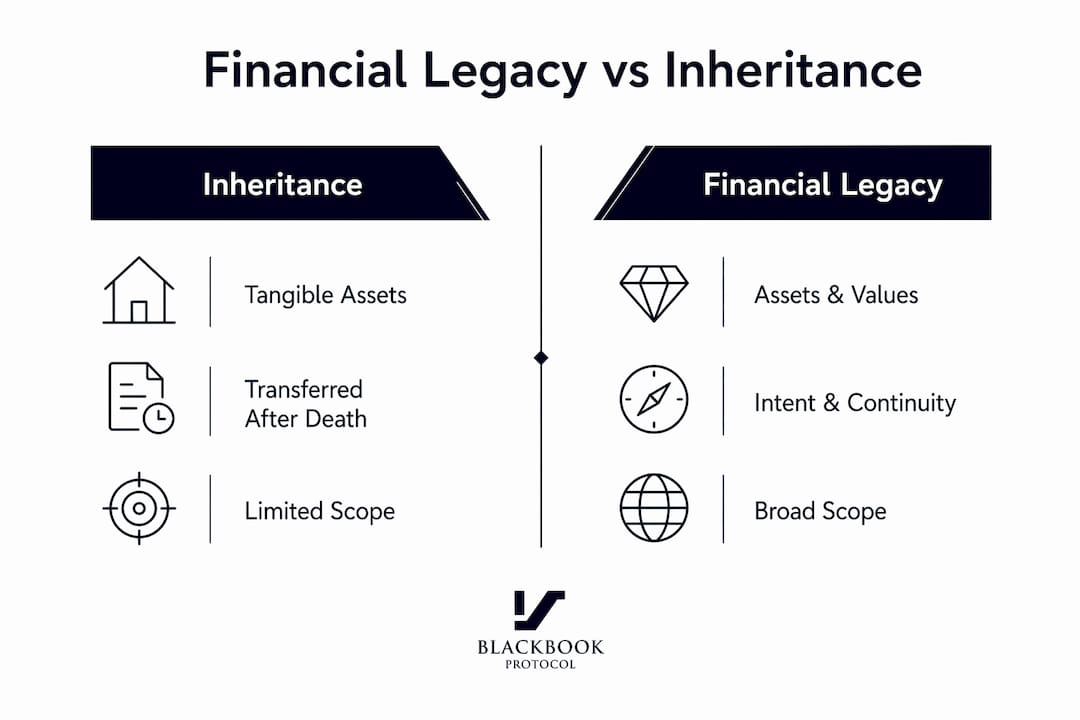
Inheritance is defined as the transfer of tangible assets after death. Financial legacy is broader. Legacy planning includes tax minimisation, business succession, and family governance that go well beyond simple estate division. That distinction matters enormously for founders, whose wealth is often tied to a business rather than liquid assets.
A founder who leaves only a will has planned for inheritance. A founder who leaves a will, a family trust, a succession plan, and documented values has planned for a legacy. The difference is the difference between a one-time transfer and an ongoing system.
Legacy planning applies at all income levels and ensures that a founder’s wealth reflects their authentic self, with impact continuing after they step back. This is not a privilege reserved for billionaires. Any founder with a business, a family, and a set of values has the raw material for a meaningful financial legacy.
| Feature | Inheritance | Financial legacy |
|---|---|---|
| Scope | Tangible assets only | Assets, values, intentions, and governance |
| Timing | Triggered by death | Built and transferred over a lifetime |
| Tools | Will and probate | Trusts, succession plans, family charters |
| Tax planning | Minimal or reactive | Proactive and structured |
| Business continuity | Not addressed | Central to the plan |
| Intangible transfer | Absent | Documented values and stewardship mindset |
The table above shows why founders who treat legacy as inheritance leave significant value on the table. Business continuity alone can determine whether a company survives the founder’s exit or collapses within two years.
What components do founders need to build a financial legacy?
Effective legacy planning requires legal and operational tools including wills, trusts, buy-sell agreements, succession plans, and powers of attorney. Without these, founders risk tax drag, family conflict, fragmented investments, and loss of influence after exit. Each instrument serves a distinct purpose.
Legal instruments
- Will. Directs the distribution of personal assets and names executors. A will alone is insufficient for founders with business interests.
- Revocable trust. Holds assets during the founder’s lifetime and transfers them without probate. Offers flexibility to amend as circumstances change.
- Irrevocable trust. Removes assets from the taxable estate permanently. Useful for founders with significant accumulated wealth.
- Buy-sell agreement. Governs what happens to business shares if a founder dies, becomes incapacitated, or exits. Succession requires detailed buy-sell agreements and clear authority transition mechanisms to prevent fragmentation and disputes.
- Power of attorney. Designates someone to manage financial and legal decisions if the founder cannot.
- Succession plan. Documents who leads the business, under what conditions, and with what authority.
Financial strategies
Tax planning sits at the centre of founders’ financial legacy work. Structuring equity through a family trust, for example, can reduce inheritance tax exposure while keeping control within the founder’s intended circle. Investment management matters too. A founder whose net worth is 90% tied to a single illiquid business has a concentration risk that undermines any legacy plan.

Non-financial elements
Intangible assets such as values, decision frameworks, and relationship capital often fail to transfer without intentional documentation. Founders who document their “why” achieve more successful legacy outcomes. This means writing down the principles that guided key decisions, mentoring successors directly, and designing philanthropic goals that reflect the founder’s purpose.
Pro Tip: Start legacy planning early and revisit it annually. Legacy planning should begin early and be regularly updated to capture evolving family and business dynamics. A plan written at 35 will not serve a founder well at 55 without revision.
Why should founders think beyond the exit event?
Founders lose identity post-exit. Successful founders plan for liquidity, longevity, and legacy rather than treating the exit as a finish line. Longevity means sustaining purpose after day-to-day business involvement ends. That requires a plan built before the exit, not after.
Liquidity is the first pillar. Founders should build liquidity during operation to navigate risks and not rely solely on exit events. A founder who depends entirely on a future sale for personal financial security is exposed to deal risk, market timing, and investor pressure. Building liquidity before exit protects both personal wealth and negotiating position.
Market and business shocks create a correlated double risk for founders. Personal portfolios may drop 20% while business revenue falls 30–40% simultaneously. Conservative cash reserves are not cautious. They are the foundation of any credible legacy plan.
The longevity pillar addresses what comes after. A founder who exits without a purpose plan often finds the transition destabilising. The legacy mindset shifts focus from short-term liquidity events to long-term influence and the sustainability of both business and family legacy. That shift requires deliberate planning, not just a good exit multiple.
Pro Tip: Treat your personal financial plan and your business succession plan as one document, not two. The risks are correlated. The solutions should be too.
Founders’ financial impact on their families and communities extends well beyond the sale price of a business. The founders who build the most durable legacies are those who plan for influence, not just income.
How can founders protect and pass on wealth across generations?
Passing on wealth requires not just assets but the mindset and wisdom for heirs to steward them. The next generation often lacks the stewardship mindset without direct mentoring alongside inheritance. This is the most common failure point in multigenerational wealth transfer.
Family governance structures address this directly. A family charter sets out shared values, decision-making rules, and expectations for heirs who enter the business. A family council creates a forum for discussing wealth, resolving disagreements, and maintaining unity across generations. Without these structures, inherited wealth tends to fragment within two to three generations.
| Strategy | Purpose | Key tool |
|---|---|---|
| Mentoring heirs | Transfer stewardship mindset | Structured apprenticeship and documentation |
| Family governance | Prevent conflict and fragmentation | Family charter and council |
| Charitable giving | Deepen family unity and lasting impact | Donor-advised fund or charitable trust |
| Trust structures | Protect assets from tax and disputes | Irrevocable or discretionary trust |
| Equity planning | Preserve control and reduce dilution | 95/5 splits and founder share structures |
Wealth transfer that includes philanthropic goals creates deeper family unity and lasting impact. Philanthropy is not a luxury add-on. It is a governance tool that aligns heirs around shared purpose rather than competing claims.
Common pitfalls to avoid when protecting generational wealth:
- Treating legacy as a one-time legal event rather than an ongoing process.
- Failing to involve heirs in the plan until it is too late to build understanding.
- Concentrating all wealth in the business without diversifying into liquid assets.
- Ignoring the tax implications of equity transfers until they become expensive to fix.
- Skipping family governance structures and assuming heirs will self-organise.
Over 80% of founders bootstrap with a median starting capital of £10,000. That context means most founders build wealth slowly and cannot afford to lose it to poor planning. The stakes of getting legacy planning wrong are higher for bootstrapped founders than for those who raised institutional capital.
Key takeaways
A founder’s financial legacy is built through legal structures, tax planning, family governance, and the intentional transfer of values, not through wealth accumulation alone.
| Point | Details |
|---|---|
| Legacy exceeds inheritance | Financial legacy includes values, succession, and governance, not just asset transfer. |
| Legal tools are non-negotiable | Wills, trusts, buy-sell agreements, and succession plans each serve a distinct protective role. |
| Liquidity precedes legacy | Build personal liquidity during operation to avoid depending entirely on an exit event. |
| Stewardship must be taught | Heirs need mentoring alongside assets to manage multigenerational wealth responsibly. |
| Start early and revise often | Legacy plans written once and left unchanged fail to reflect evolving business and family realities. |
The part most founders get wrong
Most founders I work with through Blackbookprotocol arrive focused on the exit. They want to know the valuation, the structure, the tax bill. Very few arrive asking what happens to their values, their relationships, or their purpose after the deal closes. That gap is where legacies fail.
The intangible elements are not soft extras. They are the load-bearing walls of a multigenerational plan. A trust without a documented philosophy is just a legal container. A succession plan without a mentored successor is just a piece of paper. The founders who build legacies that last are those who treat the non-financial elements with the same rigour they apply to their cap table.
The other mistake I see consistently is treating legacy planning as a single event. Founders write a will at 40, file it, and consider the job done. Life changes. The business changes. Tax law changes. A plan that is not reviewed regularly is a plan that will fail at the worst possible moment.
My honest view is this: the meaning of financial legacy for founders is not about what you leave behind. It is about what you build while you are still here to shape it. The legal structures, the governance frameworks, the conversations with your heirs, the documented values. All of that is legacy work, and it starts now.
— Blackbook
How Blackbookprotocol supports founder legacy planning
Blackbookprotocol provides founders with practical frameworks for asset protection, corporate governance, and succession planning built specifically for the UK context.

The asset protection resources include audio, an eBook, and templates covering UK Trust Law, 95/5 equity structures, and tax-efficient transfer strategies. These are not generic financial planning tools. They are built for founders who need to protect what they have built and pass it on without losing it to tax, conflict, or poor structure. The founder legacy planning checklist gives you a structured starting point to audit your current position and identify the gaps before they become expensive problems.
FAQ
What does financial legacy mean for founders?
Financial legacy is defined as the deliberate transfer of wealth, values, business continuity, and stewardship mindset across generations. For founders, it includes succession planning, trust structures, and family governance, not just the assets left in a will.
How does financial legacy differ from inheritance?
Inheritance covers tangible assets transferred after death. Financial legacy includes intangible elements such as values, philanthropic goals, and governance structures, built and transferred over a lifetime through legal instruments and mentoring.
When should founders start building a financial legacy?
Legacy planning should begin early and be updated regularly to reflect changing business and family circumstances. Waiting until an exit event is too late to address tax exposure, succession gaps, or heir readiness.
What legal tools are central to a founder’s legacy plan?
Wills, revocable and irrevocable trusts, buy-sell agreements, powers of attorney, and formal succession plans are the core instruments. Each addresses a different risk, from probate delays to business fragmentation after the founder’s exit.
Why is liquidity important in legacy planning for founders?
Founders who build personal liquidity during operation protect themselves from correlated risks where both personal portfolio value and business revenue can fall simultaneously. Liquidity before exit preserves negotiating power and financial independence.
0 comments